

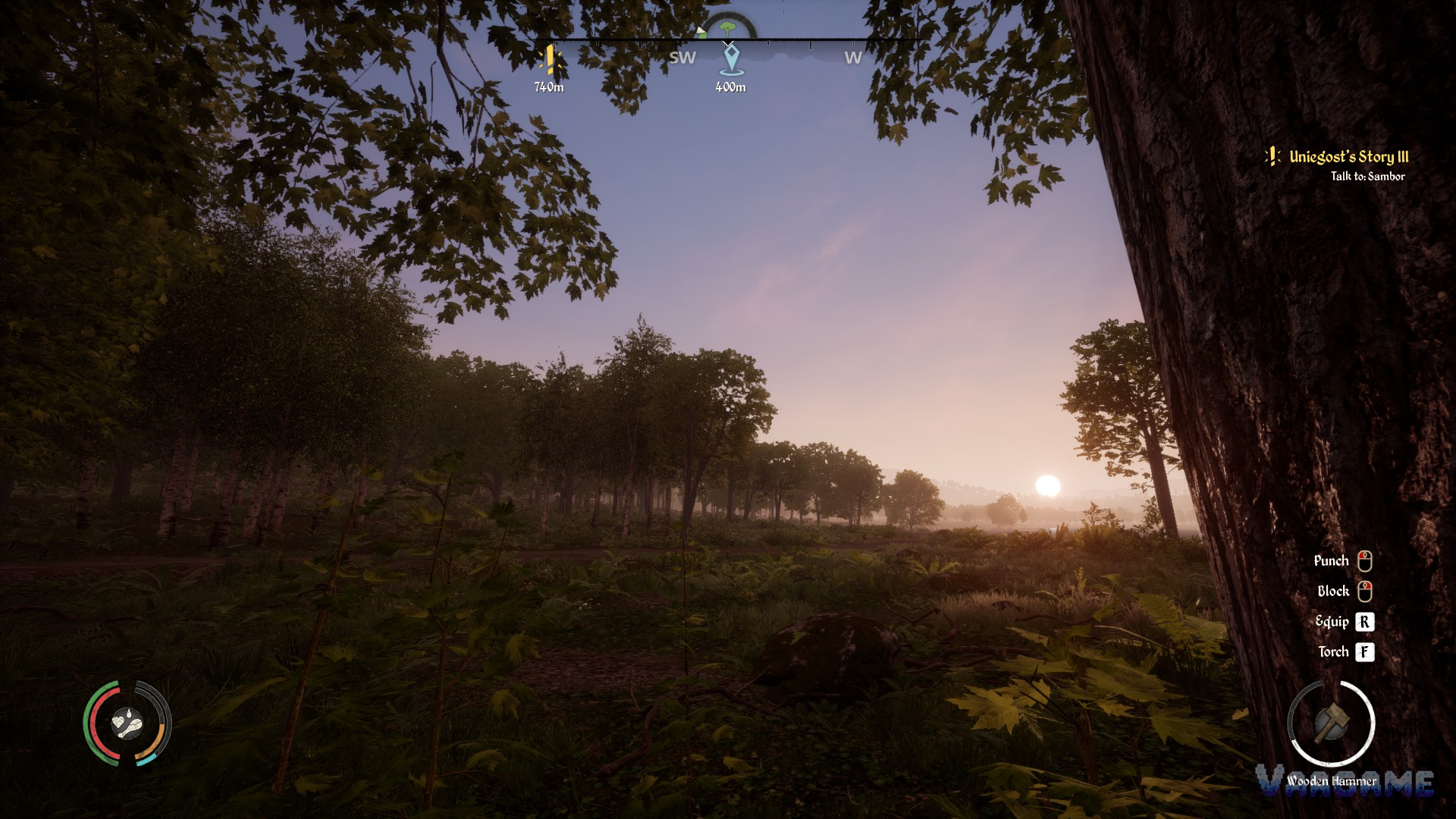
Your first goal in Medieval Dynasty is a small, survivable village: one house, steady food and water, and enough stored wood and food to get through your first winter. Medieval Dynasty is a medieval life simulation and village builder from Render Cube, published by Toplitz Productions, in which you start as a farmer or hunter and work toward becoming the leader of a thriving settlement.
This guide contains affiliate links. If you buy through them, Vaagame may earn a commission at no extra cost to you.
At a glance
Game: Medieval Dynasty, by Render Cube, published by Toplitz Productions
Early Access / Full release: Early Access 2020-09-17; full release 2021-09-23
Price checked 2026-10-25: Base game $34.99, not on sale on the check date; historic low $17.49
Maps: Valley for solo play; The Oxbow for solo and co-op play
Co-op wording: Store page wording: team up with up to 4 friends; other listings record up to 4 players
Season length: Default 3 days per season, adjustable at game setup
Achievements: 44 achievements
Version and check date: Latest patch 2.7.0.4, 2026-10-07; facts checked 2026-10-25
Language: Simplified Chinese interface and subtitles; no full Chinese voice acting
Quick answer
Build a house first, then secure food, water and firewood before you expand.
Treat each season as a short window: the default is 3 days per season, so finish time-sensitive work before the season turns.
Grow your village in small steps, from a hermitage toward a town, instead of building everything at once.
Stock food and wood before winter, and keep your people fed and watered through the cold months.
Buy the base game at the checked price of $34.99 only if that price still holds when you check out; the $17.49 figure is a historic low.
1. What Medieval Dynasty is, in official terms
Medieval Dynasty is a medieval open-world survival and village-building game. The store page describes the core loop plainly: you start as a simple farmer or hunter, design and improve your house, convince people to join your village, and build a family so the dynasty continues to the next generation. Survival indicators cover food, water, health and stamina, and the store page warns that neither you nor your people should starve or die of thirst.
Two maps frame the game. The Valley is solo only, while The Oxbow supports solo and co-op play. A third map, The Backwood, has been announced as a free DLC for 2027, and the publisher roadmap runs to the second quarter of
2027. Those future items are worth knowing about, and they change nothing about what you should do in your first week.
The game is long by design. There are more than 25 buildings, more than 120 furniture and decoration items, and more than 300 craftable items. Village development runs through nine named stages, from Hermitage through Camp, Small Farm, Farm, Hamlet, Settlement and Village to Town and City. Your first days are about stage one, and every later stage grows out of housing, food and work that already function.
2. What players think, with the sample stated
Reception is strong on a large sample. Steambase, with data updated on 2026-10-16 and checked on 2026-10-25, records about 52,700 reviews at about 90 percent positive, rated Very Positive. SteamDB gives a review percentage of 90 on the same check date. The PC Metacritic score is
73. Those three figures describe different things: player sentiment on Steam is warm, while press scoring is more mixed, so a new player should expect a game that many players enjoy for its slow village rhythm rather than a game every critic rates highly.
That slow rhythm is the main taste question. If you enjoy gathering, building, planting and watching a settlement grow season by season, the loop fits. If you want constant combat or fast progression, the early hours will feel quiet. Treat the first week as a trial of that rhythm: build, feed people, survive a season change, and then decide whether the pace suits you.
One buying note matters. The base game cost $34.99 and was not on sale on 2026-10-25. The $17.49 figure that still circulates is the historic low from a past sale, and it must not be read as the current price. Check the store price at checkout, because sale prices move and this guide does not track them daily.
3. Your first days: house, water, food, work
Start with shelter and a short supply chain. Build your first house, then set up a reliable way to get food and water and a steady timber supply. The community wiki describes technology in four branches, Building, Survival, Farming and Production, with residents actions generating technology points and buildings unlocking as points accumulate. Item recipes, by contrast, are bought with coins. Spend early coins on recipes you will use every day, and let routine work unlock buildings in the background.
Keep the first village compact. Houses near storage, work areas near timber, and fields within easy reach all save walking time across a season that lasts only 3 days by default. Season length can be adjusted at game setup, and player guides report a maximum of 30 days per season, so players who want a slower pace can set longer seasons before starting. Changing that setting mid-run is a different question, and this guide makes no claim about it.
Recruit only when housing and food are ready. Villagers need a home, food and water, and supplies stored in the matching storage buildings. Player guides report that prolonged unmet needs drag mood down and can end with villagers leaving with their families, so a second house built before its food supply exists is a liability. One fed and housed villager who works every day beats three hungry newcomers.
4. Your first winter: the checklist that matters
Winter is a supply test, and autumn is when you pass it. Before the cold arrives, confirm three things: stored food that covers the village through the season, firewood and timber in storage, and houses that are finished rather than half-built. Hunting, planting and trading all feed the same stockpile, and the store page frames winter survival as a shared problem: the village eats together, so a shortage hits everyone.
Travel and hunting get harder in snow, so do the risky work early. Gather and hunt while movement is easy, and keep winter days for short trips, repairs and indoor work. A wolf on a snowy forest road is a reminder to travel prepared and to keep distance from predators rather than testing a fight you do not need.
Skills grow through use, and six skill lines each run to level 10: Extraction, Hunting, Farming, Diplomacy, Survival and Production. The achievement list confirms all six at level 10, so winter is a good time to raise the lines your village lacks. A villager who improves at farming or production in winter is an asset when spring work starts.
5. Official PC specs, read line by line
The official minimum asks for Windows 10 or 11 on 64-bit, an Intel Core i5 at 3.3 GHz or an AMD processor at 3.5 GHz, 8 GB of memory, and a DirectX 11 GPU with 6 GB of dedicated video memory, naming the Intel Arc A580, GeForce GTX 1060 and Radeon RX
580. Storage is 20 GB, and the notes add that an SSD and 16 GB of memory are recommended even at the minimum tier. In practice, that note is the most useful line: the game will run on 8 GB, and it will feel better on 16 GB.
The recommended tier raises every line that matters for a village that keeps growing: Windows 11 on 64-bit, an Intel Core i5 or i7 at 4 GHz or a Ryzen 5 at 4 GHz, 16 GB of memory, and a DirectX 12 GPU with 8 GB of dedicated video memory, naming the Intel Arc A750, GeForce GTX 1660 and Radeon RX
590. Storage stays at 20 GB, and the SSD recommendation stays. The jump from 6 GB to 8 GB of video memory is the clearest signal: larger villages with more buildings and villagers reward the extra video memory.
Swipe horizontally to view all columns.
| Spec | Minimum (official) | Recommended (official) |
|---|---|---|
Operating system | Windows 10, 11 (x64) | Windows 11 (x64) |
Processor | Intel Core i5 at 3.3 GHz or AMD at 3.5 GHz | Intel Core i5/i7 at 4 GHz or Ryzen 5 at 4 GHz |
Memory | 8 GB RAM | 16 GB RAM |
Graphics | DirectX 11 GPU, 6 GB VRAM (Arc A580 / GTX 1060 / RX 580) | DirectX 12 GPU, 8 GB VRAM (Arc A750 / GTX 1660 / RX 590) |
Storage | 20 GB; SSD recommended | 20 GB; SSD recommended |
6. Value hardware picks, with tracker prices only
The value tier for this game is the official recommended tier, bought at the cheapest sensible level: a 4 GHz-class Ryzen 5 or Core i5 processor, 16 GB of memory, an SSD for the 20 GB install, and an 8 GB video memory graphics card. Nothing in this game needs a flagship card, and money saved on the graphics card is better kept for memory and storage, where a growing village actually feels the difference.
One graphics card price was verified on a tracker. Pricehistory.app records the ASRock Intel Arc A750 Challenger D 8 GB card at $206.43 in the United States on 2026-10-24, with a tracker lowest price of $159.99. That card matches the official recommended tier exactly, with 8 GB of video memory, so it is the value pick for a new build. Prices move, so treat $206.43 as a dated snapshot and check again before buying.
Check price on Amazon: ASRock Intel Arc A750 Challenger D 8 GB — https://www.amazon.com/dp/B0BJSYQ822?tag=vaagame20-20
Two gaps are declared openly, and no total build price is given because of them. No usable United States desktop CPU tracker price for a 4 GHz-class Ryzen 5 or Core i5 was found on pricehistory.app or CamelCamelCamel on 2026-10-25, so the CPU is listed as a tier only. No usable United States desktop 16 GB memory kit tracker price was found on the same sources on the same date, so memory is also listed as a tier only. Adding estimated prices to fill those gaps would mislead readers, so this guide leaves them blank.
Storage carries a warning rather than a buy recommendation. Pricehistory.app records the Samsung 870 EVO 1 TB SATA SSD at $326.33 in the United States on 2026-10-24, a figure far above a normal value price for that drive and consistent with a memory price spike in October
2026. Do not buy an SSD at that level for this 20 GB game. Reuse an existing SSD, wait for prices to settle, and only then buy. The official spec needs just 20 GB, so any working SSD you already own covers this game.
Swipe horizontally to view all columns.
| Part | Value tier | Tracker price and date |
|---|---|---|
Graphics card | Intel Arc A750, 8 GB VRAM (official recommended tier) | ASRock Arc A750 Challenger D 8 GB: $206.43, pricehistory.app, 2026-10-24; tracker lowest $159.99 |
Processor | Ryzen 5 or Core i5 at 4 GHz class | No usable US desktop tracker price found, 2026-10-25; tier only |
Memory | 16 GB | No usable US desktop tracker price found, 2026-10-25; tier only |
Storage | Any working SSD, 20 GB game install | Samsung 870 EVO 1 TB: $326.33, pricehistory.app, 2026-10-24; spike price, do not buy at this level |
7. A first-week plan you can actually follow
Day one is scouting and shelter: pick a site near water and timber, build the first house, and learn the nearest food and water sources. The next days are supply work: timber, food, water and the first storage, with technology points accumulating from routine actions. Recruit only after the first house and its food line are stable, and keep each new building tied to a supply line that already exists.
Before the first season change, check the village the way a manager would: does everyone have a bed, is food stored rather than carried, and is timber coming in faster than building consumes it. If any answer is no, fix that line before adding anything new. That single check prevents most early collapses, which are supply collapses with a building problem on top.
FAQ
How much does Medieval Dynasty cost right now?
The base game was $34.99 and not on sale on 2026-10-25. The $17.49 figure is the historic low from a past sale, and the end date of that past discount was not verified, so this guide gives no sale end date.
How long is a season?
The default is 3 days per season, and season length can be adjusted at game setup. Player guides report a maximum of 30 days per season. Do not treat a 12-day year as the only rule, because the setting can change it.
Can I play Medieval Dynasty in co-op?
Yes, in co-op mode, and The Oxbow is the map that supports solo and co-op play, while The Valley is solo only. Wording on player counts differs between listings: the store page says team up with up to 4 friends, while other listings record up to 4 players, so this guide does not state a single player count as settled fact.
What PC do I need?
The official minimum is a 64-bit Windows 10 or 11 PC with 8 GB of memory and a 6 GB video memory GPU such as a GTX 1060, and the recommended tier is 16 GB of memory with an 8 GB video memory GPU such as a GTX 1660 or Arc A750. An SSD is recommended in both tiers, and the game install is 20 GB.
Related guides
Medieval Dynasty Village Building Guide: Houses, Buildings and Layout