

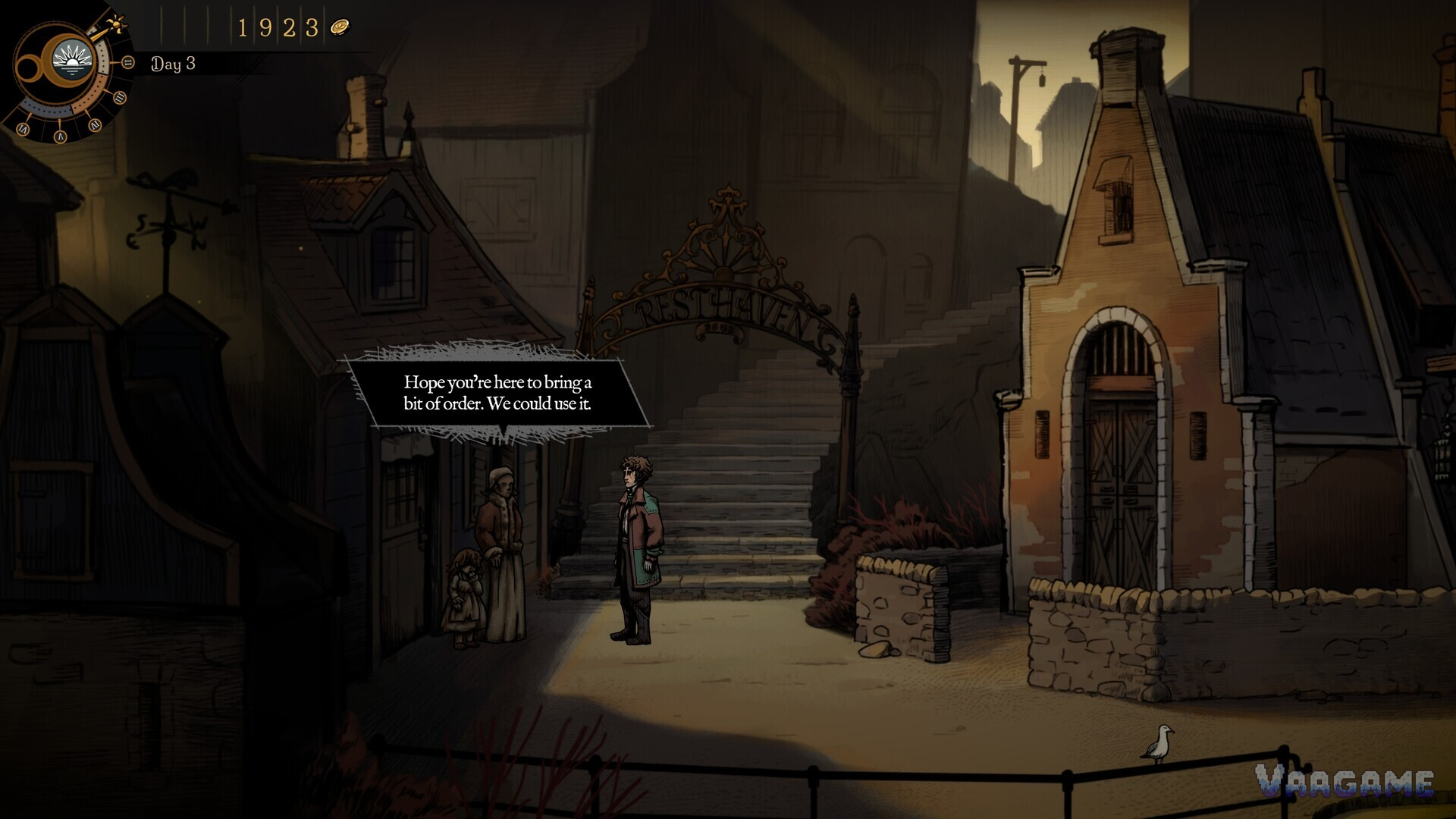
Curse of Resthaven drops you into an island colony with six days to live, a niece to find, and a goddess willing to rewind time. You are Ambrose, the newly appointed governor of Resthaven, searching for his missing niece Amalia, who arrived months earlier to investigate the island. Six days after your arrival, a cosmic cataclysm destroys the island, and the fading guardian goddess sends you back to the moment of your arrival with your memories intact. Everyone else forgets. This guide explains that first loop in plain terms: what to do on Day 1, how your first trades and your first expedition work, what the demo gives you if you played it, and why finishing the game means concluding three separate timelines before the true ending unlocks.
At a glance
Developer Hilltop Studios, publisher Digital Bandidos; released October 29, 2026
Platforms: PC, Mac, PlayStation 5, Xbox Series X|S; single-player narrative roguelite with hand-drawn graphic-novel art
$19.99 list, $17.99 with the 10% introductory offer ending November 12, 2026
You are Ambrose, governor of Resthaven, searching for his missing niece Amalia; the loop lasts six days and the full game requires three timelines
Interface, full audio and subtitles are English only; there is no official Chinese name, and this column uses 诅咒之地 as a user-facing Chinese name only
41 achievements; first playthrough length is reported by media as about 8 hours to about 10 hours, with the caveat that three timelines are needed
Last verified: October 30, 2026
1. Official introduction
Resthaven is an island colony on the Aurelian Isle of Resthaven, and your job has three parts that never separate. First, you investigate: you interrogate over 25 fully voiced residents, each with motives, secrets and shifting allegiances, winning favor to learn what they hide. Second, you govern: you collect taxes as resource cards, trade with visiting merchants, upgrade businesses and restore prosperity. Third, you leave town: card-driven expeditions take you beyond the walls to retrace Amalia's steps and face the island's horrors. A beginner who treats any one of those as a side activity will stall, because interrogation clues change what you should trade, and trade resources decide what you can carry on an expedition.
The town has four zones, and the loop gives you six days to learn them before everything is destroyed. That sounds generous until you count what competes for each day: a resident who talks only at a certain time, a merchant ship in port for a limited window, an expedition that eats a day and returns knowledge you cannot get any other way. Treat your first loop as reconnaissance, not a speedrun. Talk widely, note who knows what, make small trades to learn the price system, and take an expedition early enough that its lessons can shape the rest of the loop. The goddess rewind is not punishment for failing; it is the core mechanic, and the knowledge you keep is the real progression underneath cards and skills.
One warning belongs in the introduction, not buried in a footnote. The store page lists mature content: illustrated black-and-white depictions of violence and murder, references to suicide, themes of war and colonial oppression, alcohol and substance abuse references, and psychological distress. The gothic tone that reviewers praise is inseparable from that material. If that content is a problem for you, no gameplay system in this guide changes it, and you should weigh it before buying, not after your first loop.
2. Review coverage: labeled media coverage only
This section is labeled media coverage, not player reviews, and the distinction matters. PixelByte Gaming scored the game 9.0, reviewing on PS5 Pro, praising the prose and the time-loop systems while noting minor technical issues on PS5. MobileSyrup called it a must-play gothic adventure and described it as a much more drawn-out and dark version of Groundhog Day. KonsoliFIN scored it 80 on Metacritic. Those three outlets are the scored and quoted coverage this guide relies on, and no other score is claimed here.
A note on Steam player reviews, stated plainly: as of October 30, 2026, the Steam player-review sample is still too small to report, and this guide therefore writes no Steam review count or percentage and no player verdict. That section will be refreshed 24 to 48 hours after publication, once a real sample exists. Until then, treat the media scores above as media scores only, and treat any other site quoting a player score for this game as a claim to check, not a fact to repeat.
3. Official PC specs
The store page gives full specs for Windows and macOS, and the table below copies them without upgrading any figure. Note the pattern: Windows recommended changes only the graphics card, and macOS recommended moves from an Intel machine to an M1 machine. Storage is small at 4 GB on every tier, and memory is 8 GB on every tier, so this is not a game that punishes a modest machine on capacity; it punishes it, if anywhere, on graphics hardware. No Steam Deck rating has been verified, so this guide makes no Deck claim at all.
Swipe horizontally to view all columns.
| Item | Windows minimum | Windows recommended | macOS minimum | macOS recommended |
|---|---|---|---|---|
Operating system | 64-bit Windows 10/11 | 64-bit Windows 10/11 | macOS 12 Monterey | macOS 13 Ventura |
CPU | 3.0 GHz Quad Core | 3.0 GHz Quad Core | Intel i5, 5th gen or newer | M1 |
GPU | GeForce GTX 750 Ti or Radeon RX 460 | GeForce GTX 1080 Ti or Radeon RX Vega 64 | Intel Iris | M1 |
Memory | 8 GB RAM | 8 GB RAM | 8 GB RAM | 8 GB RAM |
Storage | 4 GB | 4 GB | 4 GB | 4 GB |
Graphics API | DirectX 11 | DirectX 11 | Not listed for macOS | Not listed for macOS |
4. Value hardware picks: spec tiers only
This section gives spec tiers only. No product is named, no price is written, and no affiliate link is attached, because no hardware item here has a confirmed listing and tracker price to stand behind. That gap is stated rather than papered over. If you already own a machine, compare it against the table above before spending anything; if you are buying, buy to a tier, not to a brand name remembered from another article.
Tier 1, meets the Windows minimum: 64-bit Windows 10/11, a 3.0 GHz quad-core CPU, 8 GB RAM, a GeForce GTX 750 Ti or Radeon RX 460 class GPU, DirectX 11, and 4 GB free storage
Tier 2, meets the Windows recommended spec: the same CPU, memory and storage as Tier 1, with a GeForce GTX 1080 Ti or Radeon RX Vega 64 class GPU
Tier 3, meets the macOS tiers: macOS 12 Monterey with an Intel i5 from the 5th generation or newer and Intel Iris graphics at minimum, or macOS 13 Ventura on M1 at recommended, both with 8 GB RAM and 4 GB storage
Tier 4, above the recommended spec: anything clearly faster than Tier 2 or Tier
3. It buys headroom, not a different game, and it is not required to play
5. Your first loop walkthrough
Day 1 priorities: learn the map before you spend anything. Walk all four town zones, meet as many residents as you can, and listen for who is connected to whom before committing to a line of questioning. The game has over 25 voiced characters, and meeting all residents is itself an achievement, precisely because breadth matters. A resident you skip on Day 1 may be the person whose secret explains a second resident's lie on Day 4, and in a six-day loop that connection is worth more than any single card. Take notes outside the game if you need to; the loop remembers your knowledge, but your own memory across a long session is less reliable than a short list of names and claims.
First trades: start small and learn the wheel. Taxes arrive as resource cards for wheat, lumber, sugar and gold, and those cards are both your income and your expedition supplies, so spending everything on the first merchant you meet is the beginner trap. Make a small trade first and watch the Name Your Price wheel, which runs from minus 100 percent to plus 200 percent. The verified example in this guide is a Sugar card with a base price of 12 gold, asked at 17 gold for a plus 42 percent Upsale, sold to the example merchant Abyssinia, whose favor is shown as hearts. That example is one screenshot, not a rule that every merchant pays the same; your first trades should teach you how far a given merchant can be pushed, and how favor hearts move, before you risk a large stack of cards on one deal. The full haggling system is covered in the trading guide.
First expedition: go early, pack deliberately, and expect randomness. Expeditions are card-driven trips beyond the town walls, and your deck is resource cards plus companion cards, so who you bring, what you carry and how you prepare shape the outcome. Selecting the right card unlocks specific outcomes rather than triggering combat, and expeditions are randomized, so each playthrough exposes different pieces of the island. Go early in the loop, while days remain to act on what it teaches you about Amalia's trail, and do not treat a strange result as failure: in a knowledge-first game, a surprising outcome is information for the next loop.
Demo carryover: if you played the free demo, you do not start from zero. The demo covers the full six-day loop plus the first day of the next loop, across all four town zones, and a demo save carries over to the full game. Completing the demo grants starting currency and skill points in the full game. That is a genuine head start, but it does not skip the learning: a demo player still needs to learn the three timelines, because the demo is one loop and the full game requires concluding three separate timelines before the true ending unlocks. Think of the demo bonus as a better first loop, not as a shortcut past the game.
Closing the loop: when the six days end, the cataclysm comes, and the goddess sends you back. What you keep is memories and knowledge, permanent skill upgrades, and temporary Boon Cards accepted from the goddess, which pair powerful benefits with grave consequences. What resets is the six days themselves, the residents memories, and the day-to-day town state. That split is the whole strategy of the game in one paragraph, and the time loop guide unpacks it: what to buy early, which boons are worth their cost, and when to push a timeline instead of gathering more knowledge. Do not rush to conclude a timeline on your first loop just because you can; a timeline concluded with thin knowledge is a timeline you will have to understand again later.
6. First-loop checklist
Walk all four town zones on Day 1 and meet as many residents as you can before committing to one line of questioning
Make a small first trade to learn the Name Your Price wheel before risking a large stack of resource cards
Take your first expedition early, while days remain to act on what it reveals about Amalia's trail
If you played the demo, confirm your save carried over and spend the starting currency and skill points deliberately, not all at once
Keep notes on who knows what, because your knowledge is what carries over when the six days reset
Do not rush to conclude a timeline on the first loop; gather knowledge first and push a timeline when you understand it
FAQ
How long is a first playthrough? Media reports give a range, not a single official number: about 8 hours in one outlet to about 10 hours in another, with the caveat that three timelines are needed for the full game. Treat any single-hour claim without that caveat as incomplete.
Do I lose everything when the loop resets? No. You keep memories and knowledge, permanent skill upgrades, and temporary Boon Cards from the goddess. You lose the six days themselves, the residents memories, and the day-to-day town state.
Is there a Steam Deck rating I can rely on? Not in this guide. No Steam Deck rating has been verified, so this guide makes no Deck claim and covers PC and Mac specs only.
Should I play the demo first? If you have not bought the game yet, yes: the demo covers a full six-day loop plus the first day of the next loop, and completing it grants starting currency and skill points in the full game, with the save carrying over.
Related guides
Curse of Resthaven Beginner's Guide: First Loop, Trading, Expeditions and the Three Timelines
Curse of Resthaven Time Loop Guide: What Carries Over, Boons, Skills and Loop Strategy
Curse of Resthaven Trading and Town Management Guide: Prices, Merchant Secrets, Ships and Upgrades
Curse of Resthaven Expeditions and Cards Guide: Map, Companions, Campsites and Deck Building
Curse of Resthaven Investigation and Endings Guide: Interrogation, Favor, Three Timelines and the True Ending
Curse of Resthaven Achievements Guide: All 41 Achievements and How to Unlock Them
Next: the time loop guide explains what carries over, what resets, and which skills to buy early, and the trading guide explains the price wheel, merchant secrets, ships and business upgrades.