

There is no single best weapon in 7 Days to Die, and any guide that names one without naming a build is selling you a shortcut that will disappoint you. Every weapon class lives under one of the five attributes, each with a dedicated combat perk that scales its damage, and the weapon that wins for you is the one that matches the attribute you are actually investing in. This guide gives you the best picks by stage, explains the tier and quality systems that confuse beginners, and ends with what to carry when the blood moon comes.
Tiers and quality: two systems, not one
Tier is the material and construction class of a weapon: a Wooden Club, a Baseball Bat, and a Steel Club are different tiers of the same family, while pipe weapons such as the Pipe Pistol, Pipe Rifle, Pipe Shotgun, and Pipe Machine Gun are the early-game entry points you craft before finding manufactured guns. Quality is a separate grade from 1 to 6 that stacks on top of tier. For melee weapons, quality affects damage, power attack damage, block damage, stamina cost, and attacks per minute. For ranged weapons, it affects ranged damage, magazine size, rounds per minute, and effective range, plus maximum durability and the number of mod slots on both types.
The practical consequence is simple: a high-quality low-tier weapon can beat a low-quality high-tier weapon for a while, and a weapon you have magazines for beats a weapon you cannot repair or feed. Crafting quality tiers come from reading magazines for that weapon family, and your weapon perk also biases loot toward those magazines, so committing to a family pays off in both damage and crafting. Do not judge a weapon by its name alone; check its tier, its quality, its mods, and whether you can keep it fed and repaired.
Tier is the weapon family step: wooden, iron, steel, and manufactured guns
Quality is a separate 1 to 6 grade on top of tier
Magazines raise the quality tier you can craft for that family
Early game: reliable, repairable, and cheap to feed
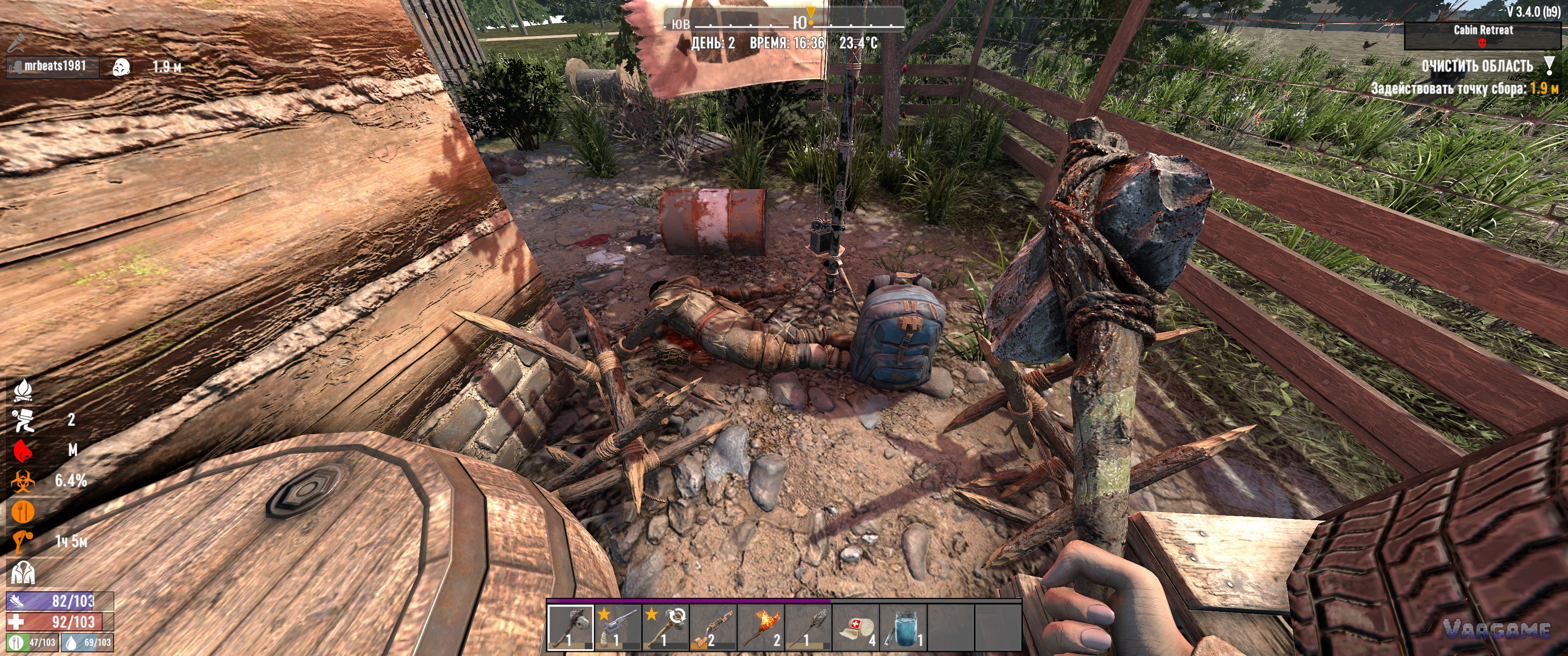
Early melee should be a wooden club or a stone spear. The club is stamina-efficient, has strong knockdown potential, and forgives a missed swing better than most early weapons. The spear keeps distance between you and the zombie, which matters more than raw damage when your armour is thin and your healing is scarce, and thrown spears can be recovered. A stone axe is a tool first and a weapon second: carry it for harvesting and building, not as your main fight plan.
Early ranged should be a wooden bow, and then a pipe weapon once you can craft or find one. The bow is quiet, its arrows are cheap and recoverable, and it is the natural stealth tool for clearing sleeping zombies in points of interest without waking the whole building. Pipe weapons are crude, short-ranged, and slow to reload, but they are your first real guns, and they teach you the ammunition discipline the rest of the game demands: aim, count your shots, and do not waste a magazine on one wandering zombie.
Early armour should be whatever padded or scrap pieces you find, upgraded as you go, with Light Armor as the general perk that reduces degradation. Do not wait for a perfect set: a full set of mismatched scrap armour you actually wear beats a perfect set you have not found yet, and the stamina and movement penalties of heavier armour hurt more in the early game, when every sprint away from a pack matters.
Mid game: commit to your attribute
By the mid game your attribute choice should show in your hands. Strength players move from wooden clubs to baseball bats and then steel clubs, with shotguns moving from pipe to double barrel and then pump action, and sledgehammers from stone to iron. Perception players move to hunting rifles and lever-action rifles, with spears moving from stone to iron. Agility players move to compound bows and iron crossbows, with handguns moving from pipe pistols to standard pistols and then magnum-class weapons. Fortitude players move toward assault rifles, and Intellect players toward stun batons and robotic support weapons.
Mid-game armour is where the Light, Medium, and Heavy Armor general perks earn their points. Light armour keeps you mobile and quiet for stealth and looting, medium armour balances protection and stamina for general play, and heavy armour suits players who fight in the open and can pay the movement cost. Match the armour to the job of the day: stealth looting in light armour, horde fighting in whatever your build can sustain, and never wear heavy armour on a long looting run just because its number looks bigger.
Mods start to matter in the mid game. A drum magazine, a scope, a silencer, or a melee mod that fits your weapon family can change a weapon more than one quality tier, and quality itself adds mod slots, so a high-quality weapon is also a more customisable weapon. Prioritise mods for your main weapon first, then for your horde-night weapon, and only then for weapons you carry just in case.
Late game: horde weapons and specialised tools
Late-game picks are about volume, range, and control under pressure. The M60 machine gun and the auto shotgun are the classic horde answers: the M60 for sustained fire against large packs, the auto shotgun for devastating close-range damage with a large magazine. The sniper rifle is the precision answer, unmatched at long range and ideal for removing screamers before they can summon more zombies. The tactical assault rifle is the versatile middle ground, useful at most ranges and comfortable deep into the late game. The SMG-5 is the mobile close-to-medium answer for players who fight on the move.
Melee stays relevant late, and the best late melee weapons are the steel club for speed and knockdown without heavy stamina cost, the steel sledgehammer for the highest single-hit damage at the slowest swing speed, and the steel spear for reach, including hitting through bars in a well-designed funnel. A stun baton with a repulsor-style mod is a specialised late pick that controls crowds rather than simply damaging them, which is exactly what a horde funnel needs when the pack presses hard.
Late armour should be a complete set matched to your build, with mods and dyes as a bonus, not a goal. Heavy armour suits Strength and Fortitude players who stand in the funnel, light armour suits Agility players who kite and reposition, and medium armour suits everyone who has not committed to either extreme. Armour rating alone does not save you on horde night: stamina management, positioning, and a repaired funnel save you, and armour buys you the seconds to recover from a mistake.
What to carry on horde night
Carry one melee weapon, one ranged weapon you can feed all night, bandages and healing, repair materials, food, and water, and nothing you cannot afford to lose. The horde-night loadout is not your best inventory, it is your most replaceable effective inventory: if a weapon breaks, you repair it; if a wall falls, you fall back; if you die, you respawn at a bedroll you placed near the fighting position and return. Players who bring their rarest gear to every horde night eventually lose it to a bad night, and players who bring nothing effective lose the base instead.
Ammunition discipline matters more on horde night than weapon rarity. Save shotgun shells and heavy rounds for the densest moments, use melee and cheap ammunition for stragglers, and never fire a weapon you cannot reload quickly while zombies are climbing your funnel. If you find yourself out of ammunition halfway through the night, the lesson is not to loot more, it is to bring more next time and to spend less early, when the horde is still thin.
Weapons to avoid investing in
Do not invest magazines, mods, or perk points in a weapon family you do not plan to use past the mid game, and do not keep a pipe weapon as a main weapon once manufactured guns are available. Pipe weapons are a bridge, not a destination, and the same applies to bone knives and wooden clubs once steel alternatives exist. The exception is a weapon you genuinely enjoy playing: a game this long rewards the weapon you will actually use for dozens of hours, and a slightly weaker weapon you love beats a stronger weapon you leave in a chest.
Quick picks by build, at a glance
Strength players should carry a steel club and a pump or auto shotgun, with a sledgehammer for single-target damage. Agility players should carry a compound bow or crossbow for stealth and a handgun for close work. Perception players should carry a rifle for range and a spear for reach. Fortitude players should carry a machine gun for volume and fists for cheap close combat. Intellect players should carry a stun baton for control and a robotic weapon for sustained support fire. In every case, the best weapon is the one whose magazines you are already finding, because that weapon keeps getting better while the others stay still.
Strength: steel club, shotgun, sledgehammer
Agility: compound bow or crossbow, handgun
Perception: rifle, spear
Fortitude: machine gun, fists
Intellect: stun baton, robotic weapon