

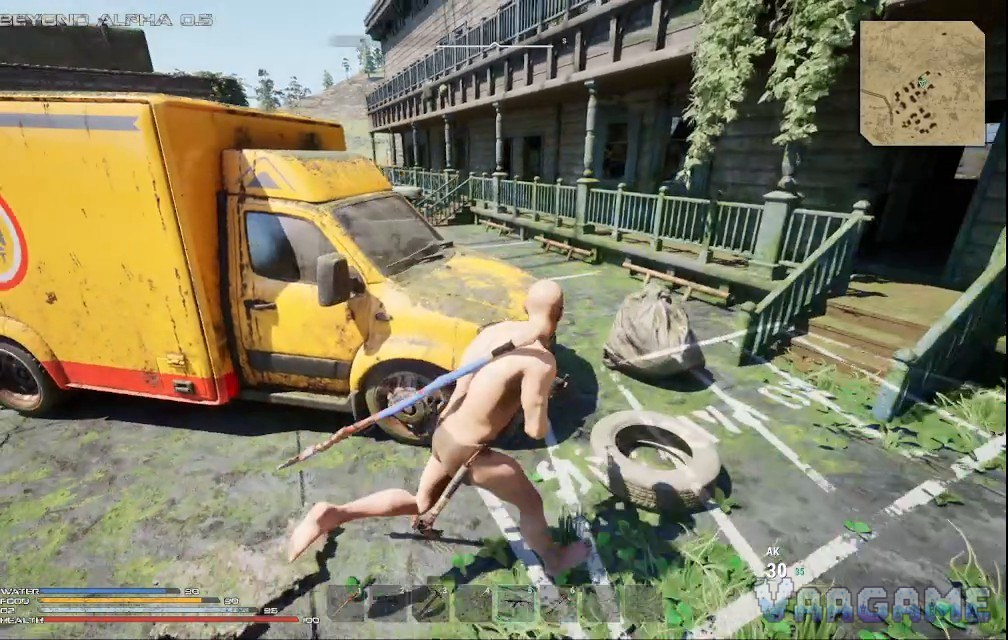
In Beyond, a game from Dagger Industries, the version the developers played every day worked. The version players would actually download did not. Devlog #17, published on itch.io on 20 October 2026, tells the story of a build that was slow in some places, broken in others, and missing an entire town in one spot, even though everything had looked fine inside the editor. The developers profiled the packaged build, chased the biggest costs first, and fixed a whole shelf of packaged-build-only bugs. This is a case about the gap between the editor and the build, and why only the build tells the truth.
At a glance
The source: Beyond Devlog #17, titled Faster frames, a proper build of the game, and real models for loot, published on itch.io on 20 October 2026 by Dagger Industries. Every fact about the game below comes from that devlog.
The symptom: the game was slow in the standalone build, and things that worked inside the editor were broken in the packaged build, including a whole town that never appeared.
The headline result, in the developers own profiled numbers: per-frame game logic fell from 22.1 ms to 9.1 ms, car physics from 5.2 ms to almost nothing, and a full frame at spawn from 12.1 ms to 9.8 ms.
Not claimed here: the devlog does not name the engine, so this article names none. All performance numbers are the developers own profiled numbers from their standalone build, not a benchmark promise for your machine. The graphics side is explicitly not done: grass and shadows are the biggest remaining cost, and a look decision has not been made yet. Picking a dropped item back up still did not work on a quick try and is listed as not finished, so this build is not presented as fully fixed.
Last verified: November 2, 2026.
First, the slow part: sixty parked cars, all checking, every frame
The developers did the unglamorous thing first: they profiled a standalone build instead of trusting the editor, and they ranked the costs biggest first. The single biggest surprise was parked cars. Every parked car checked every frame whether it was touching anything, and with about 60 cars on the map, that one check alone cost about 6.5 ms a frame, in the developers own profiling. That check is now switched off for everything except the part of the car that actually needs it. On top of that, far-away parked cars now go to sleep: a parked car with nobody within 150 m stops running its physics, and wakes again within about 120 m. The shape of the bug is the lesson. A check that is cheap once becomes expensive when it runs on everything, every frame. Nobody notices one car checking for contact; sixty cars checking, every frame, is a different story, and it hides in plain sight while you look at the flashy systems.
Parked cars were not the only thing doing too much work. Several systems searched every object in the world many times a second, and they now only look at their own type, which is a smaller question with a cheaper answer. On the art side, the texture streamer was given more memory and world textures were capped at 2K, so the spawn area reaches full detail about 12 seconds after loading, and the loading screen now waits for it. Two very detailed car models had no distance versions at all, and they now do, so far-away cars no longer cost close-up detail. The developers own before-and-after numbers show the scale of the change: per-frame game logic fell from 22.1 ms to 9.1 ms, car physics from 5.2 ms to almost nothing, and a full frame at spawn from 12.1 ms to 9.8 ms. Read those numbers as the devlog presents them, as one team's profiled standalone build, not a promise about what your project will gain. The point is the method: biggest cost first, measured in the build players get.
Then the packaged build started confessing
Speed was only half the story. The packaged build had its own shelf of bugs that never showed up in the editor. Files loaded by name, including UI pictures, building pieces, loot tables, and the gas mask visor, were not included by packaging, and they are now always included, so the game no longer arrives at the player's machine with pieces missing. Building preview was broken in a particularly confusing way: the preview showed as a solid piece and every spot said unplaceable, because the green and red preview materials were only set up inside the editor. The game now sets them itself, so the preview works the way it did in the editor. And then there was the town. A whole town by the motel, five settlement pieces holding about 98 houses, sheds, poles, and props each, never appeared in the packaged build at all. The developers rebuilt it as 490 separately placed objects, and the town is back. A missing town is a loud bug, but the quiet version of the same bug is far more common: one picture, one table, one piece that silently never ships.
The bows tell the same story in miniature. Both bows would draw but never fire, and they were rebuilt on the bow system in use. The spring bow had a second, stranger fault: its top limb pulled through its metal brace on draw; now only the limbs bend while the frame stays solid. The ammo counter was answering the wrong question, showing the arrow on the string instead of carried arrows; it now shows total arrows. Around those fixes sat smaller ones that show how wide packaged-build drift can get: respawn reloaded a save in which the player was dead, and now respawns at the bed or spawn point; quit went to the wrong menu; the main-menu character held a bow like a rifle; and dropped items rendered at full model size, meter-wide cubes and two-meter planks, and now land at item size. Two honest loose ends stay loose. The graphics side is not done, with grass and shadows the biggest remaining cost and a look decision not yet made. And picking a dropped item back up still did not work on a quick try, so do not walk away thinking this build came back perfect. It came back much better, and still unfinished, which is the normal shape of a real devlog.
What to reuse
Nothing below is presented as what the Beyond developers did beyond the fixes already described; the checklist generalizes those fixes for your own project, using only safe, non-destructive checks. The reusable idea is simple and a little humbling: the editor is a workshop, not the product. Work that is cheap in the workshop can be expensive in the shipped build, and work that exists in the workshop may simply not ship at all. So the order of operations matters more than any single fix: profile the packaged build, rank the costs, fix the biggest one, then re-profile, because the second-biggest cost usually hides behind the first. And treat the packaged build as its own game that needs its own playthrough, menus, loading, spawning, placing, shooting, quitting, and a second area you do not always check. The bugs here were not exotic: ordinary checks, ordinary files, ordinary setup, each quietly assuming the editor would cover for it. The editor will not be there on the player's machine, so test where the player actually lives.
What to do Monday morning
In your own project, profile the packaged build, not just the editor, and rank the per-frame costs biggest first before changing anything.
In your own project, smoke-test the packaged build end to end: menus, loading, spawning, placing, shooting, and quitting, in that order, on a fresh copy of the build.
In your own project, list every asset your game loads by name, then check that each one actually appears in the packaged build before you ship it.
In your own project, check anything that is set up only inside the editor, and make sure the game itself sets it at runtime instead of assuming the editor setup will ship.
In your own project, re-profile the packaged build after each fix and keep the before-and-after numbers, so you know which change actually helped.
In your own project, check what distant or idle objects still cost per frame in the packaged build, and whether they can sleep when nobody is near them.