
At a glance
The short version
- Game
- Game Travel
- Guide type
- Real Life Locations
- Read time
- 7 min read
- Last updated
- Nov 8, 2026
Quick answer
The best months to go are September, October and March for the northern lights, and any clear night from September to April can work — allow 30 to 45 minutes for the classic view, or about 2 hours for the full walk aroun
Guide details
Swipe horizontally to view all columns.
| Item | What to know |
|---|---|
Where | North coast, Snæfellsnes Peninsula, West Iceland, just west of Grundarfjörður |
Best time | September, October and March for aurora; November to early April for snow and lights; June to August for green slopes and midnight sun |
How long | 30 to 45 minutes for the viewpoint; about 2 hours for the base loop |
Difficulty | Easy, flat marked paths; icy and slippery by the falls in winter, grip shoes needed |
Tickets | Free to view; small parking fee at the Kirkjufellsfoss lot, check the sign or app on arrival |
Nearest town | Grundarfjörður, 2 minutes by car — fuel, shops and cafés |
Cost, checked 8 November 2026 | Entry free; parking fee only (figure varies, check on arrival) |
Why it looks this way
Kirkjufell is a parting gift from the Ice Age. Glaciers carved away the rock around it and left this one cone standing alone, 463 metres (1,519 feet) high, on the north coast of the Snæfellsnes Peninsula. Its name means Church Mountain, and once you see the steep, steeple-like profile against the sea, the name makes sense.
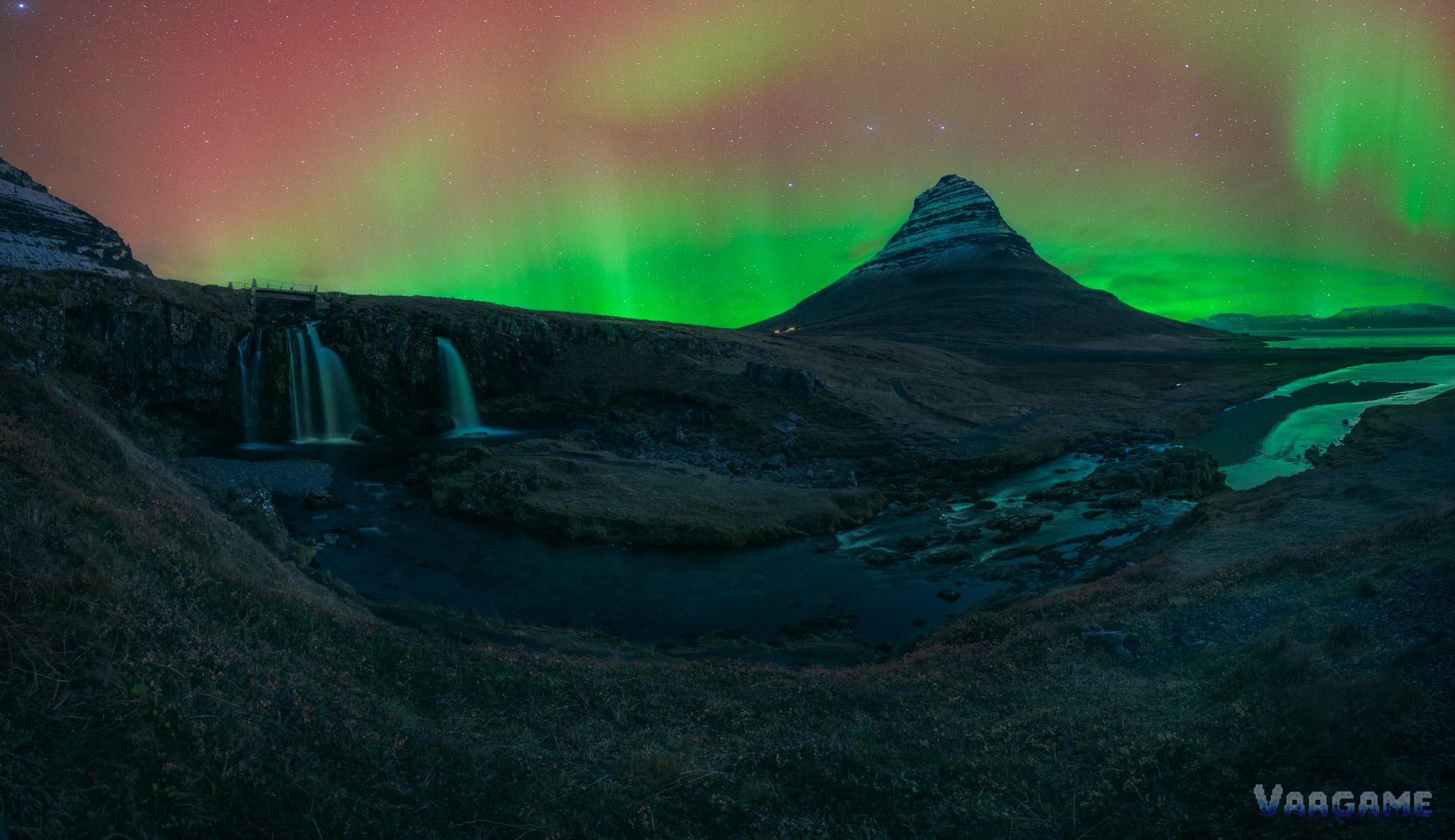
The waterfall does half the work. Kirkjufellsfoss drops in three tidy tiers in front of the peak, and the river curves toward the mountain, so the classic view frames water in front and the cone behind. Go in mid-morning or late afternoon for softer shadows and long light on the ridges; a moody overcast day suits it too, and the mountain is famous enough to have played the Arrowhead Mountain in Game of Thrones.
The same mountain changes completely with the season. From June to August the slopes turn green, and under the midnight sun the golden hour can last half the night. From November to early April it turns to ice: the cascades of Kirkjufellsfoss freeze, snow covers the cone, and on a clear dark night the northern lights can dance over the peak.
Kirkjufell is the headliner, but the peninsula around it is often called Iceland in Miniature. The same drive passes mossy lava fields, basalt columns and the Snæfellsjökull glacier, so if you have an extra day, the peninsula rewards a slow second look. This article stays with Kirkjufell itself; the rest of the peninsula is a reason to come back, not a detour to squeeze into the same afternoon.
What order to see it in
You do not need a plan longer than this. Park, cross to the falls, look from the footbridge, then walk the base if you have time. Four stops, in order.
Park at the Kirkjufellsfoss lot, just west of Grundarfjörður and across from the trailhead. The mountain is on your right as you drive west; the lot is on the left.
Cross the footbridge just above the falls. This is the classic view: three tiers of water in the foreground, the river curving toward the peak, Kirkjufell rising behind.
Drop down to the lower viewpoint for the falls close up. The mist from the water makes the paths slick, so wear shoes with a good grip and hold the rail where there is one.
If you have about 2 hours, walk the loop around the base. The mountain changes shape as you move, and the shore on the north side gives you the cone against the sea. If you are here for the aurora, come back after dark and watch from the falls viewpoint, where the mountain makes a clear shape against the sky.
Best time to go, and what not to do
The aurora season runs from September to April, when darkness returns after the bright summer. The best months are September, October and March, when the skies are clearer and equinox activity helps. November is different: by 30 November, Reykjavík has sunset at 15:53 and sunrise at 10:38, about 14 hours of darkness, which gives you a long window — but cloud and winter storms are the drawback, and November is not the best month. The new moon falls on 9 November 2026, and the NOAA 27-day outlook lists Kp 4 on 9 November and Kp 5 on 17 to 18 and 27 to 28 November, with a G1 minor geomagnetic storm watch in effect from 6 to 9 November. Those are forecasts, not a promise: no one can say the lights will show over Kirkjufell on a given night.
What not to do:
Do not climb Kirkjufell. Climbing is prohibited from 1 November to 15 June. The route is a steep technical scramble over loose rock and narrow ledges, and there have been fatal accidents. The viewpoint is the visit.
Do not leave the marked paths. The moss and soil beside the trails are extremely fragile, and a few footsteps can cause damage that takes decades to heal.
Do not drive in winter without checking conditions that morning. Check umferdin.is for roads and vedur.is for weather and the aurora forecast, and take a 4x4 from October to April. Roads are paved and usually open, but they can be icy and windy.
Do not fly a drone without checking the posted signs. Drone use may be restricted in the area.
November daylight is short, so use it well. Drive in daylight, see the falls while the sun is up, and stay after dark only if the sky is clear and you are dressed for it. Check the aurora forecast on vedur.is in the evening: cloud cover decides the night more than the Kp number does. If the forecast is cloud and wind, the mountain will still be there tomorrow — the drive back in a storm is the part to avoid.
Practical information
From Reykjavík it is about 180 km, 2 to 2.5 hours. Take Route 1 north through the Hvalfjörður tunnel to Borgarnes, then Route 54 along the north coast of the peninsula. The road is paved all the way. From October to April, a 4x4 is strongly recommended.
There is a small parking fee at the Kirkjufellsfoss lot, but the figure varies by source and by app, so check the sign or the app when you arrive and do not trust a number from an old post. There are no restrooms or cafes at Kirkjufell itself; Grundarfjörður, 2 minutes away, has fuel, shops and cafes.
Bring layers and a windproof, waterproof outer shell — the peninsula is known for sudden, powerful gusts. Wear sturdy waterproof shoes with a good grip, and in winter add ice grips for the icy path by the falls. Check umferdin.is, vedur.is and safetravel.is every morning before you set out.
Gear for the icy path
The path by the falls ices over in winter, and the falls mist keeps it slick even on a mild day. Ice grips that pull over your shoes are the one piece of gear that changes the visit: they turn a careful shuffle into a normal walk.
Prices change — check the current price on Amazon.
Bottom line: drive 2 to 2.5 hours from Reykjavík, park at Kirkjufellsfoss, cross the footbridge for the classic view, and allow 30 to 45 minutes — or about 2 hours for the base loop. Come in September, October or March for the best chance of northern lights, and do not climb the mountain. Facts, prices and forecasts on this page were checked on 8 November 2026; the aurora forecast changes daily, so check vedur.is before you go.