

I came to Los Angeles with a game in my head and sunglasses that kept sliding down my nose. The game was Grand Theft Auto V, which I had played years earlier on a couch far from California, and the city in it was Los Santos, a place that does not exist. I had driven its beachfronts and stared up at its hillside letters and treated the whole map like it was mine. Now I was walking the real streets that had lent the game its face, and my sunglasses kept slipping, and the sweat kept getting into my eyes, and that small annoyance was the first honest thing of the day. The game had given me a city I could cross in minutes. The real one was going to make me walk it, and walk it slowly, and it was going to be hot.
The Canals, Still Water
The canals were the quietest place I found all day, which surprised me, because I had expected a joke. I had expected a copy of Venice to feel like a copy. Instead I found still water between small houses, and a white footbridge arched over it, and a yellow kayak pulled up on a bank like someone had just stepped out of it. I stood on the bridge and looked down at my own reflection wobbling in the water, and the whole street was hushed in the way residential streets get hushed in the morning, with only a palm tree doing anything dramatic. A man opened a gate and carried a coffee out to his steps and did not look at me at all, which felt like permission. The canals were dug as part of a resort called Venice of America, opened in 1905 by a developer named Abbot Kinney, who had won this marshy half of a property in a coin flip and decided to build an Italian seaside town on it, complete with gondolas and gondoliers brought over from the real Venice.
Most of the canals were filled in by 1929, when cars took over, and the ones that survived fell apart and were finally drained and rebuilt and reopened in
1993. I thought about that while I stood on the bridge: a place that began as an imitation, was paved over as an embarrassment, and then was restored as heritage, and all three of those things are true at once. The game never showed me this. In Los Santos the canals were not a place I ever stopped. Here the water was so still it made me lower my voice, and I did, without deciding to.
The Boardwalk Performs
The boardwalk was the opposite of the canals, loud in every direction at once, and my shoes filled with sand within minutes. Ocean Front Walk runs along the sand with the beach on one side and a long line of shops and stalls on the other, and everyone on it seems to be performing something: a skater dropping into a concrete bowl, a man lifting weights in the open air at Muscle Beach, a painter working on a wall that will be painted over by someone else next week. I stopped to watch the skaters, because I could not do what they were doing and that is a good reason to watch anything. The beach's modern skateboarding story runs through here, through the Dogtown days of the 1970s, when the Zephyr team turned surf style into something done on concrete, and the outdoor gym at Muscle Beach has been drawing crowds since the 1960s, while the original Muscle Beach down by the Santa Monica Pier goes back to the 1930s and the birth of the whole American fitness idea.
In the game, Vespucci Beach was a place I drove past slowly, with the radio on, watching digital people do digital versions of all of this, and it felt thin in my memory compared to the real noise. A skater fell, hard, and got up laughing, and a man selling sunglasses shouted something I could not make out, and a gull stole something off a wall and was gone. Nobody in the game ever fell down and laughed about it. That was the difference, and it was not a small one.
A Sewer Pipe Becomes a Postcard
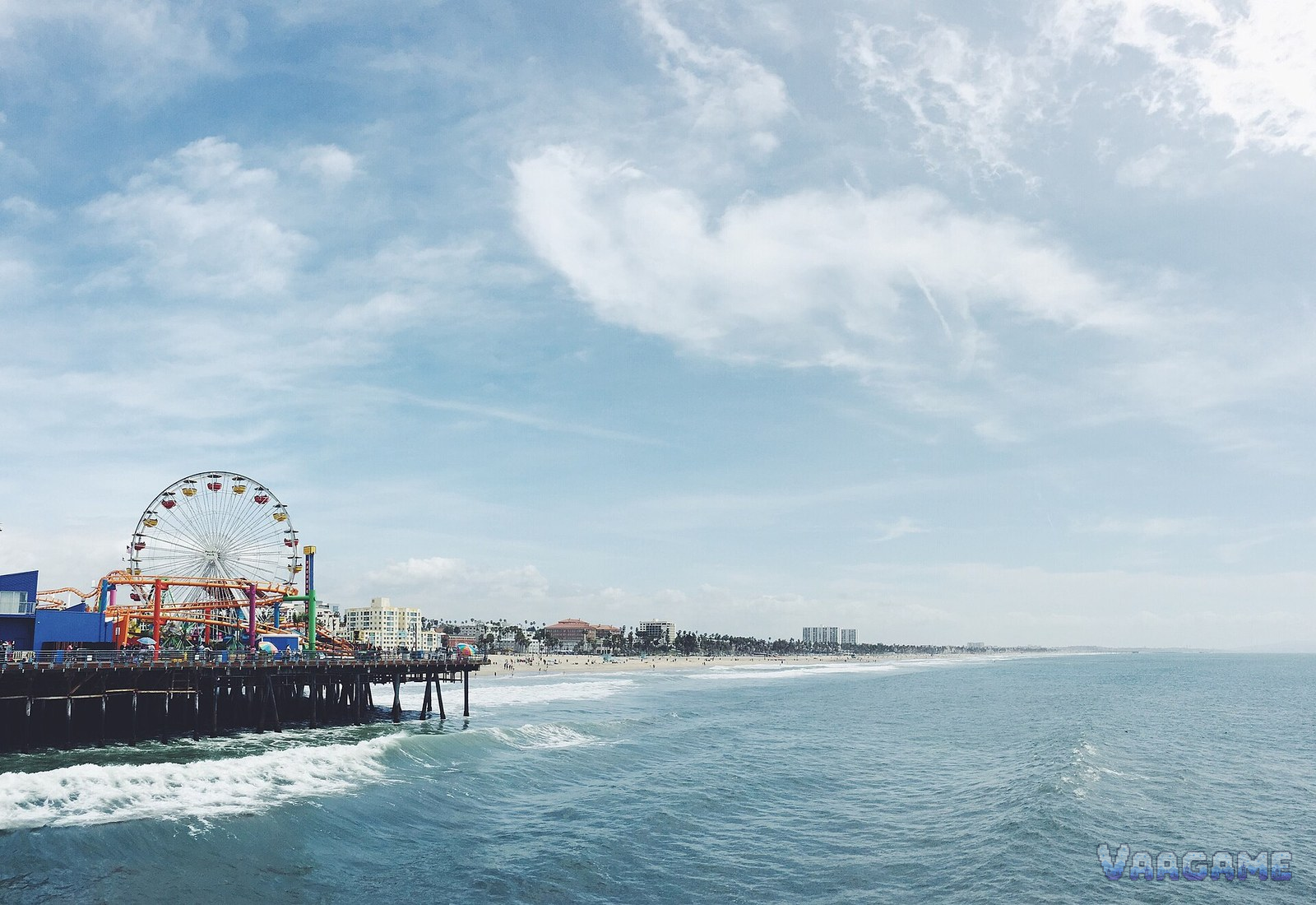
The pier taught me something I did not expect, which was that a sewer pipe can become a postcard. I walked out along the wooden planks of the Santa Monica Pier with the ocean on both sides and the Ferris wheel turning slowly ahead of me, and the boards moved under my feet in a way that made me think about how old the whole structure was. The municipal pier opened in 1909, and its first job was not romance at all: it was built to carry sewer pipes out past the breakers. The pleasure pier came later, in 1916, built by an amusement man named Looff, and the carousel inside his Hippodrome dates to 1922, with hand-carved horses still going around under the old dome. Route 66 was extended here in 1936, so the pier became the ceremonial end of the road that crossed the country.
I stood at the rail and watched the water and thought about how the game does this too, in its own way: the Del Perro Pier in Los Santos, with its rides and its lights, which reminded me of this one without ever being it. In the game I had walked the pier at night with a mission to get to. Here I had no mission, and the wheel kept turning, and a fisherman who had been standing in the same spot for what looked like hours reeled in nothing at all and did not seem to mind. The pier did not care whether I was going anywhere. That was the whole point of it, and it took me the full walk out to the end to understand that.
An Advertisement and a Gift
The letters were smaller than I expected, and that was the first thing I got wrong. I had seen the Hollywood Sign a hundred times in photographs and in the game, where the Vinewood sign sits on its hill and can be read from anywhere, and I had imagined something enormous. From the terrace of Griffith Observatory the real letters looked almost modest against the dry hillside, white and plain and a little weathered, and the modesty made them stranger, not less impressive. The sign went up in 1923 and it did not even say Hollywood: it said Hollywoodland, and it was a temporary advertisement for a housing development, built to last about eighteen months, with letters some fifty feet tall lit by thousands of bulbs. The developers sold their houses, the city took the sign over in 1944, the last four letters came off in 1949, and the whole thing was rebuilt in steel in 1978 after years of falling apart. A billboard for houses became the thing the whole world pictures when it pictures this city, and nobody planned that, which is maybe why it worked. The observatory behind me was the other half of the same story: a gift, not an advertisement.
Griffith J. Griffith gave the city more than three thousand acres in 1896 and left money in his will for an observatory that would belong to ordinary people, and it opened in 1935 with free admission, which it has kept ever since. Inside, millions of people have looked through one telescope. I stood on the terrace between the two ideas, the ad and the gift, and the city spread out below me in a haze, and the game felt very far away and very close at the same time. In Los Santos I had looked up at the Vinewood sign from a stolen car. Here I was looking at the real letters with sore feet and an empty water bottle, and the looking felt like the entire achievement.
Two Truths Downtown
Downtown arrived all at once, the way downtowns do, after a long stretch of nothing much. I came in through Union Station, and the building stopped me in the doorway: high white walls, tall arches, palm trees lined up outside like they were part of the architecture, and a waiting room that felt like it had been designed for people who were not in a hurry. The station opened in 1939 and is called the last of the great railway stations built in America, a blend of Mission Revival and Art Deco that consolidated three railroads into one terminal. It is beautiful, and the beauty has a second truth underneath it, which is that the station was built on the site of the city's original Chinatown, a neighbourhood that was declared blighted and demolished to make room for it.
I held both of those facts at the same time and did not try to settle them, because the building does not settle them either. A short walk away, Olvera Street was narrower and louder and older in a different way: a brick lane of market stalls where the city's oldest house still stands, the Avila Adobe, built in 1818, a house that was nearly demolished in the 1920s until a woman named Christine Sterling saw the demolition notice and campaigned to save it, and then built the marketplace around it, which opened on Easter Sunday in
1930. I touched a brick and it was warm from the sun, and I thought about how the game gives a player a downtown made of towers and freeways and sirens, and the real downtown gave me a station built over a lost neighbourhood and a market street saved by one stubborn person, and both of those are also Los Angeles, and neither of them fits in a car chase.
Enough Is the Whole Story
By late afternoon my feet had filed their complaint and I went looking for food the way a tired person does, without a plan and with strong opinions. I ate Baja tacos standing up, off a paper plate, with cabbage and tomato and sauce getting everywhere, and it was exactly the right amount of ceremony for the end of a long walk. The taco did not need a history lesson. But the market did, and I was standing in the part of the city that knows how to tell one. The Original Farmers Market at Third and Fairfax opened in July 1934, in the middle of the Depression, when about a dozen farmers paid fifty cents a day to park their trucks on a piece of vacant Gilmore land and sell produce off the tailgates. The land had been a dairy farm before oil was struck under it, and the market's clock tower, which carries the words "An Idea", dates to 1948, and the place has been designated a city Historic-Cultural Monument and now holds more than a hundred vendors.
I thought about that while I ate: a market that began because farmers needed somewhere to sell and a city needed somewhere to buy, and that is still, ninety years later, exactly what it does. In the game, food is something bought from a menu to restore a number. Here it was a paper plate in my hands and a tower with a phrase on it, and a city feeding itself in the same spot where it fed itself during the Depression, and the continuity felt less like nostalgia than like stubbornness. I liked the stubbornness. I stayed until the light went flat and the stalls started closing, and I did not buy anything else, because the taco had been enough and because sometimes enough is the whole story.
Next time, come back dressed like this
I did not think about what I was wearing until the sun had been at me all day, which is usually when it matters. My sunglasses kept sliding, my shirt stuck to my back, and I kept squinting up at white letters on a dry hill and white domes on a terrace, and the glare was the one thing the game had never warned me about. Next time I come back, I want a wide-brim sun hat, the kind that actually shades a face instead of decorating one, worn outdoors and taken off indoors, in the observatory above all, and in any historic house that asks for it, since the house rules come first wherever they are posted. And I want a canvas market tote, plain and sturdy, for carrying whatever the market stalls hand over, because a paper bag splits and a tote does not, and because the market is a place for carrying things home.
That is the whole kit. No costume pieces, no replica anything, nothing that belongs in a display case, and nothing worn where it is not welcome. There are no purchase links here, only the habit itself: a hat for the glare, a tote for the market, and the walk done on foot.
I left Los Angeles the way I had arrived, with the game still in my head, quieter now. The real city had not replaced it. It had just given it somewhere to stand: a canal with still water, a boardwalk full of noise, a pier built for sewer pipes, white letters that started life as an advertisement, a station built over a lost neighbourhood, a market street saved by one stubborn person, and a taco eaten standing up.
I did not finish the walk. I never rode the Ferris wheel, I never went inside the observatory, and there were streets I never turned down. The wheel was still turning when I left, and the letters were still up on the hill, and I am still not sure which of the two cities I will remember first.