

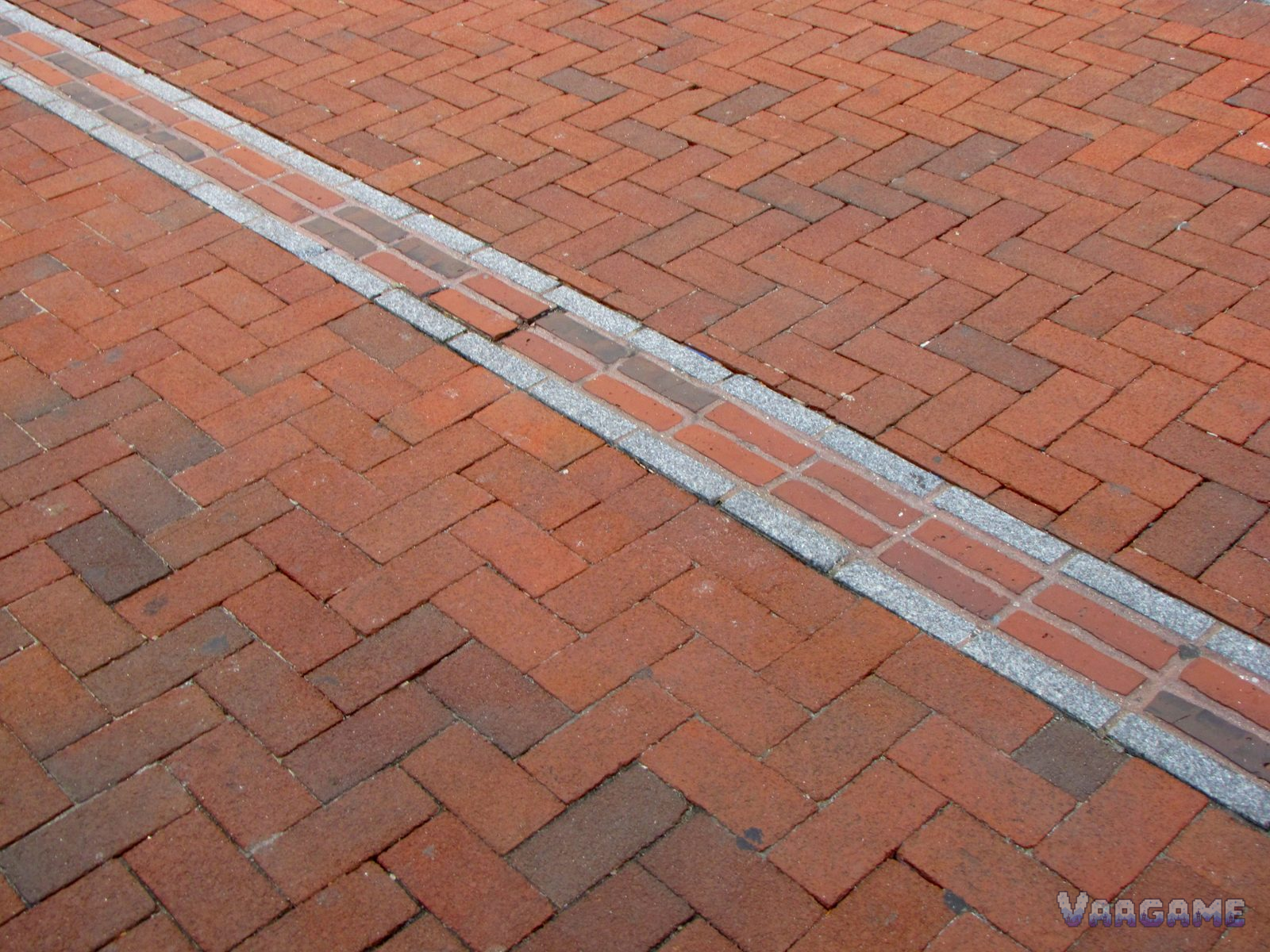
I played Assassin's Creed III years ago, on a couch, in another city. I remember Boston as a place on a screen: wet streets, crowds, a man in white moving through them. Now I am standing on the real street, and the first thing I notice is not history. It is the brick. Uneven under my shoes, darker where rain has sat in it, running straight through the grass of Boston Common: the Freedom Trail's red line, and I am following it. My hands are cold. My shoes are dusty already. A long way off, a dog is running in circles, barking at nothing. The game is the then. This street is the now. I came to see what is left between them.
The Grass Remembers Differently
The park was founded in 1634, making it America's oldest public park, and it was already old ground when the Revolution came to it. Before the war it served as a British camp: in 1775 more than a thousand redcoats were quartered here, and the column that marched to Lexington and Concord set out from this grass. In the game, the Common is one of the city's recognizable open spaces, a place to cross on the way to somewhere else. Here, I cross it slowly, because there is nowhere else I need to be. The grass is just grass. The army is gone. The dogs are here. What is left of the war is the line under my feet, still red, still going.
Connor walks this grass in the game as a man looking for a way through a city that was never built for him. He is a Mohawk assassin, not a tourist and not quite a patriot in the way the monuments mean it. The people he fights for are not a flag; they are a home, and a future for his people. I am looking for a way through too, just a smaller one: a way from the game I played to the street I am standing on. We are both, in different centuries, trying to get from one side of Boston to the other without losing what we came for.
A Room That Ran Out of Words
I push open a heavy door and the room smells faintly of old wood. Old South Meeting House was the largest building in colonial Boston when it was built in
1729. On December 16, 1773, about 5,000 colonists packed in here to debate the tea tax. Samuel Adams is said to have declared that the meeting could do nothing more to save the country. Whether those words were a signal is legend, not settled history, and the house itself does not settle the question.
What is certain is what happened that night: men boarded three ships at Griffin's Wharf and threw about 342 chests of tea into the harbor. In the game, the Tea Party is a mission, something I did with a controller in my hands and finished. Here, nothing finishes. I stand among the pews and listen for the moment a crowd runs out of words. The game gave me an action. The room gives me the weight behind it, and no button to press.
A Few Steps of Error
The building went up in 1713 and is Boston's oldest surviving public building, the seat of the colonial government. On March 5, 1770, British soldiers fired into a crowd here and five colonists died, among them Crispus Attucks. A granite circle by the balcony marks the site today. I stand on it. Then I step a few paces toward the street, because the city tells on itself: the actual shots fell nearer the customs house across the street, on what was then King Street.
My feet repeat the error on purpose. The marker and the event are a few steps apart, and I stand in that gap for a while. Six years later, on July 18, 1776, the Declaration of Independence was read to Boston's citizens from this same balcony. The game lets me play the Massacre as a scene with a beginning and an end. The pavement does not. It leaves five names, a circle of granite, and a few steps of error, and asks me to carry all three at once.
An Ordinary Front Door
Paul Revere House, built around 1680, is the oldest surviving house in downtown Boston, at 19 North Square. The Revere family owned it from 1770 to 1800, and it has been a house museum since its restoration in
1908. I step inside, into rooms with low ceilings and narrow stairs. In the game, Revere is one of Connor's allies, and the house is part of the city's fabric. Inside, the house does something the game cannot: it makes the Midnight Ride feel domestic. The man who rode out that night lived here with his family, and the ride started from an ordinary front door. I stand in that doorway and feel the whole war narrow down to one man leaving his house in the dark.
Connor leaves home too, over and over, for a cause that keeps changing its shape. So does Revere, that night. So did I, when I stopped playing and came to see the street for myself. Leaving is the one action the three of us share, and the doorway is where I finally feel it instead of reading about it.
A few streets away stands Old North Church, completed in December 1723 and Boston's oldest surviving church. On the night of April 18, 1775, two lanterns were hung briefly in its steeple by the sexton Robert Newman and the vestryman John Pulling Jr., signaling that the British were moving by water across the Charles River. The lights were up for less than a minute. The famous line, one if by land and two if by sea, does not come from that night at all: it comes from Longfellow's 1860 poem, Paul Revere's Ride. The poem made the night famous; the night itself was quiet and fast. The church is still an active Episcopal parish, and its present steeple, rebuilt after storm damage, stands about 175 feet tall. The game, like the poem, makes a night last longer than it did, because a story needs a shape and a night does not.
One door here does not open. In the game, the Green Dragon Tavern is a meeting place for assassins and, at different times, for Templars, and it is where Revere learns of British plans. In reality, the original tavern on Union Street was demolished in 1854, and the bar of the same name nearby is a later recreation. I do not get the payoff the game promised. Some doors in the game open onto rooms that no longer exist, and I have to love the game enough to let the city say so. That refusal is part of the walk, not a failure of it.
The Hill That Stayed
Across the river in Charlestown, the war stopped being an argument and became a battle. On June 17, 1775, the first large battle of the Revolution was fought here, in about two hours. It is called Bunker Hill, but the fighting happened on the nearer, lower Breed's Hill, and the name stuck anyway. British casualties ran to around 1,000 out of about 2,400 men; colonial losses were roughly 300 to
500. The hill stayed in British hands until March 1776.
In the game, the Battle of Bunker Hill is a playable mission in the same sequence as the Midnight Ride, and then the game moves on to the next sequence. The city stays behind and counts. The monument tells me how the country chose to remember it: a 221-foot granite obelisk, its cornerstone laid by Lafayette in 1825 and completed in 1843, standing exactly where the colonial redoubt stood. A mission can be won. A hill cannot be kept by wanting it. Connor fights this battle in the game. The ground keeps the bill.
A Room Built for Arguing
Back across the river, I end where Boston argued in public. Faneuil Hall was given to the city by the merchant Peter Faneuil and opened in 1742, a market below and a town hall above. It earned the name Cradle of Liberty the hard way: the Massacre victims lay here, the Boston Committee of Correspondence was formed here in 1772, and it was rebuilt after a fire in 1761 and enlarged in
1806. In the game it is one of Boston's recognizable buildings. In person, I stand in the hall upstairs for a minute without talking. A room built for arguing, holding its silence for once. I do not fill it.
Eating the Argument
I eat the city the way I walked it, one taste at a time. New England clam chowder is the cream-based one, built on clams, potatoes, salt pork and onion, as opposed to the tomato-based Manhattan version. A chowder recipe appeared in the Boston Evening Post as early as 1751, and Boston's Union Oyster House claims a chowder tradition going back to
1836. Eaten where the room is old and the bowl is hot, it tastes like the city's cooking, not like a theme. The lobster roll is the disputed one, and I like it better for the dispute. One account credits a Connecticut restaurant in 1929; another points to fishermen filling bread with lobster scraps. Maine style serves it cold with mayonnaise, Connecticut style hot with butter, and today the dish is most associated with Maine. No single inventor owns it. A working coast invented it together, and the two styles are still arguing.
Boston cream pie is the certain one, and it is not a pie at all. It was created in the Parker House kitchen around 1856, originally sold as Parker House Chocolate Cream Pie: sponge cake, custard filling, chocolate glaze. In 1996 it was named the official dessert of Massachusetts. Omni Parker House opened in 1855 and is the longest continuously operating hotel in America. Its kitchen invented two things I have already tasted by then: the cream pie, and the folded Parker House rolls, which date to the 1860s or 1870s. The story goes that a disgruntled baker threw unfinished rolls into the oven after an argument, and they came out folded. That is hotel lore, not documented history, and the hotel tells it that way. A city that argues about its own legends, out loud, is still arguing when I leave.
Next Time, Dressed for It
The walk is paused, not finished, and I already know what I will bring when I come back. Not a plan. A shape to wear: Connor's amulet, the Grand Temple key, hanging where his would hang, so the photographs have a third layer: the game, the street, and me. And the hidden blade, plastic, spring-loaded, harmless, worn on the street for the photograph, and left in the bag before going inside: more than one museum bans prop weapons outright, fake or not, so the house's rules come first. I did not dress for the first walk because I did not know yet what the walk would feel like. Now I do, and the second walk can rhyme with the first.
This guide contains affiliate links. If you buy through them, Vaagame may earn a commission at no extra cost to you. Prices and availability are as shown on Amazon.
Check on Amazon: Assassin's Creed Connor Amulet Necklace, Bronze (Ubi Workshop) — https://www.amazon.com/dp/B079K9KR14?tag=vaagame20-20
Check on Amazon: Assassin's Creed Connor Amulet Necklace, 925 Sterling Silver (Ubi Workshop) — https://www.amazon.com/dp/B071FRCWSV?tag=vaagame20-20
Check on Amazon: McFarlane Toys Assassin's Creed Hidden Blade and Gauntlet, plastic prop — https://www.amazon.com/dp/B00EGMXTI8?tag=vaagame20-20
I did not walk all sixteen sites. The red line keeps going past where I stopped, past Charlestown, past the part of the walk I saved without deciding to save it. That is fine. The game is still on my shelf. The street is still here. I look back down the line, and for a moment the two Bostons overlap: the one I played, and the one I stood in. Then a dog barks somewhere behind me, and I turn toward it, because the walk is not finished. It is only paused.