

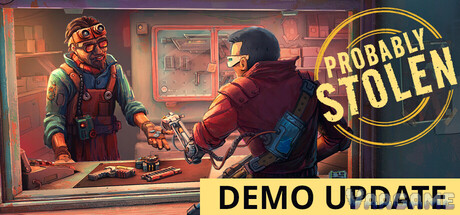
Probably Stolen keeps two sets of books. One is credits. The other is the reputation screen: five vertical tracks measuring where you stand with every power that can make your life easier or end your run. This guide covers how those tracks work in the demo, who is really standing at your counter, and the game's most dangerous regulars — the Augs.
1. Five tracks, five audiences
The reputation interface shows your standing as five gauges, one per power in the station's politics: the Lower Levels (the streets you came from), the Upper Levels (the elite who shop through intermediaries), Security (the station's law), the Black Market (its shadow), and the Revolution (the people who want the whole structure gone). The game's description of reputation is worth taking literally: it buys access and protection, and it makes you a target. A high Black Market standing opens the underground market and better fences; it also means Security's file on you gets thicker.
2. Who is actually at your counter
The store description names the casting: undercover Security working a sting, resistance members looking for leverage, fallen elites testing what you are worth. Add the regulars the demo shows you — suppliers like Georgio, who brings his latest finds to your counter in person — and the principle is simple: the customer card is a claim, not a fact. Your dossier window, the Wanted board, and the person's own record are how you check the claim. The 1.0 release expands this layer with completed character storylines for several existing NPCs and fuller backstories for the wanted names below; the main story itself arrives in a post-launch update.
3. The Wanted board
Beside the counter hangs the station's other guest list: the Wanted board, nine named faces with bounties in credits — James Bailey, The Butcher, Arthur Lafleur, Odin Haraldsson, Lou, Li Bei Wen, Juan, John Smith, and Leroy. Some faces on players' boards are already crossed out. The board matters because these are not decorations: they are people who can walk into your shop, and what you do when one does — trade, refuse, report, or reach for the counter gun — is a reputation decision with a bounty attached.
4. Security: evidence, investigations, and the brig
Security is the track with teeth. It accumulates evidence, runs investigations, and can fine or arrest you. Contraband can be hidden in a smuggler bay or smoothed over with a bribe when you are caught; Joe Wild's network sells the services of fixers who clean up evidence. The end of that road is not a game-over abstraction — the demo contains the arrest ending in full: locked in the brig for crimes against the station, your store leased to someone else while you serve the sentence, and a return to the scavenger life afterward. Every hot item you hold is a small wager against that screen.
5. Augs: the ones you shoot
The station's shared nightmare has a technical cause: a sentient AI chip went rogue and hijacked its hosts. Augs look completely normal — until they slip. Security publishes an Augmented Identification Guide for exactly this problem, and the one point every faction on the station agrees on is that an Aug should be shot on sight; you keep a gun at the counter for the moment the Shoot and Holster prompts matter.
The cruelty is the error rate. Miss an Aug and the consequences arrive later; shoot a human and they arrive immediately, in reputation and worse. Since a pre-launch patch (48.3.10), the ending tied to letting too many Augs through applies only on Hard Mode — but the counter-level costs of a wrong read exist on every difficulty. Learn the guide's signs, watch for the slip, and accept that some reads will be wrong: the game prices that in.
6. Playing the tracks: working rules
1. Decide whose customer you are. A shop that serves everyone serves no faction well; pick the two tracks your scenario feeds and let the others drift.
2. Report with intent. Reporting builds the Security track and can pay (the Model Citizen perk rewards reporting criminal customers) — and every report is visible to the other side of the street.
3. Keep contraband boring. Smuggler bay, clean paperwork habits, no hot stock stacked where an inspection finds all of it at once.
4. Use fixers before you need them. The Wild's Network sells cleanup; evidence removed early is cheaper than evidence argued later.
FAQ
How many factions are there?
Five reputation tracks are shown in the game: Lower Levels, Upper Levels, Security, Black Market, and Revolution. Individual NPCs — suppliers, wanted names, story characters — sit inside that structure.
What does the Wanted board do?
It lists nine named people with bounties. They are part of the station's population, and your response when one appears at your counter is a live decision — the full game expands their backstories.
Can Security actually end my run?
Yes. Evidence builds into investigations, fines, and arrest — and the arrest ending removes the store itself. It is the hard counterweight to the contraband economy.
How do I recognize an Aug?
Security's Augmented Identification Guide lists the signs, and Augs betray themselves by slipping. There is no certainty mechanic — a wrong call in either direction costs you, by design.