

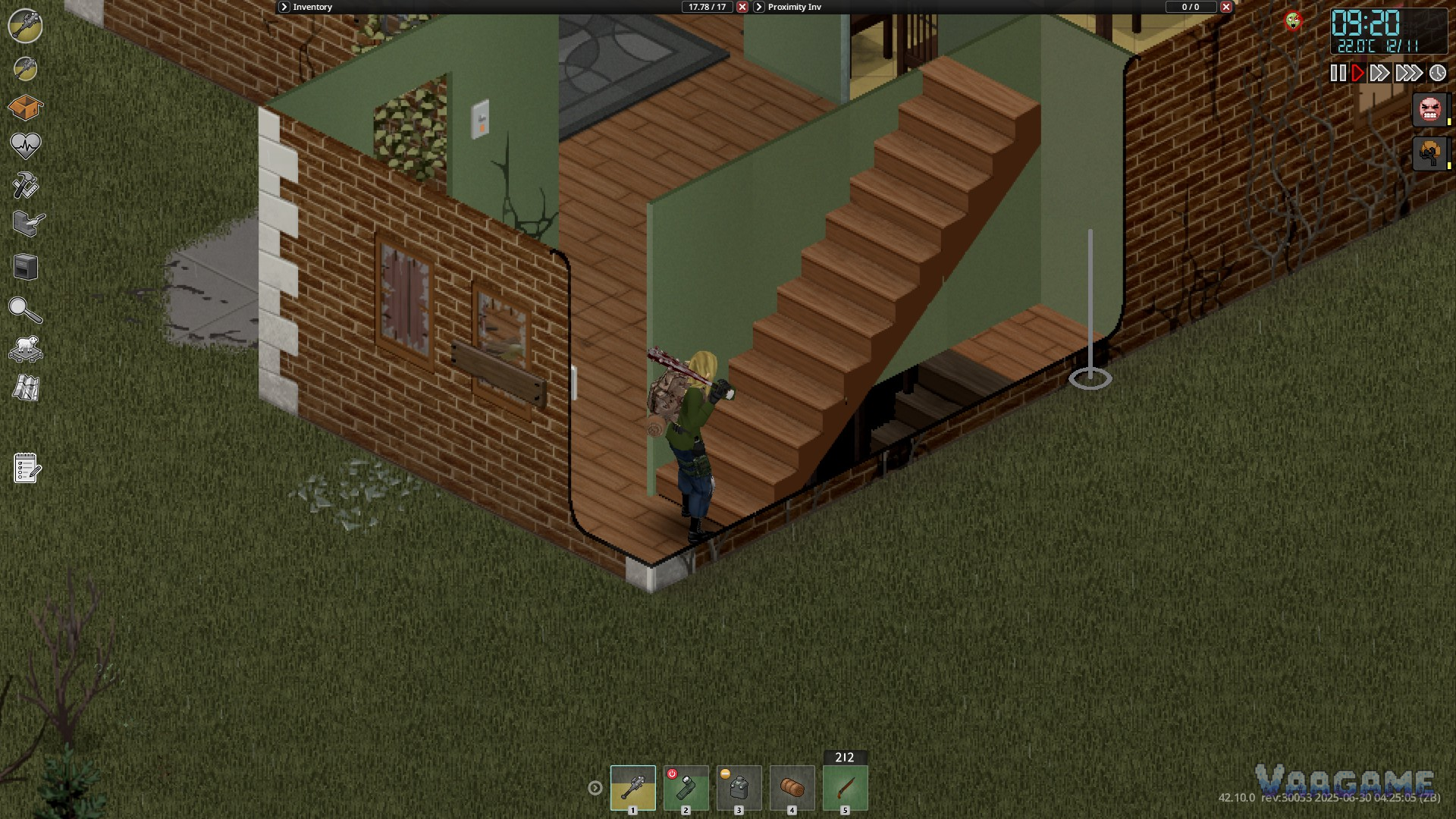
Build 42 digs the map downward. Houses, businesses and points of interest can now hide basements — storage cellars, libraries, prepper bunkers, panic rooms, even "Wayne's World" sets — and the same engine change lets Louisville stack skyscrapers up to 32 floors high. The catch: most basements are rolled by your world seed, so the bunker in someone else's video may simply not exist in your save.
Quick answer
Two kinds of basement: around 75 hand-built unique ones at fixed locations, and roughly 400 procedural ones placed by your world seed into designated spots.
You cannot dig your own basement in vanilla — basements are found, not built. Digging exists only as a mod.
Check houses for a staircase down (inside, or an exterior stair on the side of the house); businesses, military sites and POIs hold many of the fixed ones.
Frequency is a sandbox option (Basement.SpawnFrequency, default "Sometimes").
Underground rooms are pitch dark under Build 42's lighting, and most basements have one way in and out — scout before you move in.
At a glance
Swipe horizontally to view all columns.
| Topic | Build 42 facts |
|---|---|
Unique basements | ~75, hand-placed, fixed locations |
Procedural basements | ~400, seed-rolled into designated spots per world |
Dig your own? | No — vanilla has no digging; mod only |
Sandbox control | Basement.SpawnFrequency (default: Sometimes) |
Engine range | Levels −32 to +32 per chunk (Build 41 capped at 8 storeys) |
Tallest buildings | Louisville skyscrapers, up to 32 zombie-filled floors |
New challenge | Top of the World — start atop a skyscraper |
How basements generate (and why your friend's bunker isn't in your game)
Build 42's world seed decides more than terrain. On world creation, the game takes a long list of designated spots inside existing buildings and deals a random compatible basement into them — alongside zombie distribution and the randomised wilderness at the map edges. Seeds can be saved and shared, which is the only way to guarantee the same basement layout as another player.
That system splits basements in two:
Unique basements are hand-built and always attached to their location — familiar houses, businesses, points of interest and secret military complexes. If a guide names one of these, it is there in every save.
Procedural basements are drawn from a designed pool of around 400 and slotted into the designated spots your seed rolls. The same street can be basement-rich in one run and bare in the next.
Practical consequence: third-party interactive maps can mark the fixed basements but cannot show the procedural ones — they don't exist until your seed deals them. When a video tour shows a gorgeous bunker under a specific house, check whether it's a unique placement before you drive across Knox County for it. Our map guide covers what the fixed map does and doesn't tell you.
Finding them
Work a street house by house and look for the tells:
A staircase going down where the ground floor plan doesn't explain it — often off a hallway, kitchen or utility room, sometimes an exterior stair against the side of the house (pictured above).
Businesses and POIs — shops with storage cellars, and the military-flavoured sites where the hand-built bunkers live.
In multi-story buildings, check whether the stairwell continues below the ground floor.
Clear the ground floor before you descend. Whatever is in the basement has had the whole apocalypse to gather at the bottom of the stairs, and you will be fighting your way back up them if the entry goes wrong.
What you actually find down there
Procedural basements are themed draws, and the developers describe the spread honestly: some are "empty and desolate", others "full of loot beyond your wildest dreams". There is no published loot table — anyone printing exact basement loot percentages is inventing them — but the archetypes repeat:
Storage cellars — shelving, crates, preserved food and household bulk. The commonest draw and a solid early-game score.
Library basements — wall-to-wall skill books. One of the best finds in the game if your build plans around books and magazines.
Prepper and bunker basements — bunks, a fridge, long-term supplies: the themed top end of the pool.
Dormitory and living basements — beds and domestic loot; quiet, usually.
Occupied basements — the theme is zombies. Bring a weapon, not a backpack.
Living in one: basement bases, honestly assessed
A good basement is tempting as a base — one entrance to defend, a whole house of looting on top of you, and storage for days. It also has the two structural problems no amount of furniture fixes:
1. One way out. The stair that makes a basement defensible makes it a trap. If a horde pours down it while you're below, there is no window to climb from. Treat the ground floor above as part of the base: barricade it, keep it clear, and never let the house itself become the horde's waiting room.
2. Total darkness. Build 42's propagated lighting means a windowless basement is pitch black at noon. Budget for light — lamps, flashlights and the batteries to feed them — or you'll live by torch-glow. Our generator guide covers powering a below-ground base once the grid dies.
Going up: skyscrapers and Top of the World
The same vertical rework points the other way. Chunks can now run from level −32 to +32 (Build 41 capped buildings at 8 storeys), and Louisville's towers reach up to 32 zombie-filled floors. The developers themselves flagged the obvious problem during development: 32 floors spawning zombies at the normal rate is a lot of zombies. Clear towers floor by floor, hold the stairwell, and never let a cleared floor's door swing shut behind you with the floor above unheard.
If you want the vertical game distilled, the new Top of the World challenge starts you on top of one of those skyscrapers and lets you fight your way down to the street. It is also the fastest way to learn how the new height, light and zombie density interact — expect to die educational.
FAQ
Can I dig my own basement in Build 42?
No. Vanilla Build 42 has no digging or below-ground construction — basements are world content you find, occupy and fortify. Digging and expanding basements exists only through Workshop mods.
Why doesn't the house from a guide/video have a basement in my save?
Because most basements are procedural: your world seed dealt them into designated spots at world creation, and a different seed deals them differently. Only the ~75 unique basements are guaranteed. Sharing the seed is the way to share the layout.
Can I turn basements up or down?
Yes — Basement.SpawnFrequency in the sandbox options governs how often procedural basements appear (default 4, "Sometimes"). Raise it for a bunker-hunting run, lower it for a harder, sparser world.
Are basements safe from zombies?
Not inherently. Basements spawn occupied like any interior, single entrances cut both ways, and a crowd at the ground-floor windows is directly above you. Clear the basement and the house above it, then defend the stair.
Do basements respawn loot or zombies?
No official source documents basement-specific spawn or respawn rules; treat them like any other interior for your sandbox's loot and zombie respawn settings.
Related guides
Map guide: towns, POIs and the fixed world
Best base locations: above-ground competition
Generators: powering a dark basement base
Build 42 map changes: the doubled map and new towns