

In Curse of Resthaven, gold is not something you find. It is something you negotiate. As governor, you collect taxes as resource cards for wheat, lumber, sugar and gold, then trade those cards with visiting merchants, welcome ships into the harbour, and spend the proceeds on upgrading town businesses to restore the colony to prosperity. This guide explains the governor economy in order: how the four resource cards work, how the Name Your Price wheel turns a base price into a deal, how merchant favor and trade secrets change what a merchant will pay, what the ship and gold milestones actually require, and how the business upgrade thresholds work without inventing a business count the release version has not verified.
At a glance
Developer Hilltop Studios, publisher Digital Bandidos; released October 29, 2026
Platforms: PC, Mac, PlayStation 5, Xbox Series X|S; single-player narrative roguelite
$19.99 list, $17.99 with the 10% introductory offer ending November 12, 2026
Taxes arrive as four resource cards: wheat, lumber, sugar, gold; cards are traded to visiting ships or taken on expeditions
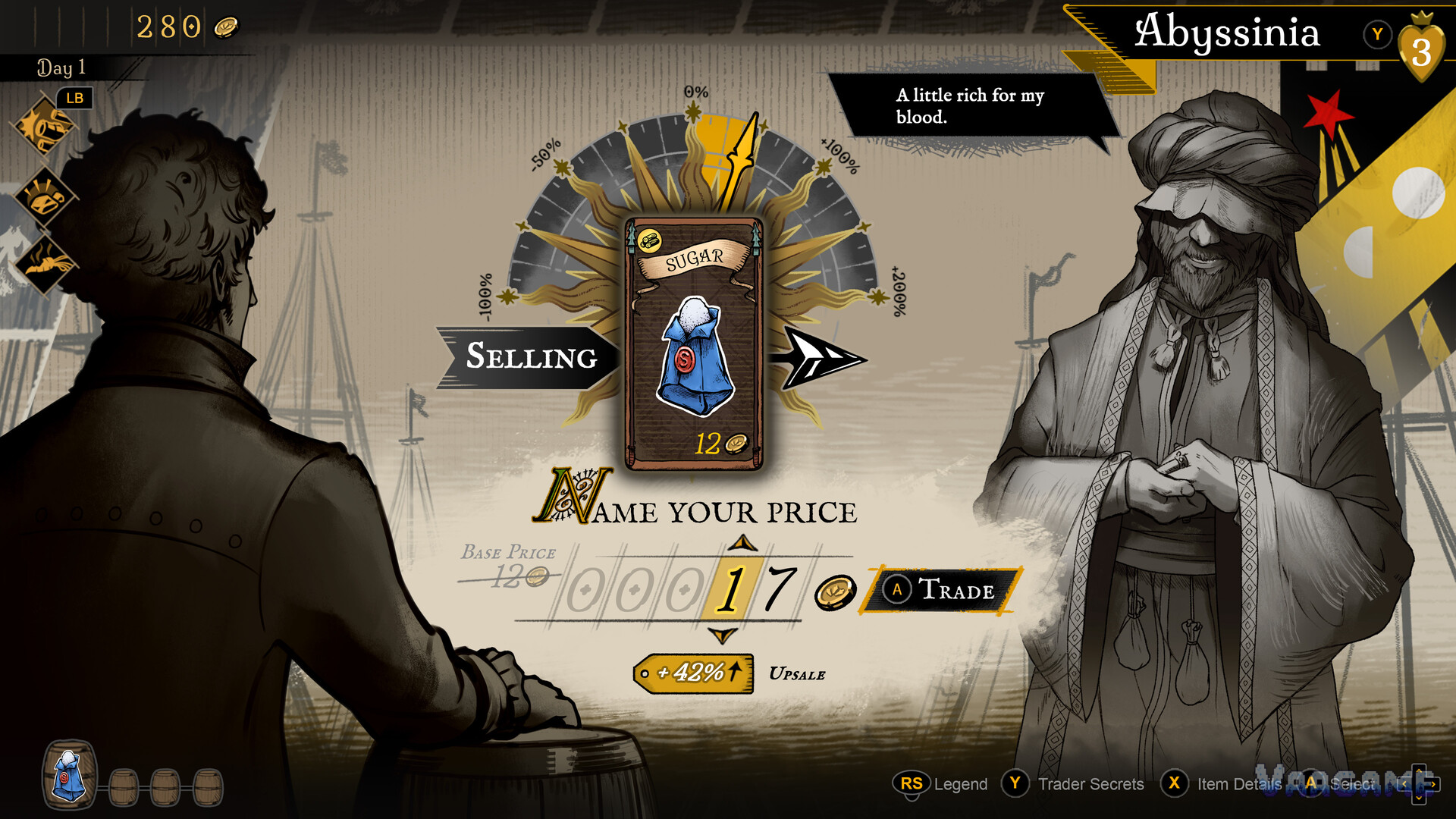
Price wheel runs from minus 100 percent to plus 200 percent; verified example: Sugar base 12 gold, asked at 17 gold, plus 42 percent Upsale
Milestones: 5 ships, 2,600 gold in a single transaction, and 10,000, 25,000 and 50,000 gold in total
Last verified: October 30, 2026
1. The governor economy: taxes as resource cards
The economy starts with an idea beginners often miss: taxes are not a number in a ledger, they are physical cards you hold. Resource cards represent physical goods: wheat, lumber, sugar and gold. Cards are collected as taxes from the island's merchants, and then you face a genuine choice with every card. Trade it to a visiting ship in port, which advances colony finances and turns goods into gold, or take it on an expedition, where it joins your deck and may unlock a specific outcome. A card spent on trade cannot open an expedition door, and a card carried into the wild cannot pay for a business upgrade.
Wheat: a tax resource card, traded to ships or carried on expeditions
Lumber: a tax resource card, traded to ships or carried on expeditions
Sugar: a tax resource card, and the verified price-wheel example in this guide, base 12 gold
Gold: a tax resource card in its own right, and the currency that trade, ships and upgrades all ultimately produce and spend
2. Name Your Price haggling: the wheel, the example, and favor
Trading is not a take-it-or-leave-it price. The trading screen gives you a Name Your Price wheel from minus 100 percent to plus 200 percent, and you set the asking price yourself. The verified example makes the arithmetic concrete: a Sugar card with a base price of 12 gold, asked at 17 gold, for a plus 42 percent Upsale. That plus 42 percent is not a bonus the game hands you; it is the gap between base price and the price you dared to ask, and whether the merchant accepts depends on the merchant, on favor, and on what you know about them. Read the example as a demonstration of the wheel, not as a target for every card.
Merchant favor is shown as hearts, and the example merchant in the verified screenshot is Abyssinia, shown with 3 hearts. Abyssinia is presented strictly as one example merchant seen in a screenshot, not as a special or best merchant, and with no claimed preference or secret. The general lesson matters: favor is visible, it varies by merchant, and it belongs in your pricing decision. A merchant who favors you can be pushed further on the wheel; one who does not is better served by a modest ask that actually closes than an ambitious ask that fails.
3. Merchant trade secrets: nine merchants, two achievements
What this guide deliberately does not do is list the nine merchants or their secrets, because the full merchant list is not verified and is left as a gap. Any guide that names all nine today is guessing at least in part, and a guessed merchant list is worse than a missing one, because it sends you looking for people who may not exist under those names. The verified facts are the count, the two achievements, the favor hearts, and the example merchant Abyssinia in a screenshot. Work from those, interrogate widely, and let the secrets you actually find in play fill in the rest. The investigation guide covers interrogation and favor in full, and it is the companion piece to this section.
4. Ships and gold milestones: what the numbers actually require
Ships are the other half of the trading economy, and their milestone is simple to state: the Bustling Port achievement requires welcoming 5 ships to Resthaven's harbour. A ship in port is a trading window, a deadline, and a reason to have cards ready before it arrives. Governors who scramble to assemble a deal after a ship docks will consistently earn less than governors who know, before the ship arrives, which cards they intend to sell and which merchants they intend to favor. Treat every ship as a scheduled event in your six-day budget, not as a surprise, and keep at least one sellable stack in reserve for a ship you have not yet met.
Gold milestones come in two kinds, and confusing them is the classic beginner error. The single-transaction milestone is Trade Master: earn 2,600 gold or more in a single transaction. That is a standout deal, and it rewards everything this guide teaches at once, favor, secrets, timing and a large stack sold at a strong ask. The total milestones are Money Pants 1, 2 and 3: earn 10,000, 25,000 and 50,000 gold in total. Those are career totals, not single-loop targets, and they reward consistency across loops rather than one spectacular sale. A governor chasing only the single-transaction record will overreach on weak merchants and lose days; a governor chasing only totals will underprice strong deals. Play for both, but judge each loop by its total contribution, and let the single-transaction record arrive when favor, knowledge and stack size align.
5. Business upgrades: thresholds without an invented total
Business upgrades are how trade profits become a lasting town, and the thresholds are precise. Boom Town 1 requires four town businesses at level
2. Boom Town 2 requires four at level
4. Boom Town 3 requires all town businesses at max level. The progression is deliberate: breadth to level 2 first, depth to level 4 second, and only then the full max-level project. A beginner who pours everything into one business hits none of the first two thresholds efficiently, while a governor who lifts four businesses to level 2 early unlocks the first achievement and spreads prosperity across the town.
One number is deliberately absent from this section: the total count of businesses at release. Demo-era coverage mentioned six upgradeable vendors, but the release count is unverified, and this guide does not state a total business or vendor count. That matters for Boom Town 3, because its requirement is all businesses at max level, and a guide that guesses the total would misstate what that achievement demands. Until the release count is verified, treat Boom Town 3 as a completion goal to work toward after the level 2 and level 4 thresholds, and check your own in-game business list rather than any number quoted here. The same discipline applies to upgrade costs and effects, which are also left as gaps rather than estimated.
FAQ
Should I trade a card or take it on an expedition? Trade it if your loop needs gold for upgrades or milestones; carry it if it may unlock a specific expedition outcome. Never spend your whole stock of one good in a single early deal, because you cannot know yet which use that loop will need most.
What does the plus 42 percent Upsale example prove? Only the arithmetic of one verified trade: a Sugar card with a base price of 12 gold, asked at 17 gold. It demonstrates the Name Your Price wheel, which runs from minus 100 percent to plus 200 percent; it does not promise the same result with every merchant.
How many merchants have trade secrets? Nine merchants have trade secrets. Trade Secrets 1 requires all of a single merchant's secrets, and Trade Secrets 2 requires one secret for all 9 merchants. The full merchant list is not verified and is not listed here.
How many businesses are there to upgrade? This guide does not state a release total, because it is unverified; demo-era coverage mentioned six upgradeable vendors, which is not a release count. The verified thresholds are four businesses to level 2, four to level 4, and all businesses to max level.
Related guides
Curse of Resthaven Beginner's Guide: First Loop, Trading, Expeditions and the Three Timelines
Curse of Resthaven Time Loop Guide: What Carries Over, Boons, Skills and Loop Strategy
Curse of Resthaven Trading and Town Management Guide: Prices, Merchant Secrets, Ships and Upgrades
Curse of Resthaven Expeditions and Cards Guide: Map, Companions, Campsites and Deck Building
Curse of Resthaven Investigation and Endings Guide: Interrogation, Favor, Three Timelines and the True Ending
Curse of Resthaven Achievements Guide: All 41 Achievements and How to Unlock Them
Next: the expeditions guide explains the map, companions, campsites and deck building, and the investigation guide explains interrogation, favor, the three timelines and the true ending.