

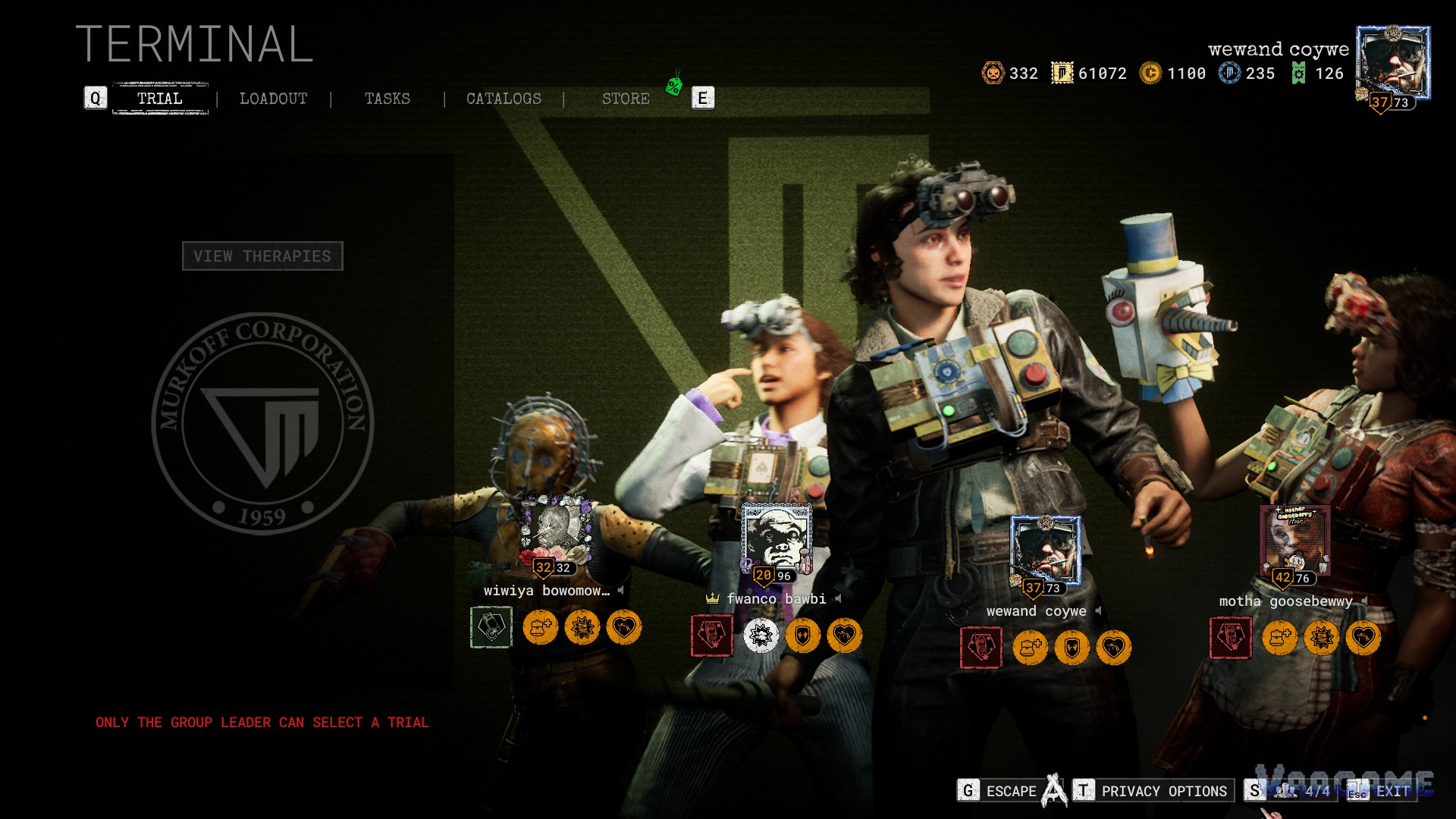
The Outlast Trials lets you complete trials by yourself or in a team of 2, 3, or 4 players, and the store page is explicit about the most important rule: coop is never forced when it comes to mandatory objectives, but working together can be highly beneficial. That sentence is the whole guide in miniature. Solo is a complete way to play, co-op is a different way to play, and the differences are specific: side-objective counts, revival, scoring, and the feel of being hunted. This guide covers each one, and it marks the two popular claims that are not verified, so you do not build a plan on them.
Quick answers
Mandatory objectives are the same solo and in co-op. Nothing in a trial main path requires a teammate.
Poster side objectives differ: 3 posters solo, 5 in co-op. Do not generalise that 3 versus 5 split to every side-objective type.
Co-op scoring gives both a team grade and a personal grade. Solo has no team-grade dimension.
When you go down in co-op, a teammate can revive you. Solo revival works differently and is flagged as community-sourced below.
Whether enemy numbers or strength scale with player count is not verified. This guide does not claim it.
At a glance
Players: solo, or a team of 2, 3, or 4 (maximum 4 including yourself, not 4 teammates)
Mandatory objectives: never forced co-op
Poster side objective: 3 solo, 5 in co-op
Scoring: team grade plus personal grade in co-op
Cross-play: Red Barrels October 27, 2026 launch post says team up across all platforms; pairwise official support-page confirmation not found
Last verified: November 1, 2026
1. The rule that matters most: co-op is never forced
The store page says you can choose to complete the trials by yourself or tackle them in a team of 2, 3, or 4 players, and it adds the sentence that settles every solo-versus-co-op argument: coop is never forced when it comes to mandatory objectives. In practice that means no main-path objective in a trial is designed to need two pairs of hands. A solo player can reach every mandatory goal, open every mandatory door, and finish every mandatory task. What co-op changes is not access, but execution: more eyes, more hands, more chances to revive, and more noise, which matters in a game built around hiding.
That is also why the game feels different solo even though the objectives are the same. Solo, every sound you make is yours, every enemy that hears something is coming for you, and every hiding spot is a decision you make alone. In co-op, the same trial becomes a shared problem: one player draws attention while another completes an objective, one player watches a door while another searches. Neither version is the intended version. The game is built to be complete in both.
2. Side objectives: the one counted difference
The confirmed counted difference between solo and co-op is the poster side objective. Collecting propaganda posters takes 3 posters in solo play and 5 in co-op, a split confirmed by two independent guides. That is a poster figure, and this guide states it as a poster figure only. Other side-objective types, such as organ samples and blueprints, were not confirmed to follow the same split at check time, so this guide does not extend the 3 versus 5 numbers to them. If a guide tells you all side objectives are 3 solo and 5 in co-op, it is generalising beyond the evidence.
3. Going down and getting back up
When your health reaches zero, you go down rather than dying outright. In co-op, a teammate who is present can revive you, and a syringe can also bring you back. The Jammer Rig, after its upgrade, can also revive yourself and teammates, which is covered in our All 6 Rigs Guide. For solo play, community sources describe revive pills as the solo substitute for the syringe. That solo detail is community-sourced, not confirmed by an official in-game statement at check time, so treat it as the best available community account rather than a verified fact, and check it in your own game before relying on it in a hard trial.
4. Scoring: team grade plus personal grade
Co-op scoring gives two grades at once: a team grade and a personal grade, and the personal grade goes into your personal record. That matters for how you judge a run. A co-op run can succeed as a team while your personal grade reflects your own contribution, including the co-operative actions the game rewards, such as pushing a door together with a teammate. Solo play has no team-grade dimension, so the grade you see is yours alone. The full grading system, including what earns and loses points and why time does not affect your grade, is covered in our difficulty and grading guides, not here, because this guide is about the solo-versus-co-op difference only.
5. What is not verified: enemy scaling
One claim appears in many casual discussions and is not made in this guide: that enemy numbers or enemy strength scale with the number of players. At check time, no official or reliable source gave a clear statement or usable data for that claim. Some secondary sources speak generally about difficulty adjusting with player count, but none provided figures that could be cited. Until such a source appears, this guide does not say enemies get more numerous, tougher, or weaker with more players, and you should not plan a solo build around the idea that a trial will be quieter alone, or a co-op build around the idea that it will be harder with four.
6. Which mode should you pick
Swipe horizontally to view all columns.
| If you want | Pick | Why |
|---|---|---|
The full story at your own pace | Solo | Mandatory objectives are never forced co-op, and every sound is yours to control |
Shared scares and faster revives | Co-op | Teammates revive you, and roles can split during objectives |
The highest personal grade | Either, played well | Personal grade is tracked in both modes; co-op adds a team grade on top |
A first trial with training wheels | Co-op with friends | A teammate can cover you while you learn a map |
FAQ
Can I finish the whole game solo?
Yes, for mandatory objectives. The store page says coop is never forced for mandatory objectives, so solo is a complete path through the game.
How many players can play together?
Up to 4 players in total, including yourself: solo, or teams of 2, 3, or
4. It is not 4 teammates plus yourself.
Do enemies get stronger with more players?
Not verified. No official or reliable source at check time gave a clear statement or data on enemy numbers or strength scaling with player count, so this guide makes no such claim.
Can I play with friends on other platforms?
Red Barrels October 27, 2026 Switch 2 launch post said players can team up with friends across all platforms with cross-play. Pairwise confirmation on official support pages was not found at check time, and cross-progression is not officially confirmed.
Does co-op change my personal grade?
Co-op scoring gives both a team grade and a personal grade, and the personal grade goes into your personal record. Solo has no team grade.