

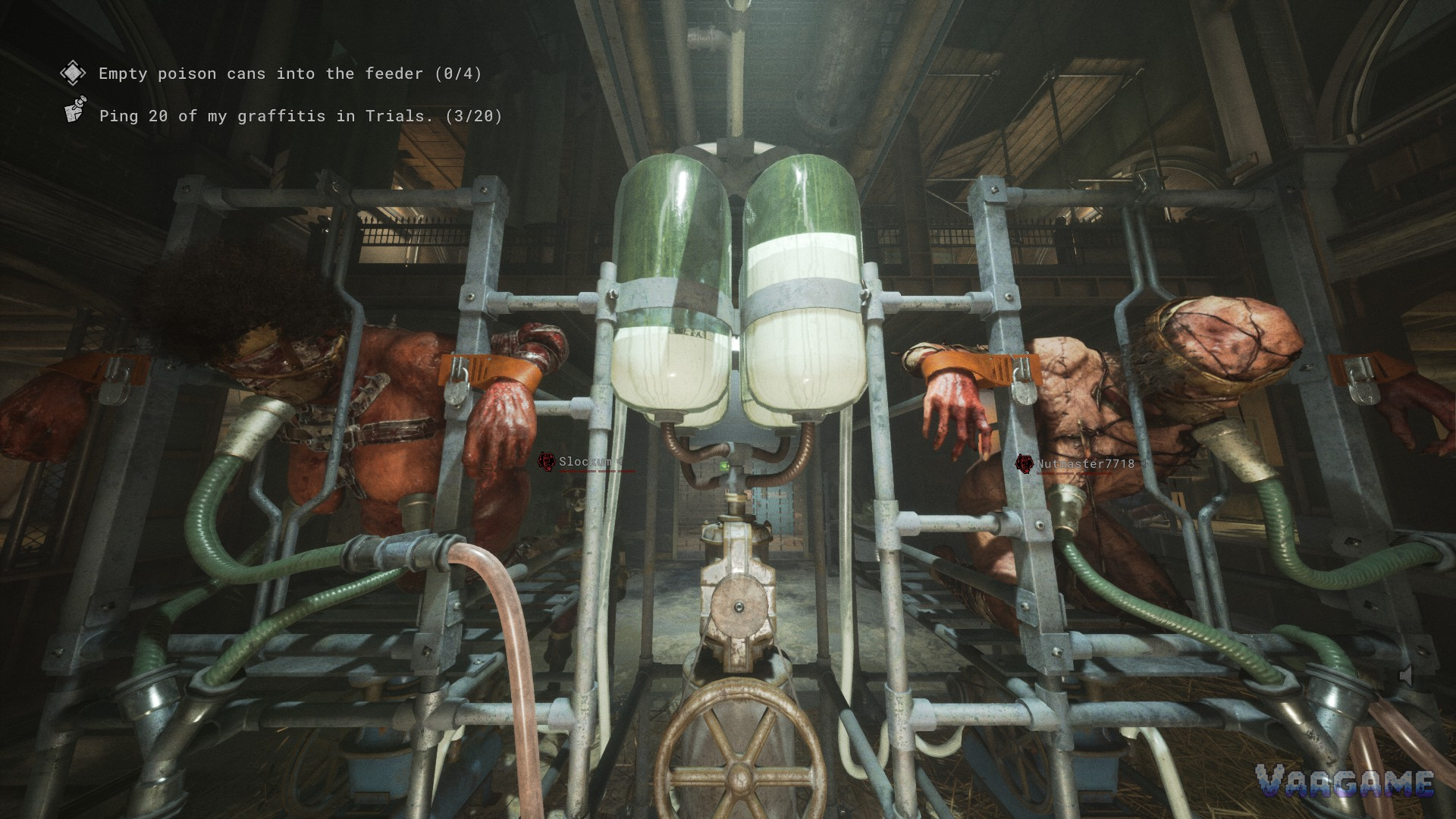
Everything you do in The Outlast Trials sits inside a three-layer structure: a Program contains Trials and MK-Challenges, and completing them earns you Rebirth. A Trial is an immersive, story-driven therapy that takes a certain time to complete in a full trial environment. An MK-Challenge is a shorter therapy that takes place in a modified or redesigned section of an existing map. That is the whole distinction, and it explains almost every confusion new players have about what to play next: if it is long and story-shaped, it is a Trial; if it is short and set in a place you already know, it is an MK-Challenge.
Quick answers
Structure: Program, then Trial or MK-Challenge. You pick a Program on the Trial Board in the Sleep Room, then pick inside it.
Trials are long and story-driven, in full environments. MK-Challenges are shorter, in redesigned sections of existing maps.
Both count toward the same goal: completing Murkoff therapy and earning Rebirth, the right to be released back into society.
Genesis is the core path, with 8 confirmed main Trials. The full MK-Challenge list per environment is not verified and is not printed here.
Rotating Weekly and Special Therapies exist, but their current rotating list is not fixed and is not printed here.
At a glance
Structure: Program > Trial / MK-Challenge
Where you choose: Trial Board in the Sleep Room
Core path: Program Genesis, 8 main Trials confirmed
Goal: Rebirth, release back into society
Programs beyond Genesis: Escalation, Trial Maker, Invasion, plus rotating therapies
Last verified: November 1, 2026
1. The three layers, in order
The top layer is the Program. Think of it as a course of therapy, a named collection with its own rules. The middle layer is the individual therapy you actually play: either a Trial or an MK-Challenge. The bottom layer is the session itself, what happens inside one run. You never pick a Trial in the abstract. You go to the Sleep Room, open the Trial Board, pick a Program, and then pick a Trial or an MK-Challenge inside that Program. If you are ever lost about what to do next, go back to the Trial Board and read which Program you are in, because that answers the question.
Swipe horizontally to view all columns.
| Layer | What it is | Example |
|---|---|---|
Program | A named course of therapy with its own rules | Genesis, Escalation, Trial Maker, Invasion |
Trial | A long, story-driven therapy in a full environment | Kill the Snitch, Locksock the Warden |
MK-Challenge | A shorter therapy in a redesigned section of an existing map | Bribe the Judges, Cancel the Broadcast |
2. Trials: long, story-shaped, full environments
A Trial is the main event. The store page calls Trials immersive story driven therapies that take a certain time to complete, and that wording is precise: a Trial has a story shape, a named target, and a full environment built around a theme. You enter a place, you are given disturbing tasks, and you are only allowed to leave after completing them. Trials are where the game story advances, where Prime Assets hold dominion over their themed environment, and where a run feels like an episode rather than a round.
3. MK-Challenges: shorter, in places you already know
An MK-Challenge is the same idea at a smaller scale. The store page calls them shorter therapies occurring in modified or redesigned section of an existing map. The key words are shorter and existing map. An MK-Challenge does not build you a new world. It takes a section of a map you already know, changes it, and gives you a shorter therapy inside it. That is why MK-Challenges are good for a short session, for practising a map, or for progressing when you do not have time for a full Trial, and why they never feel like a second story campaign: they are not meant to.
4. Genesis: the core path and its 8 main Trials
Program Genesis, subtitled Path to Rebirth, is the core path: the collection of themed therapies planned by Dr. Easterman that contains the main Trials and MK-Challenges, with adjustable difficulty and most special Variators absent. Its 8 confirmed main Trials, in the order the community project list gives them, are the spine of the game story. Each one is named for its target, and each belongs to a themed environment.
Swipe horizontally to view all columns.
| Main Trial | Environment | Season note |
|---|---|---|
Kill the Snitch | Early trial environments | Core Genesis trial |
Cleanse the Orphans | Early trial environments | Core Genesis trial |
Grind the Bad Apples | Early trial environments | Core Genesis trial |
Vindicate the Guilty | Early trial environments | Core Genesis trial |
Pervert the Futterman | Early trial environments | Core Genesis trial |
Poison the Medicine | The Docks | Added with Season 1, Project Lupara, July 16, 2024 |
Pleasure the Prosecutor | Downtown | Added with Project Breach, December 10, 2024 |
Locksock the Warden | Prison Farm | Added with Season 7, Project Boneyard, July 14, 2026 |
What this guide does not print is the full MK-Challenge list for each environment. Each environment has several MK-Challenges, and the complete per-environment list was not verified at check time, so printing one would mean inventing entries. Two MK-Challenges are confirmed in this guide because they are tied to a verified season: Bribe the Judges and Cancel the Broadcast, both added with Season 7 Project Boneyard, and both set in the Prison Farm context. The same gap applies to the rotating Weekly Therapy and Special Therapy lists: they exist and rotate with seasons, but a fixed current list was not verified, so none is printed. If you need the current rotation, read the Trial Board in your own game, because that is the authoritative list.
5. The other Programs: Escalation, Trial Maker, Invasion
Swipe horizontally to view all columns.
| Program | What it is | Unlock |
|---|---|---|
Escalation (Endurance) | Roguelite mode: start with nothing, build a loadout as you go deeper through randomised trials, with rising difficulty and rewards; the run ends when everyone dies | Therapy Level 15 |
Trial Maker (Create Your Trials) | Build your own trials | Therapy Level 10 |
Invasion (Trust No One) | Be invaded by an Imposter player in your own trial, or invade others as an Imposter | Therapy Level 30 |
Escalation launched July 16, 2024 with Season 1 Project Lupara, and Trial Maker launched April 22, 2025 with Season 3 Project Relapse. The unlock levels above come from the community project list, and they are worth knowing because they explain why a new player does not see all Programs at once: the game gates its stranger modes behind Therapy Level progress. Complete side objectives in Genesis to earn the extra experience that moves your Therapy Level, and the other Programs open in turn.
6. Rebirth: what you are actually working toward
Rebirth is not a level and not a single trial. It is the status you earn by completing Murkoff therapy: the Trials and MK-Challenges that make up the course. The store page states the goal plainly: complete the therapy and earn the right to be released back into society. In practice, that means your progress is the list of Trials and MK-Challenges you have completed, and your Therapy Level is the number that tracks it. Do not treat Rebirth as a finish line you cross once and stop at. Seasons keep adding Trials, MK-Challenges, and events to the same structure, so the course keeps growing, and the current season content is covered in our Season 7 and October 2026 Comeback guide, linked below.
FAQ
What is the difference between a Trial and an MK-Challenge?
Trials are long, story-driven therapies in full environments. MK-Challenges are shorter therapies in modified or redesigned sections of existing maps. Both count toward completing Murkoff therapy.
What is a Program?
A Program is a named course of therapy that contains Trials and MK-Challenges. You pick a Program on the Trial Board in the Sleep Room, then pick inside it. Genesis is the core path.
How many main Trials are in Genesis?
Eight are confirmed: Kill the Snitch, Cleanse the Orphans, Grind the Bad Apples, Vindicate the Guilty, Pervert the Futterman, Poison the Medicine, Pleasure the Prosecutor, and Locksock the Warden.
Why is there no full MK-Challenge list in this guide?
Because the complete per-environment MK-Challenge list was not verified at check time. Printing one would mean inventing entries, so this guide lists only the MK-Challenges tied to verified seasons and tells you to read the Trial Board for the current list.
What is Rebirth?
Rebirth is the status earned by completing Murkoff therapy, meaning its Trials and MK-Challenges, and the right to be released back into society. It is tracked through your completed list and your Therapy Level.