

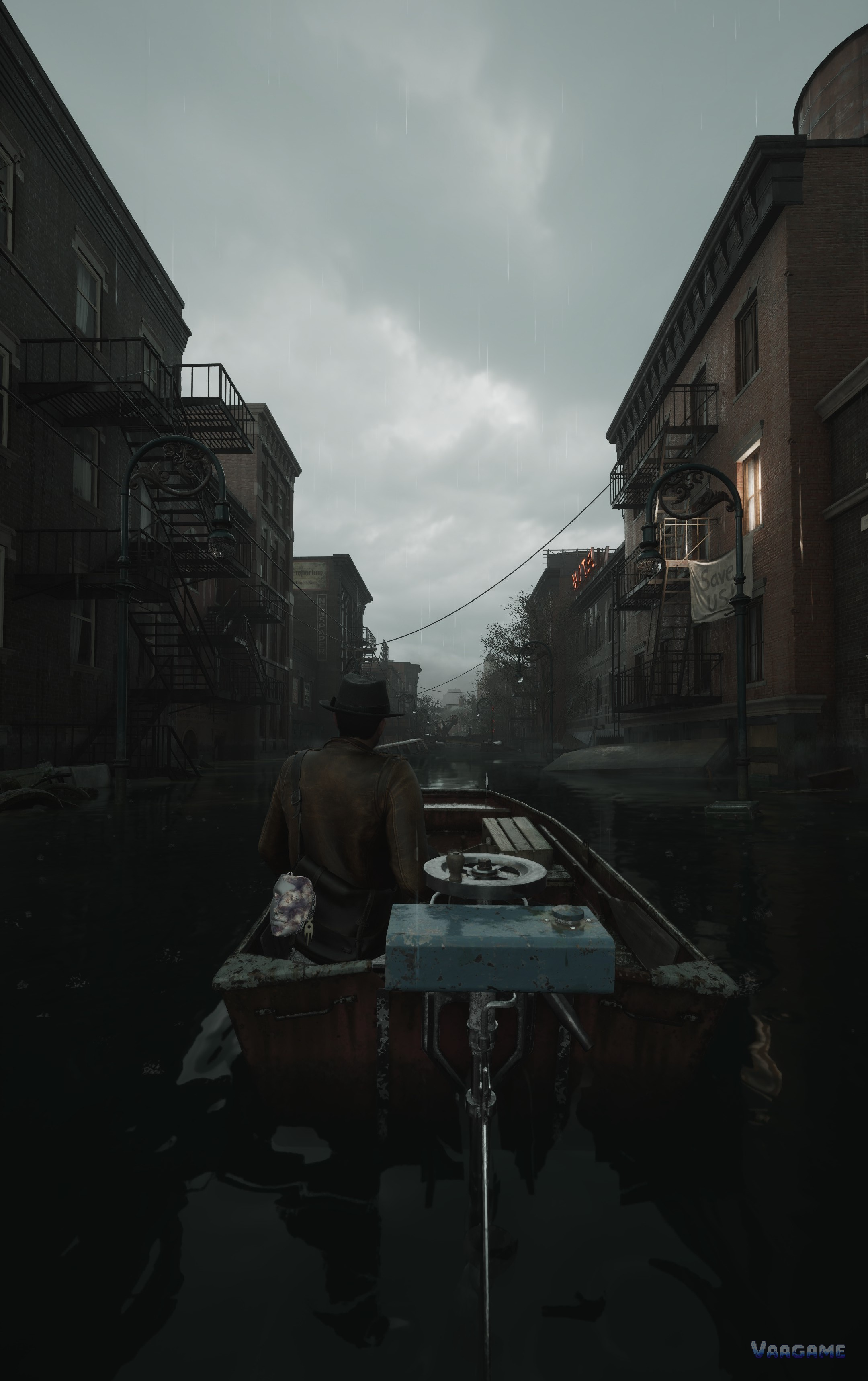
The Sinking City 2 is a third-person survival horror game set in a flooded 1920s Arkham. You play Calvin Rafferty, an occult adventurer searching for Faye, whose soul was trapped in the Dreamlands after a ritual failed. Ammo is scarce, the city is hostile, and your safe rooms are the one place the flood cannot follow you.
Quick answer
Optional investigations never block the main story, but they pay for themselves in supplies, upgrades, and safer routes.
Do not try to kill everything. Ammo is too scarce, and most fights can be escaped by running for a safe room.
Your first stop is always a safe room: save, store loot, and unlock Talents before pushing further.
Aim for the glowing red weak points. They deal far more damage than body shots and save bullets.
Inventory space starts tiny. Return to safe rooms often instead of hauling everything with you.
At a glance
Developer: Frogwares
Genre: Third-person survival horror, single-player
Platforms: PC (Steam / Epic), PS5, Xbox Series X|S; Nintendo Switch 2 version planned for 2027
Price: $49.99 standard edition; 25% off until October 31, 2026 ($37.49), after which it returns to $49.99
Current version: Update 1.1.0 (October 6, 2026)
Achievements: 23
Main story length: Reviewers report roughly 7 to 14 hours depending on difficulty and exploration; around 20 hours for 100%
1. About the game: the official picture
The Sinking City 2 is Frogwares’ third-person survival horror game, set in a flooded 1920s Arkham. You play Calvin Rafferty, an occult adventurer searching for Faye, whose soul was trapped in the Dreamlands after a failed ritual. The story is fully independent of the first game: no knowledge of Charles Reed’s story is required. It is single-player only, on PC (Steam and Epic), PlayStation 5, and Xbox Series X|S, with a Nintendo Switch 2 version planned for
2027. The standard edition costs $49.99, with a 25% discount until October 31, 2026.
2. What kind of game this is
The Sinking City 2 mixes investigation, gunplay, and survival in a city that is half drowned. You walk its streets, take a small boat between districts, open shortcuts, and decide case by case whether a fight is worth the bullets. The story stands alone: you do not need the first game to follow Calvin’s search.
Swipe horizontally to view all columns.
| System | What it does |
|---|---|
Investigations | Optional cases solved on the Investigation board; they reward supplies, upgrades, and Talent points. |
Combat | Third-person gunplay against Slither, Deep Ones, and Shadows, with scarce ammo. |
Exploration | Walking plus boat travel, shortcuts, and rooms marked looted or unlooted. |
Survival | Small inventory, scrap crafting, and Talents unlocked with Dream Essence at safe rooms. |
3. Difficulty: combat tiers and investigation tiers
Combat and investigation use separate difficulty settings, and only the investigation setting changes how much help you get. Combat tiers change how hard fights hit and how forgiving they are; investigation tiers change only how clues are presented, never the puzzle itself.
Swipe horizontally to view all columns.
| Setting | Options |
|---|---|
Combat | Sweet Dreams (optional invincibility), Restless Slumber (normal), Hard Night, Sleep Demon. |
Investigation | Breezy (key information highlighted, evidence icons carry matching symbols) or Brainy (no highlights, all evidence icons look alike). |
If you enjoy solving clues yourself, the common recommendation is normal combat with Brainy investigation: full combat pressure, no hint crutches. If you are here mainly for the story, Sweet Dreams removes the combat threat entirely.
4. Combat basics: five weapons, weak points, and when to run
You start with a pistol and can find four more weapons, each with two findable parts. Ammo never stretches far: dodge, strike in melee, and stomp downed enemies instead of spending bullets on finished fights. Every enemy has glowing red weak points, and hitting them deals far more damage than body shots.
Swipe horizontally to view all columns.
| Weapon | Role |
|---|---|
Equalizer Mk. II | Starting pistol. |
Field Surgeon | Shotgun. |
The Minuteman | Submachine gun. |
Black Reef Longshot | Rifle. |
Linguist’s Folly | Grenade launcher. |
5. Exploration and survival: boats, shortcuts, and the safe room loop
Arkham is explored on foot and by skiff. Unlocking shortcuts turns long hostile walks into short hops, and rooms tell you whether anything is left inside: markers distinguish looted rooms from unlooted ones, so you stop re-clearing empty space.
Inventory starts tiny, so the loop is: go out, gather, come back. Scrap becomes healing items and ammo through crafting, and Dream Essence unlocks and equips Talents at safe rooms, generally one major Talent plus three minor ones at a time. Enemies cannot enter safe rooms, which makes them the only reliable place to breathe.
6. How saving works
The game autosaves at major checkpoints, and you can save manually at safe rooms using the conch record player. Safe rooms also store loot and unlock Talents, so treat every safe room you pass as a stop: save, store, and only then push on. The number of manual save slots has not been confirmed in reliable sources, so this guide does not state one.
7. Your first hour, step by step
1. Reach the first Safe Room. Save, store what you are carrying, and unlock your first abilities.
2. Follow the Gate Switchboard note to the shop across the street and pick up the Fuses. The Allen Radio Store door carries an Est 1908 hint.
3. Return to Apartment 5 and open the wall safe with the code
1908. Inside are pistol ammo and a Dolorocide Pill.
4. Expect your first fight inside the Radio Store right after you close the item description menu. Aim for the glowing red weak points.
5. Head back to a safe room to bank what you found before pushing into the next district.
8. Mistakes to avoid
Skipping every optional case. They never block progress, but skipping them leaves you under-equipped later.
Hoarding scrap instead of crafting. Turn scrap into healing items and ammo before you need them.
Treating every fight as mandatory. Retreat, resupply, and return with an upgrade is often the correct play.
9. What players say
Sample note: Steam’s public review API could not be read directly in this check (the request returned the Steam homepage instead of review data), so the excerpts below come from public Steam community review pages and a SteamCozy snapshot of Steam reviews dated September 25,
2026. Helpful counts are snapshot values, not live counts. Positive excerpts are confirmed Recommended; negative excerpts are labeled by their confirmation status.
“I know, you know, we all know -- this is basically a Resident Evil game with a Lovecraftian paint job. But here’s the thing: that’s why I enjoyed it so much.” (Recommended, 47 helpful in the snapshot.)
“Atmosphere is arguably the game’s biggest strength. The flooded 1920s version of Arkham is grimy, oppressive and beautifully grotesque.” (Recommended, 31 helpful in the snapshot.)
“The Sinking City 2 successfully channels classic survival horror, blending investigative mystery with tense exploration, combat, and an engaging story.” (Recommended, from the community recommendation list.)
“This is one of the most frustrating purchases I’ve made in recent memory. I insta-bought it for its full price, before reviews came in, because Sinking City 1 is one of my favorite Lovecraftian games, but boy-oh-boy was I in for a rude awakening.” (Not Recommended, 29 helpful in the snapshot.)
“This is more of a neutral, middle-thumb rating, but if considering whether it’s worth playing, I give it a no. I’d score The Sinking City 2 a 6/10.” (Self-described neutral, conclusion “no”, community page, October 20.)
The pattern is consistent: atmosphere and classic survival horror tone earn praise, while combat carrying too much of the game and unmet expectations from the first game draw the criticism.
10. Official system requirements, explained
The Steam store page lists both a minimum and a recommended tier, so this section interprets both. One caution: the main store page text extraction in this check did not return the requirements section, so the figures below come from store search snapshots from about four days earlier, cross-checked against the DLC store page, and should be re-verified against the live page if a figure looks wrong. An older demo-era listing (12GB of memory, RX 7600 XT or RTX 3060, Windows
10) applied only to the demo and must not be used for the full game.
Swipe horizontally to view all columns.
| Tier | Official requirements | Target |
|---|---|---|
Minimum | Windows 11 x64; Intel Core i7-8700K or AMD Ryzen 5 3600X; 16GB RAM; NVIDIA GeForce GTX 1070 or AMD RX 5700, 8GB VRAM; DirectX 12; 70GB storage; SSD required. | 1080p, 30fps, Low preset. |
Recommended | Windows 11 x64; Intel Core i5-14600K or AMD Ryzen 5 7600X; 32GB RAM; NVIDIA GeForce RTX 4070 Ti or AMD RX 7900 XT, 12GB VRAM; DirectX 12; 70GB storage; SSD required. | 1440p, 60fps. The preset name differs between sources (Balanced versus Medium); only the resolution and frame rate are stated firmly here. |
What this means in practice: the memory jump from 16GB to 32GB and the recommended GPU class (RTX 4070 Ti) are the demanding parts, while the SSD requirement and 70GB of space apply to both tiers. A value build around an RX 6600-class GPU clears the minimum tier comfortably and targets 1080p; it does not meet the recommended tier’s 1440p at 60fps bar.
11. Choosing hardware: a value build, honestly priced
Prices below were checked on October 25, 2026 through ASIN-level price trackers (pricehistory.app, CamelCamelCamel, Keepa public pages), never directly on Amazon, which blocks AI agents. Each price carries its tracker snapshot date. The honest headline first: a complete build total cannot be closed today. CPU, graphics card, and SSD prices have no valid current tracker price, partly because of an industry-wide NAND and SSD price spike in October 2026, so this section does not invent a total and does not reuse October 23 prices as today’s prices.
Swipe horizontally to view all columns.
| Part | Checked price | Note |
|---|---|---|
Motherboard: ASUS Prime B550M-A AC (AM4, mATX, DDR4, PCIe 4.0, WiFi), substitute for the MSI B550M PRO-VDH WiFi, whose tracker page has no current price. | $97.88, snapshot October 24, 2026; historical average $126.14. | Confirmed substitute. |
Power supply: Thermaltake Smart 500W 80+ White, substitute for the MSI MAG A550BN 550W 80+ Bronze, whose two ASIN listings have no current tracker price. Note the spec difference: 500W White, not 550W Bronze. | $39.99, snapshot October 20, 2026; historical average $39.48. | Confirmed substitute. |
Memory: TEAMGROUP T-Force Vulcan Z DDR4 16GB (2x8GB) 3200MHz CL16. | $149.99, snapshot October 24, 2026; historical average $76.32. Above the long-term average, in line with October’s high DDR4 price band. | Confirmed. |
Case: Thermaltake Versa H17 (mATX). | $49.99, snapshot October 23, 2026; historical average $55.51. | Confirmed, no anomaly. |
CPU: AMD Ryzen 5 5600G class (target). | No valid current tracker price. The 5600G box ASIN and all checked alternatives (5700G, 5600GT, 4600G) show blank or stale tracker prices. | Gap: do not fill with an estimate. |
Graphics card: RX 6600 8GB class (target). Clears the minimum tier; does not meet the recommended tier. | No valid current tracker price. The ASRock Challenger D and PowerColor, Sapphire, MSI, and XFX alternatives all show blank or stale tracker prices. | Gap: do not fill with an estimate. |
Storage: 1TB NVMe (target). | No sane current tracker price. The WD Blue SN580 shows $298.00 on pricehistory (October 24 snapshot), far above its Camel Amazon average of $65.46 and historical high of $84.99, and 13 checked alternatives all show inflated October spike prices ($149.99 to $299.99). Wait for NAND prices to normalize rather than paying spike prices. | Gap: spike, not a normal price. |
Confirmed items subtotal: $97.88 + $39.99 + $149.99 + $49.99 = $337.85. That is a partial sum, not a build total: CPU, graphics card, and storage are excluded because they have no valid current price. Prices are roughly accurate tracker snapshots, labeled with their dates, and are not maintained daily.
FAQ
Do optional investigations block the main story?
No. The store page states that optional cases never gate progress. They unlock safer routes, scarce supplies, and upgrades, so they are worth doing even though the main story never waits for them.
How do I save?
The game autosaves at major checkpoints, and you can save manually at safe rooms using the conch record player. Safe rooms also store loot and unlock Talents, so make every safe room a stop.
Is there a sanity system?
No. Reviews confirm this game has no sanity mechanic, so you do not need to manage a sanity meter alongside health and ammo.
What changed in Update 1.1.0?
The October 6, 2026 update added HDR and HDR10+ output, AMD FSR 4.1.1, and a Legacy DLSS mode; rebalanced four combat encounters with fewer enemies and waves; let inventory and weapon upgrades carry into Ex Oblivione; added a Pure New Game option and two free outfits for Calvin; and brought the Steam demo back with save transfer to the full game.