

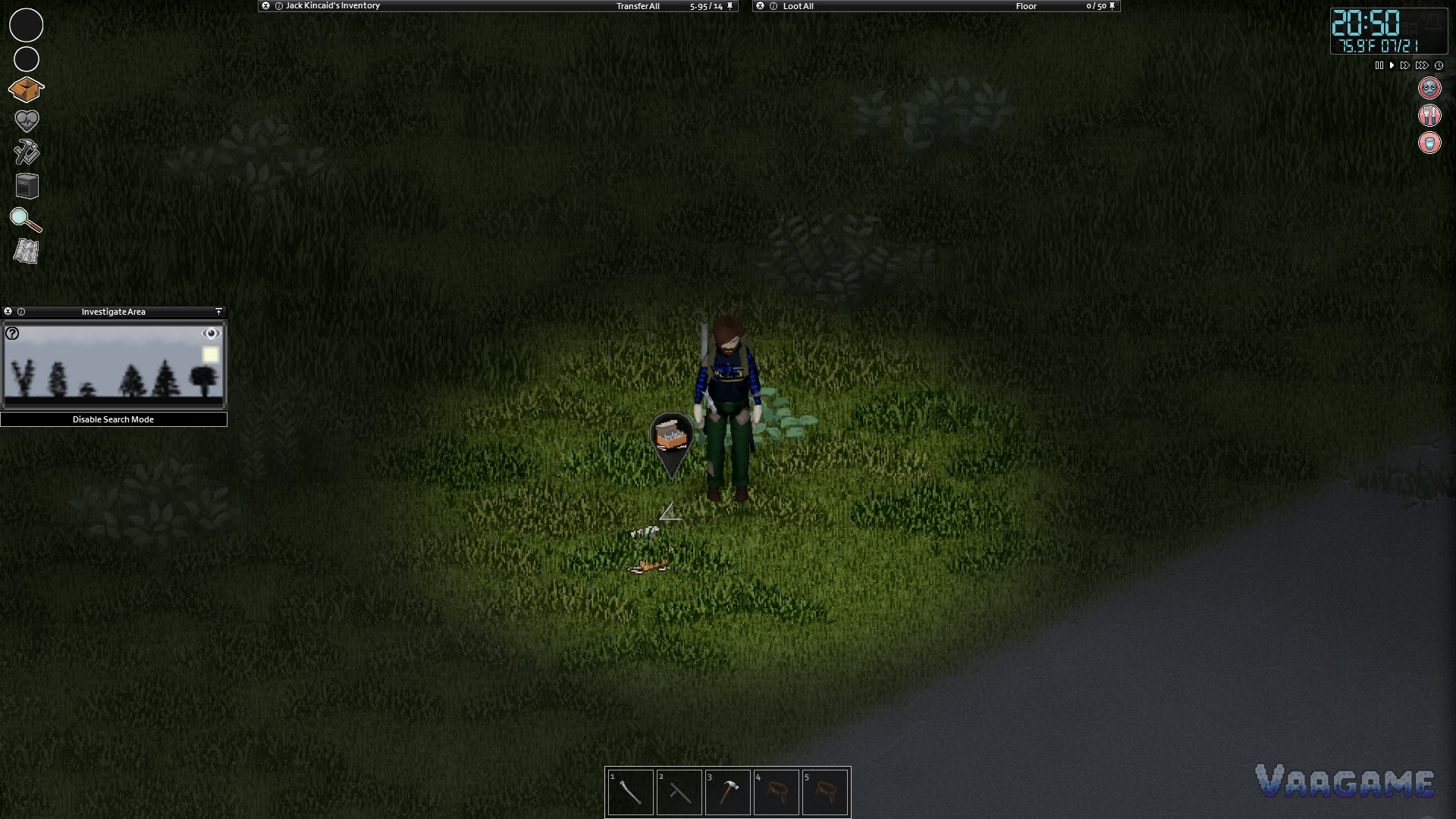
Foraging in Build 42 is no longer the emergency berry button. It feeds the new crafting economy — clay for pottery, flint for knapping, limestone for the forge — on top of food, herbs and bait. Under the hood it changed too: search radius scales from 3 tiles to 10, XP is paid for finding rather than picking up, and every berry rolls its own poison dice.
Quick answer
Turn on Search Mode from the Investigate Area panel; finds appear only on outdoor ground inside your vision radius.
Radius = 3 + 0.7 per level: 3.0 tiles at level 0, 10.0 at level 10, hard cap 15 with bonuses and aiming (×1.33).
Search Focus unlocks per category: Berries/Mushrooms at 3, Insects/Wild Plants/Trash at 4, Animals/Crops at 5, Medicinal Plants at 6, Fruits/Vegetables at 7.
XP is earned when you find an item, not when you pick it up.
Poison rolls per item, not per type. Without Herbalist knowledge you can't tell a safe berry from a lethal one; Black/Blue and Beauty/Winter berries are always safe, Holly always toxic.
At a glance
Swipe horizontally to view all columns.
| Topic | Build 42 facts |
|---|---|
Search radius | 3.0 tiles (L0) → 10.0 tiles (L10), cap 15 with bonuses |
Aim / sneak bonus | ×1.33 aiming, ×1.10 sneaking (higher one applies) |
Vision bonuses | Park Ranger +2, Eagle Eyed +1, Herbalist trait +0.2 |
XP trigger | Finding items (B42 change — not pickup) |
Books | Foraging I–V, XP multipliers ×3 / ×5 / ×8 / ×12 / ×16 |
Radius killers | Darkness, weather, panic, exhaustion, eye-covering clothing |
How Search Mode works
Click the magnifying-glass icon to open the Investigate Area panel and enable Search Mode. The panel names your current zone — Deep Forest, Farm Land, Town Zone — and that zone decides what can appear. The screen darkens outside your vision radius; icons only spawn on valid outdoor floors inside it.
Walk — do not run; movement is one of the penalty multipliers and running is the worst of them. Near a find, an eye icon appears over your character with a direction arrow; stay close and the eye fills until the item reveals itself. Double-click to take it, right-click to discard it where it lies.
Search Focus weights the rolls toward one category — but only one you have already unlocked. Focusing Fruits at Foraging 3 does nothing: the Fruits focus unlocks at level
7. Focus is a bias, not a key.
The radius math (and why old guides are wrong)
Older guides quote a 4 + 0.5 × level formula topping out at 9 tiles — not the Build 42 system. The current formula scales linearly from 3.0 tiles at level 0 to 10.0 at level 10:
Swipe horizontally to view all columns.
| Foraging level | 0 | 2 | 5 | 8 | 10 |
|---|---|---|---|---|---|
Base radius (tiles) | 3.0 | 4.4 | 6.5 | 8.6 | 10.0 |
Vision bonuses raise the floor and ceiling before skill scaling — Park Ranger +2 is the largest, Eagle Eyed +1, the Herbalist trait +0.2 — then aiming multiplies by 1.33 (sneaking ×1.10; only the higher applies), with a hard cap of 15 tiles.
Then penalties take their cut, multiplicatively: darkness, weather, panic, exhaustion, eye-covering clothing. Stacked, they can erase up to ~95% of your radius — why foraging at night, tired, in a storm, feels like the zone is empty. It isn't. You are.
What unlocks when
Each Search Focus category unlocks on its own level — there is no single level-2 "everything" unlock:
Swipe horizontally to view all columns.
| Level | Search Focus unlocks | Notable item gates |
|---|---|---|
0 | Tracks*, Firewood, Stones | Log, Stone, Flint, Clay, Worm |
2 | — | Garden vegetables (Carrots, Potato, Tomato…) |
3 | Berries, Mushrooms | Onion, Slug, Snail |
4 | Insects, Wild Plants & Herbs, Trash | Cherry, Rosehips |
5 | Animals, Crops | Orange, Dead Mouse, Dead Rat |
6 | Medicinal Plants | Lemon, Lime, Jalapeño |
7 | Fruits, Vegetables | Apple, Grapes, Mango, Frog |
8 | Hidden: Rarities, Medical, Ammo, Bones | Grapefruit, Peach, Corn, Wild Eggs |
9–10 | — | Banana (9); Pineapple, Watermelon, Dead Rabbit (10) |
*Tracks is a focus category from level 0, but tracks belong to the new Tracking skill — grinding Foraging won't level it, and track finds are clues, not pickups. Note the level-0 Log: B41-era guides gating logs behind level 3 describe the old game.
Zones: where to walk
Loot rolls with relative weights per zone, not fixed percentages, and zones differ in icon density: Deep Forest, Forest and Organic Forest are richest (roughly 8–10 icons at full stock); Vegetation 6–8; Farm Land 5–7.5; Town and roads 3–5; Trailer Park as thin as 1.5–5.
Berries — deep and ordinary forests carry the heaviest weights.
Mushrooms — Organic Forest first, then Birch Forest; rain, the hours after rain, and night all help.
Fruits and vegetables — Farm Land leads; farmland is also where the Crops focus pays.
Stones, flint and clay — roadsides and stony ground. Flint matters now: knap a Flint Nodule for a Sharp Flint Flake (older guides' Chipped Stone).
Town zones are not empty: urban forage includes trash and, at high focus levels, medical items and even ammunition.
Zones deplete as you pick them and refill over the following days, the pool rerolling when time, weather or month changes. Rotate three or four zones instead of re-searching one stripped copse.
Poison: the per-item roll
The rule that kills taste-testers: poison is rolled for each individual item when it spawns, not once per berry type per world. Two safe berries from a bush prove nothing about the third.
Without Herbalist knowledge, finds display as Unknown Berry / Unknown Mushroom. With it, toxic ones rename to Poisonous Berry / Poisonous Mushroom before you eat them.
Always safe: Black, Blue, Beauty and Winter Berries. Always toxic: Holly Berries.
Generic mushrooms are the dangerous end — the highest poison power in the forage data. Treat every Unknown Mushroom as armed.
Herbalist knowledge comes from the Herbalist trait (4 points; also +0.2 vision, an XP boost and category specialisations) or the Herbalist magazine (Wilderness Survival). The magazine teaches the knowledge and the poultice recipes — Plantain, Comfrey, Wild Garlic, and the other medicinal plants need it — but grants none of the trait's bonuses. Lemon Grass is the exception needing no Herbalist knowledge, and it only treats minor food poisoning.
Levelling Foraging
Because XP pays on finding, the grind is a walking route, not a picking route: sweep fresh ground in daylight, rested and calm, and let the finds come to you — spread-out finds even pay a small bonus over clustered ones.
Read the Foraging skill books (five volumes, two levels each, ×3 to ×16 multipliers); Exposure Survival episodes 5 and 7 add small TV XP boosts (12.5 and 87.5). Worms and insects from your haul feed traps and fishing — see our trapping guide and fishing guide.
FAQ
Why is my search radius tiny even at high level?
Stacked penalties: darkness, weather, exhaustion, panic and eye-covering clothing each multiply your radius down — together, up to ~95% of it. Forage rested, in daylight, eyes uncovered, before blaming the zone.
Is it safe to eat berries if the first two were fine?
No. Poison rolls per item instance. Either know the always-safe types (Black, Blue, Beauty, Winter), or get Herbalist knowledge and read the renamed labels.
Where do I find clay and flint for crafting?
Both sit in the Stones category from level 0 — clay near water, flint along roads and stony ground. Clay feeds pottery; flint feeds knapping and the forge chain.
What changed versus Build 41 foraging?
The radius formula (3 + 0.7 per level, cap 15), XP on finding instead of pickup, per-category focus unlocks, logs from level 0, tracks split into the Tracking skill, and Chipped Stone renamed to Sharp Flint Flake.
Related guides
Trapping: spend your worms and insects well
Pottery: where the clay goes
Hunting & Tracking: the other half of Search Mode
Fishing: the rest of the wild food economy