

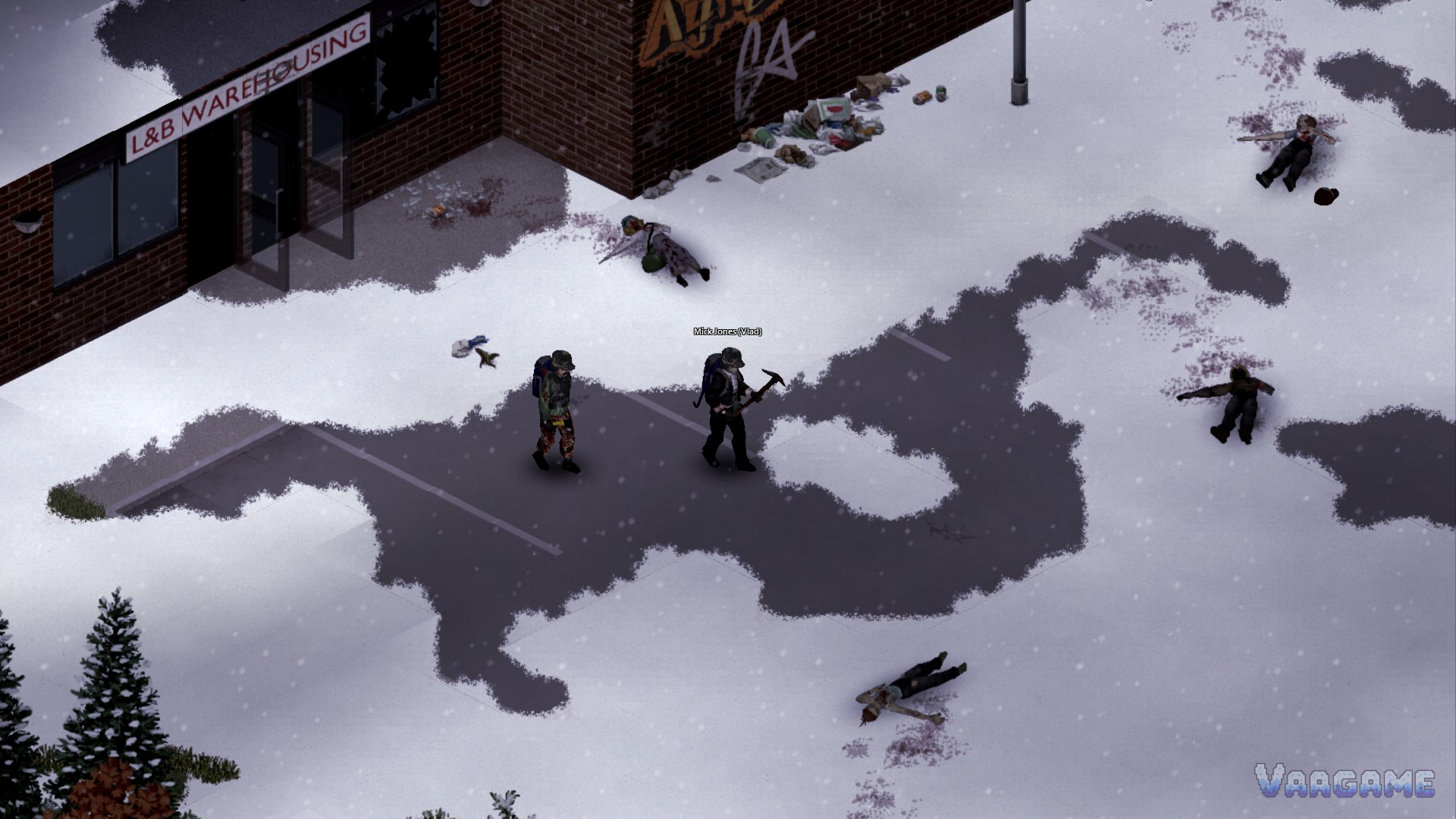
Winter in Build 42 runs from December 1 to the end of February; from the default July 9 start you have roughly five months to get ready. It is a logistics season, not a content lockout: crops don't all die, collectors don't stop, fish still bite — but cold, wetness and wind kill the unprepared faster than any horde, and the famous old rules ("snow doesn't fill barrels", "winter fishing is −20%") are both wrong in this build.
Quick answer
The cold chain is Chilly → Cold → Freezing → Hypothermia; at Hypothermia your movement and attacks are crippled and health slowly drains.
Wet is the fastest way down: wet clothing destroys your insulation. Keep a full dry spare outfit at base.
Snow fills rain collectors at half rate (×0.5) — it does not stop them. The water is tainted; purify before drinking.
No crop can be sown in December or January. Winter food is autumn-sown cold-hardy crops (barley, wheat, rye, flax, garlic) plus stores, traps and fishing.
Vehicle heaters do nothing until engine temperature passes 30 — and burn extra fuel while they run.
At a glance
Swipe horizontally to view all columns.
| Topic | Build 42 facts |
|---|---|
Winter | Dec 1 – end of Feb (default start: July 9) |
Hypothermia | Body temperature band −1.00 to −0.75; health drains |
Windchill steps | 5 / 10 / 15 / 20 °C colder than air temperature |
Snow collectors | Fill at ×0.5 rain rate |
Winter fishing | No calendar penalty — bite chance scales with air temperature |
Heater rule | Engine temperature > 30 before the cabin warms |
The cold chain: how winter actually kills you
Project Zomboid tracks a body-temperature value, and the cold moodles read off it in four steps:
Swipe horizontally to view all columns.
| Moodle | Body temp | Effect |
|---|---|---|
Chilly | −0.25 to 0 | Warning only |
Cold | −0.50 to −0.25 | Movement/attack speed reduced |
Freezing | −0.75 to −0.50 | Movement/attacks severely impaired |
Hypothermia | −1.00 to −0.75 | Critical penalties; health slowly drains |
Three drivers push you down that chain, in practical order:
1. Wetness. Wet fabric accelerates heat loss more than anything else in the system. The Wet moodle escalates at 15 / 40 / 70 / 90 wetness — Soaking or Drenched outdoors in wind, you are on a timer.
2. Wind. Windchill is its own moodle, in °C felt colder than the air: Slight 5°, Uncomfortable 10°, Freezing 15°, Horrific 20° colder. A still −5° day and a windy −5° day are different problems.
3. Cold air and hunger. Ambient cold does the base work, and being Hungry (level 2+) reduces your heat generation.
Recovery: indoors, dry, near heat, rest. The lethal habit is looting "one more house" while already Cold or Freezing. Separately, Has a Cold (Runny Nose → Nasty Cold) builds its own meter — and sneezing makes noise that can pull zombies.
Clothing: insulation and wind resistance
Build 42 clothing carries two cold stats — Insulation (heat kept) and Wind Resistance (windchill ignored) — compared per body part in the Clothing Insulation panel. Prioritise head, torso, hands and feet, and layer: stacked pieces, not one heroic coat.
Two rules matter more than any item list: clothes warm only the character wearing them — never your base, crops or car — and a wet outfit is a broken outfit. Keep a complete dry spare set at base and swap the moment you come in soaked; it is the cheapest survival habit in this guide.
Shelter and heat
Safe indoor heat comes from the map's built-in fixtures: fireplaces and wood stoves. Stock firewood before the multi-day storms, not during them.
The Automated Emergency Broadcast System is your planning tool: a two-day forecast (temperature, wind, fog, precipitation) plus advance warnings of harsh weather, blizzards included. In winter it decides whether tomorrow is a loot day or a firewood day.
Water: the half-rate rule
The persistent myth says snow doesn't fill rain collectors. In the current build it does — at half the rain rate (×0.5), provided the collector is outdoors and has room. Snow-melt is tainted like rainwater: purify it (heat the container) before drinking. Plan storage accordingly — a base that drinks comfortably through autumn rain can run dry in a long cold snap at half earning speed.
Farming: winter is a calendar, not a wall
With Plant Growing Seasons enabled (the Apocalypse default), two rules govern outdoor crops:
Non-cold-hardy plants become cursed in winter — multiplied health/disease pressure — and temperatures at or below ~10 °C damage them further.
Cold-hardy list: Barley, Rye, Wheat, Flax, Garlic, Wild Garlic, Kale, Cabbage, Leek — but Kale (bad months Nov–Jan), Cabbage and Leek (Oct–Jan) still fail in deep winter.
The reliable winter field is sown in autumn: grains in August–October (best September), garlic in July–September (best August), maturing on a roughly 108-day clock. There is no December or January sowing window for anything.
Indoors is no loophole: Kill Inside Crops is also default-on, and indoor plants wither unless houseplants or in a "greenhouse" room — and greenhouses don't change sow months. And budget calories, not just produce: snow travel burns more energy, so winter diets need fats and proteins alongside the cabbage. Full planner: our farming guide; winter protein: trapping.
Fishing in winter: temperature, not the calendar
The "winter fishing −20%" figure in older guides is the Build 41 model. Build 42 has no calendar penalty — bite chance scales with the air temperature where you stand:
Swipe horizontally to view all columns.
| Air temperature | Bite-chance multiplier |
|---|---|
Comfortable range | ×1.0 |
0–15 °C | ×0.75 |
−10–0 °C | ×0.5 |
≤ −10 °C | ×0.25 (reduced, not zero) |
The dawn/dusk windows (04:00–06:00, 18:00–20:00) still pay ×1.2, so a mild December afternoon fishes at triple the rate of a deep-freeze morning: watch the forecast, fish the warm spells. Foraging thins but doesn't vanish either — winter berries fruit in the cold months.
Vehicles in the cold
Heater procedure: working Heater part and fuel, start the engine, wait until engine temperature is above 30, then switch the heater on. Below that threshold it won't usefully warm the cabin — and it draws extra fuel while it runs.
Batteries: the Car Battery Charger restores charge (not condition), empty to full in about 6 game hours; swapping needs a screwdriver, engine off, no Mechanics level for the battery itself. Charge a spare before winter, not during a blizzard.
The autumn checklist (do this in October)
1. Sow the winter field — grains and garlic, on the calendar above.
2. Stack firewood for weeks, not days, at every heated room.
3. Assemble two full outfits — the one you wear and the dry spare.
4. Fill every water container while collectors earn at full rate.
5. Charge the spare car battery; park the winter vehicle under cover, fuelled.
6. Bank calories — canned goods, fats, and a working trapping line.
FAQ
When does winter start and end?
December 1 to the end of February (seasons: spring March–May, summer June–August, autumn September–November). From the default July 9 start, your first winter begins about five months in.
Is outdoor farming impossible in winter?
No — sowing is impossible in December and January, and non-hardy crops are cursed, but autumn-sown hardy grains and garlic grow through winter: they are the intended winter field. What dies is the idea of planting your way out of a January food shortage.
Can I melt snow for water?
No snow-melting mechanic is documented in the current build. Winter water is collectors at half rate, stored water and plumbed fixtures — plan storage in autumn.
Does the "Winter is Coming" −30 °C figure apply to normal winters?
No. Those temperatures belong to the Winter is Coming challenge mode (its "summer" peaks at 0 °C). Default winters are cold and dangerous, but not the challenge's numbers.
Do zombies slow down or thin out in winter?
Winter's documented effects are on you — temperature, wetness, daylight, calories — not on zombie speed or population. Expect the same horde, in worse light, while you move slower.
Related guides
Farming: the full seasonal crop planner
Trapping: winter protein that never closes
Fishing: bite multipliers and the revamped system
Foraging: what the winter forest still offers