

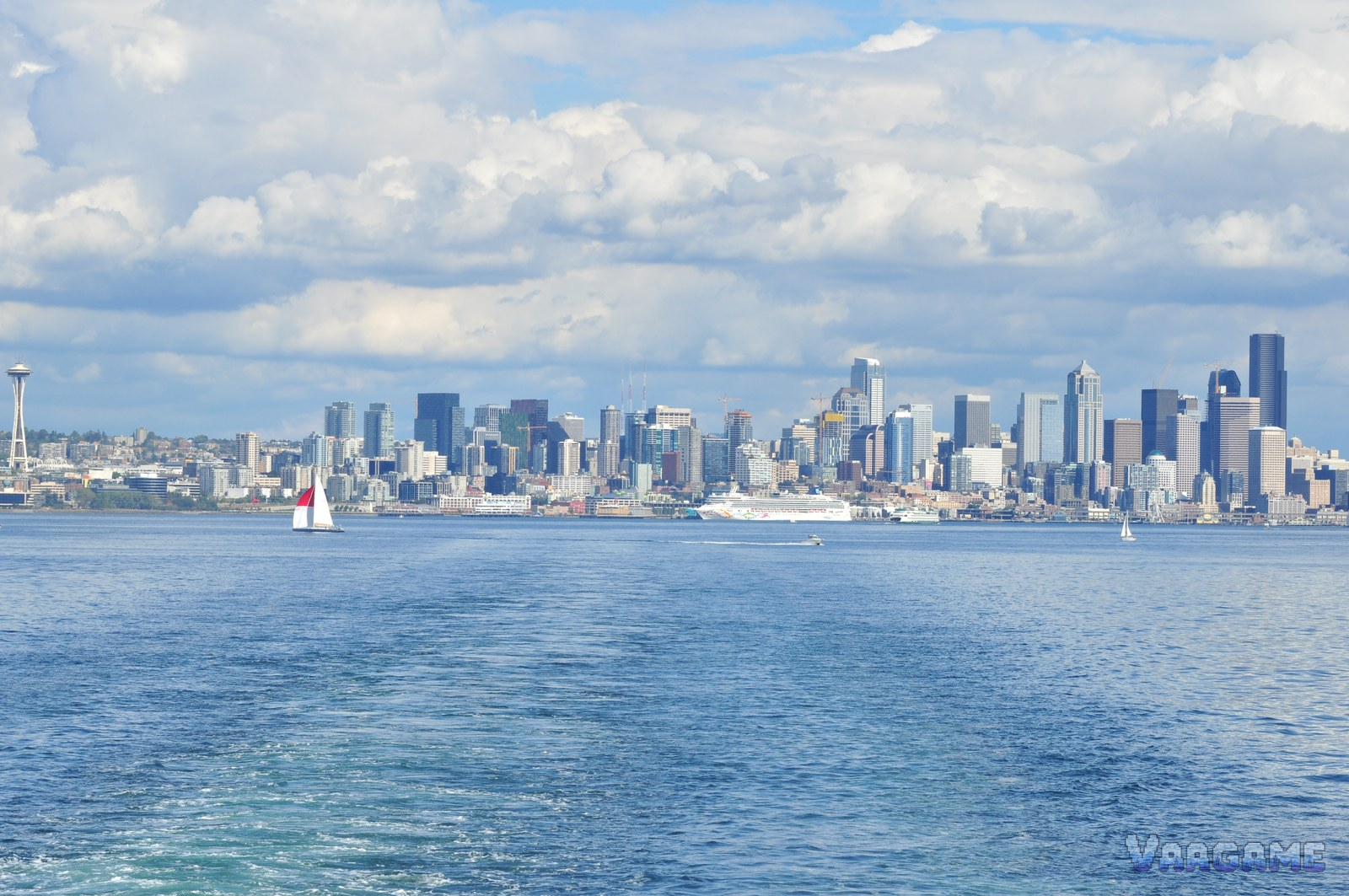
I arrived in Seattle with rain on my jacket and a game in my head that had never let me leave the city alone. I had played Ellie's walk through a ruined Seattle years before, on a couch far from any ocean, and the city had stayed in me the way a song stays after the room goes quiet. The real Seattle met me first with wet pavement and the smell of salt and coffee, and with a skyline across grey water that looked nothing like the game and everything like the reason the game had chosen this place. The tower at the edge of the skyline was still standing. The water was still moving. My backpack was heavier than it needed to be, the way bags get when a person packs for weather and for feelings at the same time, and I had no list to follow, only the game in my head and the streets in front of me. That was the first difference, and it kept repeating all day: in the game, Seattle is a place people fight over because there is so little left; in the real city, the fight has mostly been about keeping things standing.
Brick Over Ashes
In Pioneer Square I stood under an iron pergola and put a hand on cold brick. The brick was the story. Seattle's first city here was mostly wood, and in June of 1889 a fire took several dozen blocks of it in a single day. The city did not mourn the wood for long. It rebuilt in brick and stone, by law, and it raised its streets, burying the old ground floors below the new sidewalks so that the first city now sits underneath the second like a basement nobody quite owns. I thought of Ellie walking a Seattle where every building is also a second city built on a first one: the Wolves took a city the old government had already lost, and the Seraphites tried to live as if the old city had never happened.
Both of them were building on ashes, the way this square was. The difference is that Pioneer Square kept its ashes visible. The brick still shows the decision. The pergola is iron, not wood, because the city learned what burns. Almost the whole district went back up within two years, which is a speed that sounds like panic until a person stands in it and sees that it was also a refusal: the city refused to stay a ruin, and it refused to pretend the fire had not happened, both at once.
A Market That Refused to Close
At Pike Place Market the red sign and the clock were the first things I saw, and the noise was the second. Farmers have sold here since 1907, when the city set the market aside so growers could sell straight to shoppers instead of through middlemen who had pushed prices out of reach. On the first day a handful of farmers sold out to a crowd of thousands. More than sixty years later, when the city wanted to clear the market away for something newer, the people who shopped here voted to keep it, and the market stayed. I bought a paper cup of coffee and stood where the crowd thickens, watching fish slide across ice and bouquets change hands.
In the game, food is something people kill for, or guard, or go without. Here, food is something people hand over, loudly, in public, with jokes attached. The market survives for the same reason it started: somebody has to keep feeding a city, and somebody has to keep showing up to be fed. The game gives Ellie and Dina a theatre to hide in, a dark room with seats and a stage and a door that locks. The market is the opposite kind of shelter, a bright room with no door at all, where safety comes from being seen by a crowd instead of hidden from one.
A Tower Built for Tomorrow
I did not go up the Space Needle. I stood below it with my neck craned and my coffee going cold, looking at a tower that was built to say the future would be fine. It went up for the 1962 World's Fair, when Seattle promised visitors a life in the Space Age, and its shape came from a sketch its chairman made after dinner in a tower restaurant in Stuttgart. Six hundred and five feet of optimism, finished in about four hundred days. The fair is long gone, and the tower stayed, the way optimistic buildings do when the optimism dates faster than the steel. Ellie's Seattle has no fair and no promise.
Its towers are for watching enemies, not horizons. During the fair, people waited hours for the elevators up this tower, and they waited gladly, because the wait itself was part of believing in the view at the top. Standing under the real one, I felt the gap between the two cities most sharply: one city once built a tower to show what tomorrow would look like, and the other, in the game, is what happens when tomorrow stops arriving. Both are Seattle. Neither cancels the other.
The Hill Where People Chose Each Other
Capitol Hill made me climb. The water tower in Volunteer Park is a round brick drum with a spiral stair inside, built around the turn of the last century to hold water piped in from the Cedar River and to give the hill a place to look out from. I climbed slowly, my legs complaining, and at the top the city opened up: the bay on one side, the lake on the other, mountains behind cloud. The park was named for volunteers of the Spanish-American War, and the hill around it later became the place Seattle's gay community and its counterculture made their own, after years of gathering first in Pioneer Square. That history is not a plaque to me; it is the reason the hill feels lived in rather than displayed. Ellie and Dina, Abby and Lev: the game keeps returning to the same small truth, that when big institutions fail, people choose each other, one at a time, and defend that choice.
On the hill, with the wind coming off the water, the choice looked ordinary. Couples walked dogs. Someone tuned a guitar two benches away. Nobody was defending anything, and that was the point. Later I walked past the glass conservatory at the park's far end, warm air and green leaves behind glass on a cold day, and thought about Lev, who left a whole belief system rather than live inside a rule that denied who he was. The hill has room for that kind of leaving, and for staying, both.
A Lighthouse That Does Not Choose Sides
Discovery Park was where I finally stopped trying to match the game to the ground. The trail runs through forest to a bluff above Puget Sound, and at the bottom, on the rocks, stands the West Point Lighthouse, built in 1881, still white, still watching the shipping lane. The land was once Fort Lawton, an army post that spent most of a century facing outward toward the water, and in 1973 the city took it back and made it a park, named for the ship that first charted this sound. I sat on driftwood and watched the tide come in over stones that had been smoothed long before any fort, any game, any of my ideas about this place. Ellie leaves Seattle in the end, and Abby leaves too, and both of them leave because staying would mean one more death.
The lighthouse does not leave. It does not choose sides. It just keeps its light on the water where boats still pass, and I understood, sitting there with wet shoes, that leaving is also a way of keeping something. The park's other story stayed with me on the walk back through the trees: the tribes who had claimed this surplus land for a cultural center of their own, and who got part of it, not all of it, and built there anyway. Two truths again, unreconciled, sharing one bluff.
Coffee, the Ordinary Thing
The coffee came back into my hands all day, the way it does in Seattle. The first Starbucks opened in 1971 a block from the market, in a shop that sold beans and tea and spices and no drinks at all, and when its building was torn down a few years later the store moved up the street to the address tourists queue for now. The famous first store is really the second store, and the city does not seem to mind the correction. I liked that. Seattle keeps its myths the way it keeps its markets: used, argued over, still standing. The first store opened in the middle of the Boeing recession, when a billboard outside town famously asked the last person leaving Seattle to turn out the lights, and still three young men decided the city needed better beans.
That is a small, stubborn kind of optimism, closer to the market's than to the fair's. In the game, a hot drink would be a luxury, maybe a risk, something to be boiled over a fire and guarded. Here it is the most ordinary thing in the city, bought without thinking, carried in one hand while the other hand holds a railing, a map, a friend's sleeve. The ordinary is what the game is mourning. I drank it slowly on the walk back, and the cup warmed my hands the way Ellie's world never lets a cup stay warm for long.
Next time, come back dressed like this
Next time, come back dressed like this. I would come back in a denim jacket with the collar turned up against the rain, sturdy boots that do not mind wet stone, and something small and quiet: a moth pin, maybe, for the moth on Ellie's arm, the one that covers the bite scar and says, without words, that a person can be marked and still be a person. There are no purchase links here. I checked, and I could not confirm a reliably in-stock, verifiable listing for the thing I actually wanted, so there is nothing to buy from this page, and I would rather say that plainly than dress up a guess as a recommendation.
No replica weapons, either: the game is full of them, but houses and museums have their own rules, and their rules come first wherever they apply. The jacket and the boots are enough. The rest is walking. A pin on a lapel survives rain better than a costume does, and it does not ask anyone else to play along.
I left Seattle the way I came in, across water, with the skyline getting smaller and the rain starting again. The city did not resolve anything for me. The game did not either, and that felt honest. Ellie is still walking somewhere in my head, and Abby too, and the real city is still here, feeding people, keeping its brick, letting its towers stand.
I did not finish matching them, and I did not need to. The last thing I saw was the needle above the rooftops, thin against the cloud, and then the water took the rest. Somewhere behind me there were streets I had not walked and rooms I had not entered, and they will still be there, which is a different feeling from the game's, where every unopened door might be the last one.