

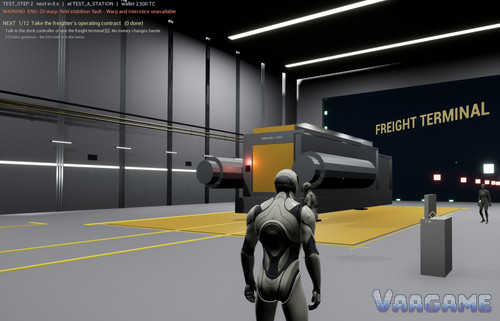
On longer test routes in Second Distance, a hitch arrived roughly once a minute, regular enough to feel like a timer. Interstice Foundry describes it in Devlog 002, dated October 29, 2026, and the devlog is unusually honest about the path to the fix: the first suspect was timed shader-cache eviction, but disabling that cycle caused a memory leak, so the change was withdrawn. The delivered fix instead changed HUD line rendering and restored the engine default. The final report records zero frames over 33 ms during a 32.6-minute endurance run on the same development PC. That is one build on one machine, not a general verdict; other-hardware testing is still needed. Disclosure, stated plainly at the top because the devlog states it: Second Distance is an AI-assisted production, with creative direction, review and final decisions staying with the author.
At a glance
The source: Interstice Foundry Devlog 002 for Second Distance, dated October 29, 2026, on itch.io. Every fact about the game below comes from that devlog, and no engine is named in it, so this article names none.
Disclosure, as the devlog itself states it: Second Distance remains an AI-assisted production, with creative direction, review and final decisions staying with the author. The devlog also says there is no public build being announced, and the environments, economy values and presentation are still prototype material.
The symptom and the withdrawn fix: a noticeable hitch roughly once a minute on longer test routes. Early tracing suggested timed shader-cache eviction, but disabling that cycle caused a memory leak and the change was withdrawn. The delivered fix changed HUD line rendering and restored the engine default.
The measured result, with its limits stated: zero frames over 33 ms during a 32.6-minute endurance run on the same development PC. That is a measured result for one build and one machine; the devlog says it still needs hands-on review and testing on other hardware.
What is NOT claimed here: the devlog does not name an engine, does not present a public build, and does not present the newer holographic radar as a packaged playtest result; the radar work is described as still in development validation.
Last verified: November 3, 2026.
A hitch that kept time was the clue, not the noise
Regularity is what makes this hitch interesting, and it is also what makes it easy to misread. A hitch roughly once a minute on longer test routes does not look like a single heavy asset or a one-off spike; it looks like something on a cycle, and the devlog says the team first followed that reading. The same devlog pass was also building the sense of occupying the ship rather than floating a camera through rooms: visible legs, hands and a shadow in first person, an over-the-shoulder third-person view, distinct presentations for walking, running, sitting and standing, and footsteps tied more closely to movement. The cockpit was rebuilt around the seated eye position, with working switches, hands on the controls and a clearer flight HUD, and a newer checkpoint adds a holographic radar that separates stations, vessels, rocks and planets by shape, with basic targeting and navigation controls. None of that context proves anything about the hitch. It matters because it shows what was changing around the hitch while the hitch was being chased, and because scale is exactly what a body is meant to make readable: a hangar, a cockpit seat and the machinery around the player should feel sized by the body standing in them.
The honest middle of this case is the fix that did not ship. Early tracing suggested timed shader-cache eviction, which fits the once-a-minute shape well enough to be tempting: a periodic cleanup, a periodic hitch, a neat story. But disabling that cycle caused a memory leak, and the change was withdrawn. That sentence deserves more attention than it usually gets, because it is the difference between a team that found a suspect and a team that checked what removing the suspect would cost. A leak is not a quieter hitch. It is a cost that grows while the game runs, and accepting it would have traded a visible, regular problem for a slower, less visible one. The delivered fix went in a different direction instead: it changed HUD line rendering and restored the engine default. The devlog does not spell out a deeper mechanism for the HUD change beyond that description, so this article does not invent one, and it does not present the HUD change as proven root cause in any stronger sense than the devlog does. What the devlog reports is the change, the withdrawal of the earlier change, and the endurance result that followed.
Withdraw the trade, restore the default, then prove it on a long run
The proof offered is narrow, and the devlog says so itself rather than leaving the reader to discover it. The final report records zero frames over 33 ms during a 32.6-minute endurance run on the same development PC. Read that sentence the way it is written: same machine, one build, one long run, and a frame-time threshold of 33 ms. It is a real measurement, and a 32.6-minute run is long enough to have caught a roughly once-a-minute hitch many times over if the hitch were still happening at its old rate on that machine. It is not a claim about other hardware, other drivers, or other routes, and the devlog explicitly says the result still needs hands-on review and testing on other hardware. The immediate priorities it lists point the same way: package and review the newer cockpit changes, continue measuring performance, and judge the body, radar and flight controls through hands-on play. A clean endurance number is a checkpoint on that road, not the end of it.
Scope discipline is the other half of this devlog. Second Distance has no public build being announced in this post, and the devlog separates what has been attempted, what is working in the prototype, and what still needs proving. The environments, economy values and presentation are still prototype material. The holographic radar is still in development validation rather than a packaged playtest result, even though its design intent is stated plainly: the player should be able to read nearby space from inside the ship without the cockpit becoming a decorative overlay. The AI-assisted disclosure belongs in the same discipline. The devlog states that creative direction, review and final decisions stay with the author, and this article repeats that statement rather than softening it or using it as a judgement on the work. Readers can then weigh a prototype result for what it is: a developer's own report on their own machine, with the limits printed next to the number.
What to reuse
Nothing below is presented as what Interstice Foundry did beyond the steps already described; the checklist generalises those steps for your own project. The reusable idea is a sequence, not a single trick: notice the period first, then test one suspect at a time, then check what the test itself costs. A periodic hitch invites a periodic suspect, but a suspect that only looks right is not a fix, and a fix that introduces a growing cost is a trade, not a solution. Restoring a default is also a legitimate fix, not an admission of defeat: a custom cycle that has to be defended against leaks may be worth less than the default it replaced. And a long run on one machine is the beginning of proof, not proof itself. The run has to be long enough to have caught the old hitch repeatedly, it has to be repeated on the same machine to show it was not a lucky run, and then it has to survive other hardware before anyone calls the hitch fixed.
What to do Monday morning
In your own project, log frame times over a long session on a fixed route, and look for a period before you name a suspect, so a regular hitch is separated from random spikes.
In your own project, test one suspect at a time, and measure the side effect of the test itself, especially memory growth over time, before you call any change an improvement.
In your own project, withdraw a change that trades one problem for a growing cost, even if the original symptom disappears, and record the withdrawal so the suspect is not tried again blindly.
In your own project, consider restoring the engine default before adding a more elaborate custom cycle, and keep the default as the comparison point for any later custom work.
In your own project, re-run the same long route on the same machine after the fix, long enough that the old hitch would have recurred many times, and repeat the run before you trust a single clean result.
In your own project, broaden the test to other hardware only after the same-machine result repeats, and keep the one-machine result labelled as such until the broader test exists.