

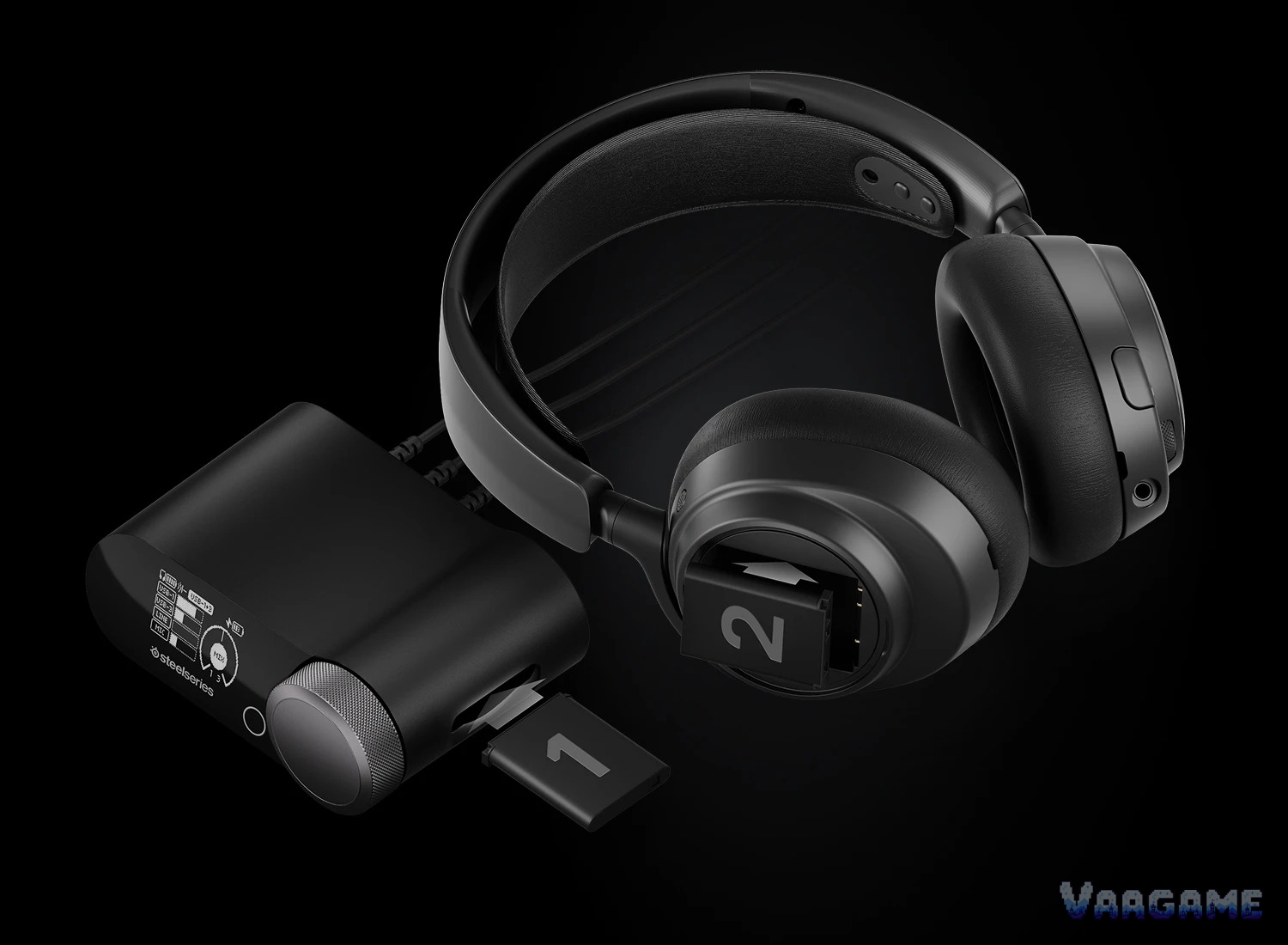
SteelSeries spent years selling you a different Nova Pro for each console. The Arctis Nova Pro Omni, launched in May 2026, ends that: one SKU is meant to cover PC, PlayStation, Xbox, Nintendo Switch, and mobile, with a base station that mixes up to four audio sources at once and a battery system designed so you never wait for a recharge. Reviewers broadly agree the sound and the hub live up to that pitch. They disagree about how much the weight, the plastic frame, and the flagship price tier should bother you. This is a reputation review, not a hands-on test by Vaagame: what follows is what independent reviewers and the manufacturer's own specifications actually say, including where they disagree.
At a glance
What it is: a wireless over-ear gaming headset with a GameHub base station, succeeding the Arctis Nova Pro Wireless as SteelSeries' multi-platform flagship.
The headline idea: OmniPlay. One headset, no console-specific version: connect PC, PlayStation, and Xbox through the GameHub and mix up to four sources at once.
The battery idea: two hot-swappable batteries, one charging in the GameHub while the other powers the headset. Manufacturer ratings are 30 hours per battery over 2.4GHz with ANC off, 50 hours over Bluetooth with ANC off, and 19 hours per battery with 2.4GHz, Bluetooth, and ANC all on.
Sound: custom 40 mm neodymium drivers, Hi-Res Wireless certified at 96kHz and 24-bit. SteelSeries' own FAQ notes PlayStation 5 and Xbox show 48kHz and 24-bit, the maximum those systems currently support.
Weight: 339 g for the headset and 169 g for the GameHub. This is not a light headset, and reviewers treat comfort, not weight alone, as the deciding factor.
No price is quoted in this review: no ASIN-level tracker price was verified on 2026-11-04, so no affiliate link is included either. Check the exact variant before buying.
What Omni actually changes
The old Nova Pro line forced a choice at checkout: a PC and PlayStation version, or an Xbox version. The Omni removes that choice. Its GameHub has three USB-C inputs, a line-in, and a line-out for speakers, plus Bluetooth, and SteelSeries defines OmniPlay mixing as USB1 plus USB2 or USB3, plus Bluetooth, plus line-in. The rear panel labels the third USB port USB3/Xbox, and the official FAQ adds two setup details buyers should know: for the best Sonar compatibility, connect a PC to USB-1, and for Xbox, use only USB-3 in Xbox mode. That is genuinely simpler than buying the wrong console version, but it is not plug-and-play magic: a three-console desk still needs you to pick the right port and mode.
Sound: the least disputed part
On sound, the reviewers line up. TweakTown scores the headset 91 percent and praises rich, detailed sound with a warm, balanced tuning on the custom 40 mm drivers, calling it a small but notable step up from the 2022 Nova Pro. WCCFTech calls the Omni a refined take on the one-headset-for-everything concept, with improved connectivity and a more capable GameHub. SlashGear goes furthest, calling it the best-sounding headset its reviewer had experienced, while Stuff offers the useful counterweight: dropping the Elite model's costly carbon drivers means the Omni is not quite the crossover king its bigger brother was, with audio that lacks some bite and outright fidelity of the best music-first headphones, but the gap is smaller than the price gulf would suggest. Read together, that is a consistent picture: excellent for games, very good for music, not the outright audiophile pick in the family.
Battery: the headline numbers need their conditions
SteelSeries' headline battery figures only make sense with their conditions attached, and reviewers' real-world numbers show why. The manufacturer rating is up to 30 hours per battery over 2.4GHz with ANC off, up to 50 hours over Bluetooth with ANC off, and 19 hours per battery with 2.4GHz, Bluetooth, and ANC all on, with a 15-minute USB-C fast charge giving up to 4 hours of play. TweakTown reports around 20 hours when using both 2.4GHz and Bluetooth, and around 100 hours of Bluetooth playback across two batteries. PCMasters, testing with medium noise suppression and two audio sources at once, got about 13 to 14 hours before a swap, and still awarded 85 percent, noting a swap takes under 20 seconds. These are not contradictions: they are different loads. The honest summary is that the second battery, always charging in the GameHub, matters more than any single-hour figure, because a swap, not a recharge, is what ends the wait.
Comfort, microphone, and software
Comfort is where the 339 g weight stops being a simple objection. TweakTown calls the comfort luxurious, crediting weight distribution, minimal pressure, and soft faux-leather cushions, and says the ski-band headband design is hard to fault, though adjusting it is less smooth than on the Elite, which used metal rather than plastic. PCMasters likewise praises wearing comfort over long sessions and positional awareness for competitive play, while noting the build leans on plastic. The microphone is the retractable ClearCast Pro with AI noise rejection, rated 50 to 16,000 Hz. Software runs through SteelSeries GG on desktop, Sonar for chat mix and EQ, and a mobile app; TweakTown points to hundreds of curated presets, and the GameHub itself carries an OLED display and control wheel for volume, EQ, and source switching without opening software.
The honest objections
The objections are specific, not vague. TweakTown lists only two USB cables in the box against three USB inputs, a GameHub prone to fingerprints, and no optional portable 2.4GHz dongle, which means travel use leans on Bluetooth once you leave the desk. SlashGear reports one incident in which the headset refused to talk to its gaming PC until a driver update arrived the next day; that is a single incident, not evidence of a pattern, but it is worth knowing before a tournament night. Stuff's verdict is the sharpest buying advice in the roundup: most gamers wanting a do-it-all headset would be better off skipping the Elite for this one, which also means buyers who only play on one system are paying for a hub they may never fill. And one sample gap must be stated plainly: this review quotes no single verified owner-rating count, because retailer listings for this model disagree with each other and no Amazon US rating count was verified from the listing itself, so no merged figure is presented as fact.
Review scores and sample record, kept separate
Expert score, TweakTown review: 91 percent. A single outlet's score, not an average and not a user sample.
Expert score, PCMasters review: 85 percent, including a measured 30 hours and 12 minutes over 2.4GHz in that outlet's own test. A single outlet's score and test, not a pooled figure.
Expert verdicts, qualitative only: WCCFTech (refined one-headset-for-everything take), Stuff (recommend skipping the Elite for most do-it-all buyers), SlashGear (best-sounding headset its reviewer had experienced). No numbers are attached to these verdicts.
Owner-rating samples: NONE quoted. Retailer listing counts for this model conflict across listings, and the Amazon US rating count for ASIN B0GS7PZH2P was not verified from the listing itself. No figure from any aggregator is substituted, and no counts are added together.
What was NOT used: manufacturer list figures and retailer deal reports are not presented as tracker prices, and no hands-on testing, review sample, or first-person experience is claimed by Vaagame anywhere in this article.
Related on Vaagame
SteelSeries Arctis Nova 5 Wireless Reputation Review 2026: The Multi-System Headset That Earns Its Presets (slug: steelseries-arctis-nova-5-wireless-review-2026)
Best Gaming Headsets Under 100 (2026) (slug: best-gaming-headsets-under-100-2026)