

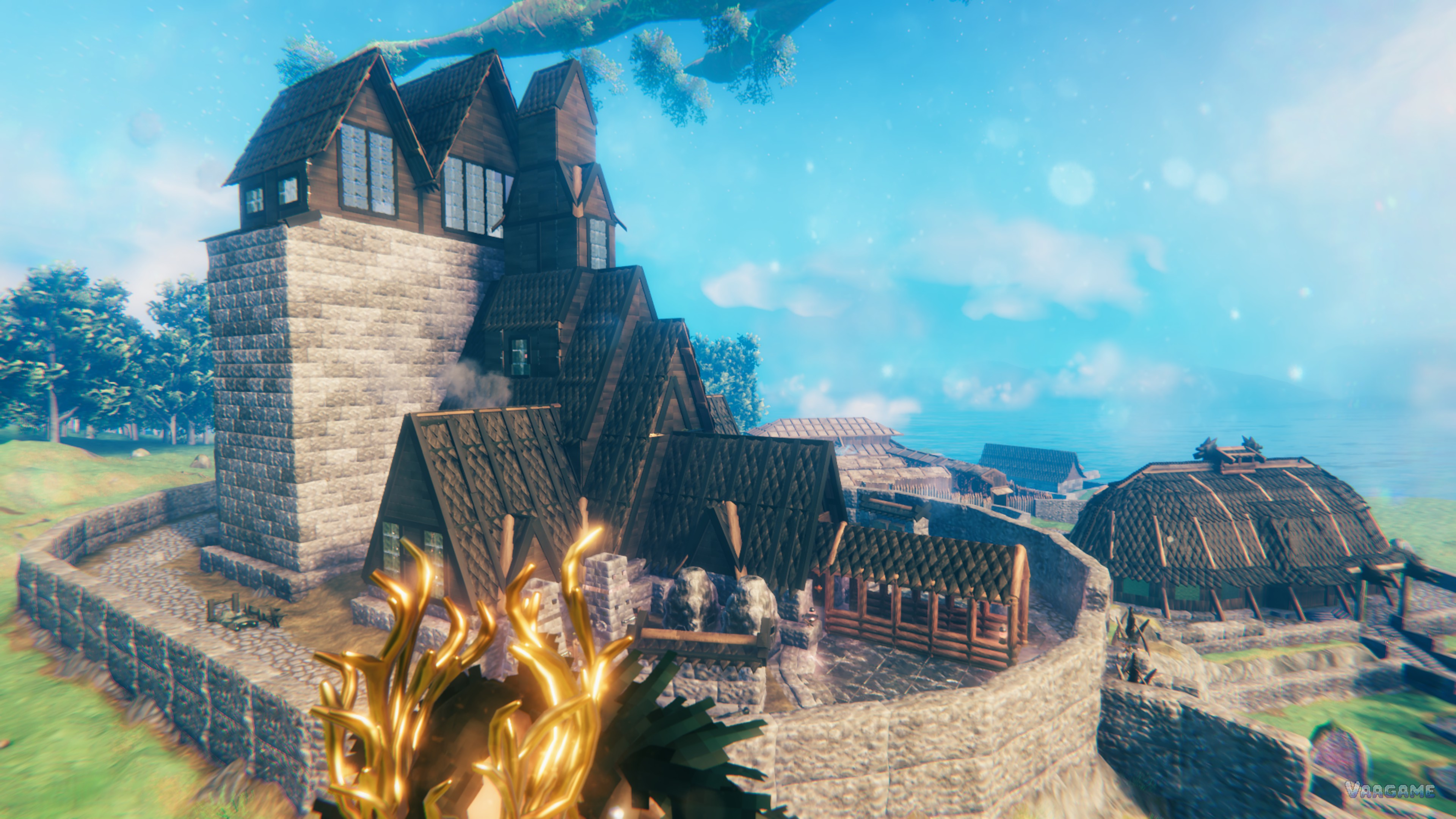
Every Valheim builder hits the same wall: a roof that looks finished, one more piece placed, and half the building on the ground. The cause is almost never bad luck. It is the stability system, a set of rules about support, materials, and distance from the ground that decides what stands and what falls. Learn those rules once, and you stop rebuilding and start planning towers, halls, and harbors that survive.
How stability actually works
Think of support as water pressure flowing up from the ground through connected pieces. A piece sitting directly on the ground, a rock, or a raised earth wall has full support. Every step away from the ground, the support drops, and every material drops it at a different rate. The hammer shows the result as a color when you aim at a piece: blue is grounded, green and yellow are solid, orange is at the limit, and red is about to fail. A piece built onto a red piece will usually collapse, so red is not a warning to ignore, it is a stop sign.
Swipe horizontally to view all columns.
| Material | Max support | Breaks at or below | Vertical loss per step | Horizontal loss per step |
|---|---|---|---|---|
Wood | 100 | 10 | 1/8 | 1/5 |
Core wood | 140 | 10 | 1/10 | 1/6 |
Stone | 1000 | 100 | 1/8 | 1/1, all of it |
Iron-reinforced wood | 1500 | 20 | 1/13 | 1/13 |
Black marble | 1500 | 100 | 1/8 | 1/2 |
Grausten ashstone | 2000 | 100 | 1/10 | 1/3 |
Read that table as build advice, not trivia. Stone looks like the strongest material, and for height it is, but its horizontal loss is total: a stone floor pushed sideways over open air loses everything in one step, which is why stone balconies and stone bridges over gaps fail so dramatically. Iron-reinforced beams lose almost nothing in either direction, which is why they are the answer to every long span and tall tower in the late game. Core wood is the early game hero: cheap, tall, and much better than plain wood for pillars.
The five rules that keep buildings up
Ground everything first. Level the site with the hoe and raise earth under the footprint so the whole ground floor reads blue before you build up.
Take the shortest vertical path to the ground. A tall build survives on pillars and walls that run straight down, not on floors that wander sideways first.
Support every few pieces. If the hammer color is sliding toward orange, add a pillar or a wall now, while the fix is cheap, not after the roof is on.
Never trust a single chain. One pillar holding one roof is one troll hit from a rebuild. Double up the load paths on anything you cannot afford to lose.
Check color before committing expensive pieces. Aim the hammer, read the color, and only then place the iron beam or the stone block you spent an evening mining.
Roofs, rain, and smoke: the three quiet killers
A piece under a roof does not decay from rain, and a player under a roof does not get wet. A workbench without a roof over it does not work at all. Unroofed wooden and iron-reinforced pieces lose 5 percent of their health per minute of rain, down to 50 percent, while stone, marble, and dark wood or ashwood pieces mostly shrug rain off. Shelter is checked point by point, so one hole in the roof is enough for the piece below it to start getting wet. When a roof leaks, the fix is the hole, not more walls.
Smoke is the second quiet killer. A hearth, campfire, or heated hot tub produces smoke that damages you and can smother the fire if it has nowhere to go. Give smoke a clear route upward with a vented opening near the roof, while keeping rain off the flames. The classic solution is a chimney with a small roof cap above it: smoke out, rain kept off, fire stays lit, and the comfort bonuses from the fire keep counting.
Building big: towers, halls, and harbors
Large builds fail in planning, not in placing. Decide the footprint on raised ground, run the vertical supports first, and only then fill in floors and decoration. A stone ground floor with timber above is the most forgiving large pattern in the game: stone gives you height and defense, timber gives you cheap upper floors and roofs, and iron beams rescue any span that stone cannot cross. For a tower, keep the footprint small, keep the core walls continuous all the way down, and step the upper floors inward so each level sits on the one below instead of cantilevering off it.
Open frames and domes deserve a warning of their own. They look light, but every beam in an open frame still needs a support path to the ground, and a wide roof with no intermediate pillars will sag into orange and red long before it looks finished. If you want a grand open interior, hide the structure: run iron beams inside the walls, or drop a central pillar and dress it as a hearth column, a trophy post, or a stairwell. The room reads as open, the numbers stay honest.
Defense: build the raid out of your base
Defense in Valheim is mostly site selection plus walls. A base on raised ground behind a ditch or water is worth more than a base with twice the walls on flat land, because most raiders have to path through the obstacle before they ever touch your work. Earth walls raised with the hoe are cheap, immune to the usual early-game damage in a way fences are not, and double as the grounded foundation your buildings want anyway. Keep animal pens and farms inside the perimeter, keep the main gate away from the crafting hall, and give yourself a repair route: a wall you cannot reach to repair is a wall that falls.
Two layout decisions save more bases than any wall material. First, ores and metal bars cannot travel through portals, so smelting and smithing want to live near where the group actually works, with carts and ships doing the hauling, not a portal network that cannot carry the load. Second, a workbench suppresses enemy spawns around it, so overlapping workbench coverage across the base is free defense: place benches to cover pens, farms, and gates, not just the crafting corner.
Comfort: the buff that pays for the furniture
Comfort controls one thing: how long the Rested bonus lasts after you rest. The bonus itself never gets stronger with more comfort. It gives faster health regeneration, faster stamina regeneration, faster Eitr regeneration, and faster skill experience gain, and comfort only stretches the timer. The formula is simple: Rested duration equals 7 minutes plus your comfort level, so comfort 10 gives 17 minutes. Spend roughly 20 uninterrupted seconds near a lit fire inside a shelter to gain it, or sleep in a bed to apply it at once.
The rule most players miss is the category rule: every furniture piece belongs to a category, and only the single highest-value item in each category counts toward comfort. Five chairs add nothing beyond one chair, and three rugs count as one rug bonus. Furnishing for comfort is a checklist, not a numbers game: one strong item from each distinct category, all within 10 meters of where you rest, with fire sources lit and the hot tub heated if you use one. When your comfort number looks lower than expected, something is out of range or unlit, and that is the whole diagnosis.
Mistakes that cost an evening
Building a stone floor sideways over open air. Stone horizontal loss is total, so it falls in one step.
Roofing last. Rain decay and workbench rules punish an unroofed base the whole time you are still building it.
Forgetting the smoke vent. A sealed hall smothers its own hearth and eats the comfort bonus with it.
One pillar, one roof. Give anything valuable a second load path before the first raid tests it.
Decorating before supporting. Trophies and banners are cheap to replace; the iron beam under them is not.
Building the farm outside the walls. Raiders eat crops and livestock first, because they are outside.
Build in this order and the system stops fighting you: site and raised ground, vertical supports, roof, walls, and only then decoration and comfort furniture. The builders whose bases survive are not the ones with the most materials. They are the ones who read the hammer color before they place the piece.