

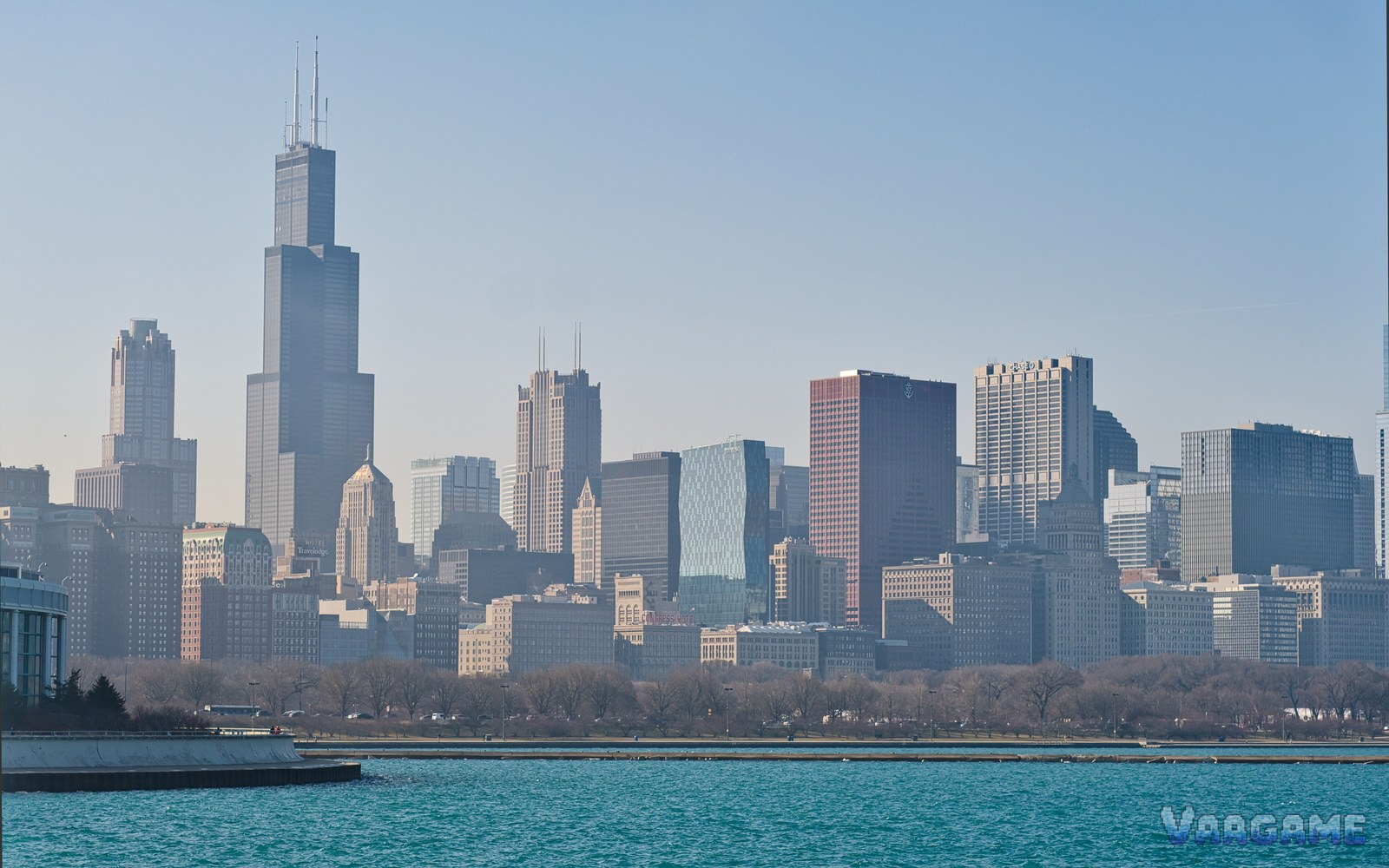
I came into Chicago off the lake, with wind in my coat and a game in my head that had never quite left the city alone. I had played Aiden Pearce's Chicago years before, on a couch far from any lake, a city where a phone could open traffic lights and trains and strangers' lives, and the idea had stayed in me the way an argument stays after the room goes quiet. The real city met me first with cold air off Lake Michigan and a skyline that looked almost like the game's and not quite like it, which was the whole point. One tall tower stood above the rest, dark and stepped, the way a tower stands when it has stopped trying to be the tallest and settled for being itself. My phone stayed in my pocket. Nobody here was a profile to open. I had no list to follow, only the game in my head and the streets in front of me, and that was the first difference, repeated all day: in the game, Chicago is a system to be hacked because one system runs everything; in the real city, the systems are older, messier, and mostly built by people who were trying to keep a city alive, not to own it.
The Tower That Stayed
The Water Tower stopped me because it looks like a castle that wandered into the wrong century. It is limestone, pale and turreted, built in 1869 to hold a tall standpipe for the pumping station across the street, and it stands in the middle of Michigan Avenue traffic as if the avenue had agreed to walk around it. In October of 1871, fire took the city around it. The fire began on the night of October 8 and burned until the morning of October 10, destroying more than seventeen thousand buildings across about three square miles, killing around three hundred people and leaving about a hundred thousand homeless. The tower's roof caught fire and its pumps stopped, so on the night the city needed water most, the water tower could not give it any.
And the stone stayed. That is the whole story in one building: it failed at its job and survived anyway, and the city kept it for the second reason rather than the first. Aiden's Chicago is also a city of systems that fail the people they were built for. The difference is that nobody in the real city gets to reboot the tower. It stands there, patched and useless and loved, because a city sometimes keeps the thing that broke as a way of remembering what breaking cost.
A River Turned Around
At the river I stood by a bridge and watched the water go the wrong way, or what used to be the wrong way. The Chicago River once ran into Lake Michigan, and the lake was the city's drinking water, so the city's sewage ran straight toward its own throat. In 1900 the city finished a canal and turned the river around, sending its water west through the Des Plaines and Illinois rivers toward the Mississippi, away from the lake. It was an audacious piece of engineering, and it worked, in the sense that the lake was protected. It also worked by moving the problem downstream, which is a sentence the city still has to live with.
I liked the honesty of that, standing there with bridge lamps coming on over the water. Aiden spends his game redirecting flows too, stopping traffic, opening bridges, sending boats and trains where he wants them, as if a city were a set of taps. The real river was redirected once, by workers with shovels and a canal, and it has stayed redirected ever since, which is a slower and stranger kind of power. The water below me was dark and ordinary, carrying tour boats and reflections, and it did not care who had last given it orders.
The Train Overhead
The L came over my head before I saw it, a rumble on steel that rattled the windows of the shops below. The first elevated train ran in 1892, pulled by a small steam locomotive, and by 1897 the downtown Loop was complete, a rectangle of riveted steel hung over the streets so that the city's lines could finally meet in the middle. The CTA took it all over in 1947, and the trains have been running above the sidewalks ever since, the only downtown elevated system left in an American city. I stood under the tracks and watched a train pull in, doors opening, people getting on with bags and coffee and tired faces, and nobody in the car was a line of data.
In the game, a train is something a phone can summon or stop. Here, a train is something a person waits for, misses, catches by running, and the difference is not technical at all. It is the difference between a city as a machine with a single switch and a city as a crowd of separate lives that happen to be going the same way for a few stops.
A Pavilion Made of Air
Millennium Park began for me under a roof that is not a roof. The Pritzker Pavilion's trellis is a web of steel arcs hung over the lawn, holding speakers and air, and standing under it felt like standing inside a drawing of a building that had decided not to have walls. The park itself was built over rail yards and parking lots and opened in 2004, a piece of ground the city decided to give back to itself. In the game, the same park has the same trellis, the same lawn, the same bandshell shape curving at the far end, and a woman standing on the grass taking a photograph of it, which is exactly what people do in the real park too.
I did not need the game to tell me the park was a good place. I needed the game to make me notice how strange it is that a city builds a roof with no walls and then fills the space underneath it with people who are not buying anything, not going anywhere, just sitting on grass under steel. That is a kind of system too, but it runs on nothing a phone can hack: shade, sound, and a lawn.
Faces Without Names
A short walk away, the Bean bent the whole city out of shape. Cloud Gate is a sculpture by Anish Kapoor, built between 2004 and 2006 from a hundred and sixty-eight stainless steel plates welded into a seamless skin, thirty-three feet high and sixty-six feet long, a hundred and ten tons of mirror. I walked under its arch and found two strangers touching their own reflections, phones in their hands, laughing at the stretched versions of themselves. In the game, pointing a phone at a stranger returns a life: a name, a job, a bank balance, a secret.
The real mirror returns only a face, bent and nameless, and gives nothing back that could be used. Nearby, the Crown Fountain's two glass towers show the faces of a thousand Chicagoans, one after another, with water spilling from their mouths when the fountains run. A thousand faces, and not one of them comes with a file attached. That felt like the park's quiet argument with the game: a city can look at its people without keeping them.
Looking Up at Willis
I did not go up the Willis Tower. I stood at its foot with my neck craned, the way people do, and let the building do what it was built to do, which is to make a person feel small in a good way. It was finished in 1973 as the Sears Tower, a hundred and eight stories and fourteen hundred and fifty-one feet of bundled tubes, the tallest building in the world until 1998, and in 2009 its name changed to Willis Tower, though the old name still slips out of people's mouths. The tower in the game stands in the same skyline, taller and cleaner than the real one, the way game cities always are.
The real tower has flags at its base, a soot-coloured sky behind it, and windows that catch the light one tube at a time. Aiden looks at towers the way a hacker looks at a network, from above, for weak points. Standing below the real one, I looked at it the way a pedestrian does, from underneath, for weather. Both views are true, and neither one owns the building.
A Pizza That Argues With Itself
The pizza arrived in a black pan, still in the pan, with a slice already gone and cheese pulling where the slice had been. Deep-dish is a Chicago argument served hot: a thick crust with its sides standing up, cheese laid down first, then fillings, then tomato sauce on top, the whole order reversed from the pizzas most of the world knows. The usual story says it was invented in 1943 at a restaurant on Ohio Street, by Ike Sewell, and the restaurant still tells that story. A pizza historian who spent years on the question says Sewell did not join the place until early 1944, and that the real inventor may have been someone else in the kitchen, or several someones, and the argument has never been settled.
I ate it slowly, with a knife and fork, because a slice that tall does not pretend to be finger food, and I thought the argument was the point. A city that rebuilt itself from ash, reversed its river, and hung its trains in the air is not going to agree on who invented its pizza. It is going to argue about it, loudly, while eating, which is its own kind of civic pride.
Next time, come back dressed like this
Next time, come back dressed like this. I would come back in a dark coat with the collar turned up against the lake wind, a cap pulled low for the same reason, not for hiding, and boots that do not mind wet stone or steel stairs. The coat is the point, not a costume: Aiden's coat is famous, but the version worth wearing is the one that keeps a person warm while walking, with deep pockets for cold hands and a phone that stays in the pocket. There are no purchase links here.
I checked, and I could not confirm a reliably in-stock, verifiable listing for the thing I actually wanted, so there is nothing to buy from this page, and I would rather say that plainly than dress up a guess as a recommendation. No replica weapons, either: the game is full of them, but houses and museums have their own rules, and their rules come first wherever they apply. Walk the city without profiling anyone. That is the whole outfit, and the whole idea.
I left Chicago the way I came in, with the wind behind me and the skyline getting smaller, and the game still running quietly in my head. The city had not resolved anything for me. The game had not either, and that felt honest. Aiden is still walking somewhere in my head, and the real city is still here, keeping its tower, turning its river, running its trains above the street, bending its own face in a mirror and not asking for anything in return.
I did not finish matching them, and I did not need to. The last thing I saw was the dark tower above the rooftops, thin against the cloud, and then the lake took the rest. Somewhere behind me there were streets I had not walked and doors I had not opened, and they will still be there, which is a different feeling from the game's, where every unopened door might be the last one.