

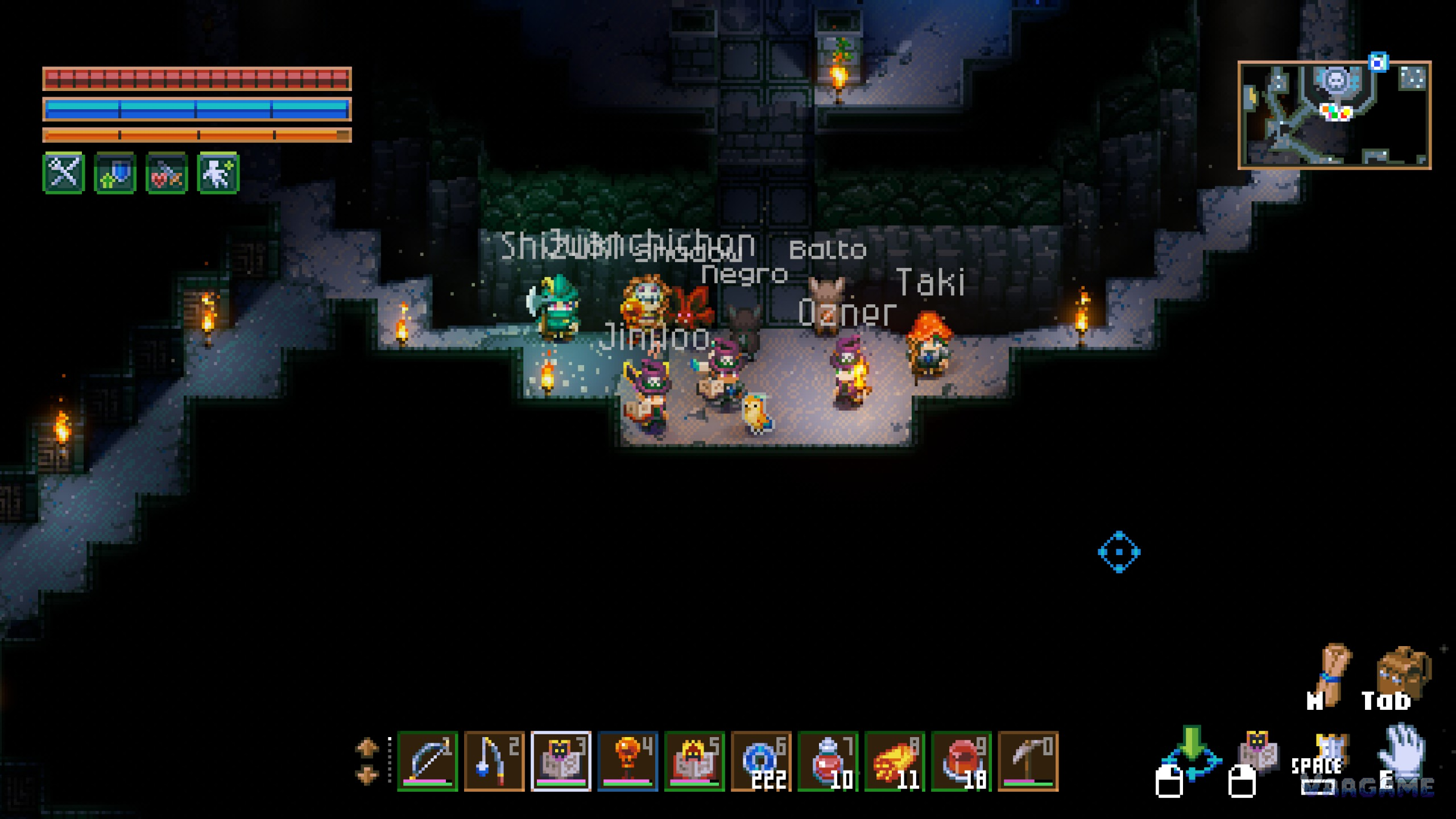
The world belongs to the house, and the character belongs to you: that split is the whole idea behind Core Keeper multiplayer. A world save holds the base, the bosses and the explored map, while your character save holds your skills, gear and inventory, and your character can carry all of it into any friend's world as a guest. Core Keeper supports 1–8 players in online co-op with native hosting and no dedicated server to set up, so a session is mostly a matter of agreeing whose world to play in. This guide covers the two save types, boss scaling, the four difficulty combinations, crew roles, and the real limits of crossplay.
Quick answer
Crew size: 1–8 players share one world, and every character keeps its own separate save
Saves: Worlds and characters are independent files, so your character can visit multiple worlds and bring its progress home again
Boss scaling: Boss health scales with the players present, with each extra player adding less than the one before, and the exact scaling differs per boss
Crossplay verdict: PC players on different storefronts can play together, PC and console players cannot share a server, and consoles only connect within their own family
At a glance
Players: 1–8 in one world, online co-op
Hosting: Native multiplayer, no dedicated server required
Saves: World saves and character saves are separate; one character can enter many worlds
Boss health: Scales with players present, recalculated when players join or leave; regular enemies keep their health and spawn in greater numbers instead
World difficulty: Normal or Hard, chosen when the world is created
Character type: Normal or Hardcore, chosen when the character is created
PC crossplay: Between different PC storefronts, enabled in the settings and handled through PlayFab
PC to console: Not supported; console play stays within the same console family
1. Two saves: the world is the house, the character is yours
Core Keeper keeps two separate save files for every explorer. The world save holds everything fixed in place: dug-out terrain, the base around the Core, lit statues, defeated bosses and the uncovered map. The character save holds everything personal: your 12 skill levels, your gear, your inventory and your character type. Neither file contains the other, and that separation drives every co-op habit in this guide.
Because the files are separate, a single character can enter any number of worlds, local or remote. Keep a settled solo world of your own, take the same character into a friend's fresh world on Friday night, and come home on Sunday with new gear and higher skills, with no progress lost on either side. A visiting character arrives with its own equipment and levels, which cuts both ways: a veteran makes an enormous difference in a young world, so crews who want a shared fresh start should roll new characters together, while crews who want help can invite a geared friend in as heavy support.
Practical housekeeping follows from the split. Back up both files before experimenting: a world backup protects the shared base, a character backup your personal progress. Hosts should treat the world file as the crew's shared property: it is the one file nobody can reconstruct from their own save if it is lost. Agree on one main crew world early, because boss kills, statue progress and base building all live in the world file, and scattering sessions across four half-finished worlds means four sets of early bosses to redo. The character side needs no such discipline: one well-kept character can serve every world you will ever join.
2. Boss scaling: health follows the room
Boss health in Core Keeper is calculated from the players present, and three rules describe the whole system.
Health scales with players present, and recalculates live
The count that matters is who is in the world when the fight happens. When a player joins or leaves, boss health is recalculated automatically, so a boss engaged by a duo and finished by a trio changes strength mid-session without anyone touching a setting. A crew member idling at base still counts: presence in the world is the input, wherever on the map that player is standing.
Each extra player adds less than the one before
The scaling has diminishing returns built in. Moving from one player to two raises boss health by a noticeable step, while moving from seven to eight adds a smaller step on top. Large crews stay viable: eight players face a much tougher boss than a solo player does, and the fight still ends faster, because eight sets of damage land at once. The practical reading for crew planning is simple: a boss attempt is a crew appointment, and a short-handed attempt is still real progress, since the kill counts in the world whoever was present for it.
The amount differs for every boss
There is no single multiplier and no universal percentage to memorise. Each boss scales by its own amounts, so a rule of thumb learned on an early slime will mislead you on a late Titan. Treat every boss as its own case, gear for its tier, and expect the fight to lengthen with crew size rather than transform.
One neighbouring system is worth separating from boss scaling, because groups routinely confuse the two. Regular enemies do not scale at all: a slime in an eight-player world has the same health and damage as in a solo world. What changes is quantity. Enemies spawn around each player, so more players spread across the map means more spawns in total, and a split crew each meets its own local crowds.
3. Four combinations: world difficulty meets character type
Two separate choices shape a co-op run, set in two separate places. World difficulty (Normal or Hard) is chosen when the world is created and belongs to the host's world file. Character type (Normal or Hardcore) is chosen when each character is created and belongs to that player alone. One world can therefore host a mixed crew, Hardcore and Normal characters digging side by side. Neither choice can be changed in game afterwards.
Swipe horizontally to view all columns.
| Setup | World difficulty | Character type | Consequences | Best for |
|---|---|---|---|---|
Standard run | Normal | Normal | Standard enemy and boss stats, death drops your main inventory into a gravestone and you respawn at the Core or a bed | First-time crews learning the game together |
Heavy world | Hard | Normal | Every enemy and boss has double health and damage, boss chests gain 50% more loot slots, deaths still only drop your inventory | Experienced crews who want harder fights with a forgiving death rule |
Glass explorer | Normal | Hardcore | Standard world stats, your character is deleted permanently on death, with no compensating advantage | Solo-style challenge players visiting or hosting a calm world |
Full punishment | Hard | Hardcore | Double enemy and boss health and damage, 50% more boss chest loot slots, and death deletes your character for good | Veteran crews running a deliberate challenge campaign |
Two clarifications save arguments later. First, the Hard world's only compensation is the larger boss chest: the extra loot slots are real, and no Hard-exclusive items hide behind the difficulty. Second, Hardcore offers nothing in return: it is a pure challenge rule, and its cost lands unevenly in a crew, since one Hardcore death removes that player's character, skills and gear while everyone else plays on. Mixed crews should say the quiet part out loud before the first boss: the Hardcore player is volunteering for stakes the rest of the crew does not share.
4. Splitting the work: how crews organise themselves
Nothing in Core Keeper assigns roles, and every character can train all 12 skills. Crews still fall into a natural division within a few sessions, because skills level by doing: the player who farms levels Gardening and Cooking fastest, the player who digs pulls ahead in Mining, and specialisation compounds on its own. Four loose jobs cover most of a shared world's needs, and most players rotate through two of them.
The farmer-cook
One player tends the crop plots, keeps the cooking pots running and stocks the food chest before expeditions. The crew eats better buffs, hunger stops interrupting boss attempts, and the group's Gardening and Cooking levels concentrate where they do the most good.
The miner-builder
One player pushes the digging frontier, opens tunnels and ore routes, and owns the base layout: workbenches, furnaces, storage and rail lines. A single builder keeps the shared base coherent, and everyone benefits from shorter trips home.
The fighters
Two or more players gear first for combat and take point on boss attempts and dangerous biomes. Since boss health rewards attendance, the fighters' real job is scheduling: getting the full crew online and into the arena together.
The quartermaster
One player tracks the unglamorous supplies: torches, food, spare gear, scanner parts and boat or rail materials. Crews rarely appoint this role, and feel its absence on every expedition that stalls for a missing stack of bridges.
Rotation matters more than assignment. The farmer who never fights will stall in combat skills, and the fighters who never dig will stall in Mining, so healthy crews swap jobs between expeditions and let the levels even out.
Shared bases run on agreements, so make them early and keep them simple. One chest row per category, a food chest refilled before it is emptied, and Titan expeditions that wait for a full crew will prevent most co-op friction. The game enforces none of these house rules, which is exactly why stating them once beats arguing about them at the third boss.
5. The truth about crossplay
Crossplay is the word that causes the most confusion in Core Keeper co-op, because the in-game option of that name covers less than most players assume. The official position draws one hard line and one open door.
The open door is on PC. The game's Crossplay setting exists so that PC players who bought the game on different storefronts can play together, and it runs through PlayFab. Both sides need the setting enabled, and once it is on, a Steam copy and a copy from another PC storefront share a world like any other crew.
The hard line separates PC from consoles. PC and console players cannot share a server. A friend on Switch, PlayStation or Xbox cannot join your PC world, and your PC character cannot visit theirs. Console play stays inside each family: PlayStation 5 and PlayStation 4 players connect to each other, as do Xbox Series X|S and Xbox One players, per the publisher's account of the feature as reported in the press. Plan purchases around this: the platform split is decided at the till, and no setting changes it later.
Swipe horizontally to view all columns.
| Pairing | Same server? | How it works |
|---|---|---|
PC on Steam meets PC from another storefront | Yes | Enable Crossplay in the settings on both sides, connection handled through PlayFab |
PC with any console | No | PC and console play are separate, with no shared servers |
PlayStation 5 with PlayStation 4 | Yes | Same console family, per the publisher's account |
Xbox Series X/S with Xbox One | Yes | Same console family, per the publisher's account |
Mixed-platform groups still have a workable pattern: run one campaign per platform family, and let a shared voice call carry the social side of the evening.
A final session note for PC crews: update 1.3 was followed by a line of stability patches (the 1.3.0.x series, running to 1.3.0.6 in October 2026), so keeping every copy on the same current version is the first fix to try when a session misbehaves. Keep expectations accurate here: those patches are general stability work, and the practical co-op rules in this guide, host-based worlds and per-platform servers, are the ones to plan around.
Common co-op misconceptions
Swipe horizontally to view all columns.
| Mistake | Fix |
|---|---|
Assuming regular enemies gain health per player | Regular enemies keep their solo health and damage at any crew size, only their spawn numbers rise |
Rolling a Hardcore character for a crew's first world | Hardcore deletes the character on death with no advantage in return, so save it for a deliberate challenge run |
Buying a copy to play with Switch friends from PC | PC and console cannot share a server, and console play only connects within the same family |
FAQ
How many players can play together?
Up to 8 players in one world. That is the official figure for Core Keeper co-op, and a full eight-player crew is a complete, ordinary way to run a world, as the crew photo at the top of this guide shows.
Can I enter the world while the host is offline?
Plan around the host needing to be there. Native multiplayer is host-based with no dedicated server in the standard setup, so the crew world lives in the host's save and sessions happen while the host is running it. Groups on different schedules should agree on hosting hours, or rotate the campaign world to whoever hosts that week.
Can my character visit a friend's world?
Yes. Characters and worlds are saved separately, and a character can enter multiple worlds, local or remote, carrying its own levels, gear and inventory. Progress you make as a guest stays on your character, and your own world at home is untouched by the visit.
What happens when a player joins mid-session?
Boss health is recalculated from the players present, so a join or a departure during an expedition changes the health of bosses you engage from that point on. Regular enemies are unaffected in strength; you will simply meet more spawns in total as more players spread across the map.