

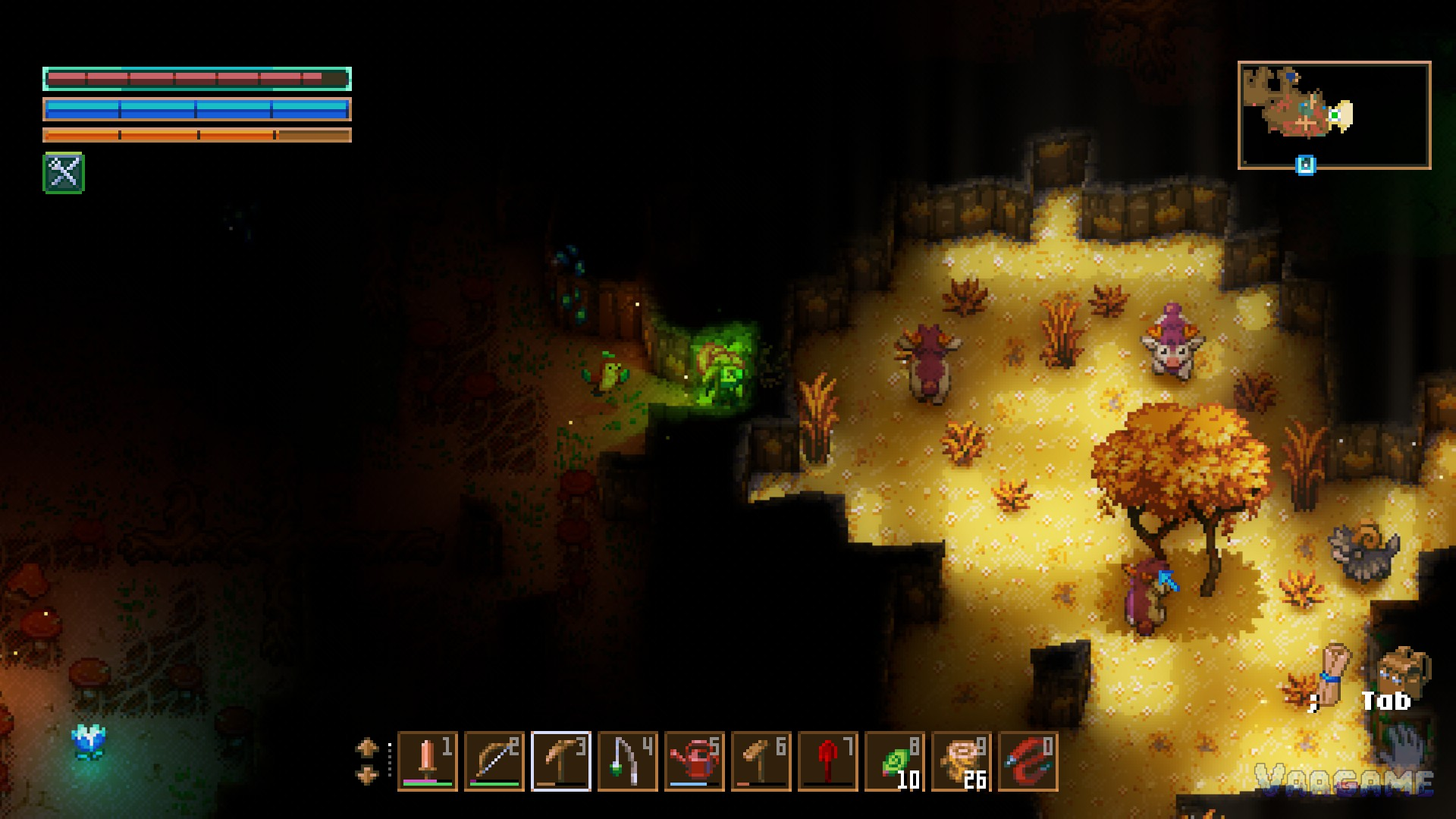
Core Keeper has no character experience bar at all: your explorer improves along 12 independent skill tracks, and each one levels only from its own activity. Dig walls and Mining rises. Land hits and Melee combat rises. Take a finished dish out of the cooking pot and Cooking rises. Every skill caps at level 100, every level pays a small permanent bonus, and every five levels earns a talent point for that skill's own tree. Once you know how each skill counts its experience, levelling stops being a mystery and becomes a by-product of playing with intent. This guide lays out the counting rules first, then the full table of all 12 skills, the fastest honest way to train each cluster, how talent points and respecs work, and what update 1.3 changed for summoners and mages.
Quick answer
No shared XP exists: each of the 12 skills levels from its own activity, and progress in one never feeds another
Counting decides everything: combat skills count hits, Vitality counts kills, and life skills count completed actions such as a dish collected or a fish hooked
Every level pays: each skill grants a small permanent bonus per level, from +1 max health for Vitality to +1 fishing power for Fishing
Talent points: 1 point every 5 levels in a skill, plus 5 bonus points at level 100, and a respec costs 200 Ancient Coins at any time
At a glance
Skills: 12 in total: Mining, Running, Melee combat, Vitality, Crafting, Range combat, Gardening, Fishing, Cooking, Magic, Summoning and Explosives
Level cap: 100 per skill
Experience: Earned per skill from its own activity only
Talent points: 1 per 5 levels in that skill, plus 5 extra at level 100, for 25 points per maxed skill
Talent tiers: Spending 5 points in a tier unlocks the next tier of that tree
Respec: 200 Ancient Coins, available at any time
Update 1.3 changes: Summons are permanent, mana regeneration continues while casting, and early Melee, Range and Magic levelling is faster
1. Count first: hits, kills and actions
Every argument about fast levelling in Core Keeper is really an argument about counting. The 12 skills use three different counters, and training a skill with the wrong one in mind wastes hours.
Hit-counted skills
Melee combat, Range combat, Magic, Summoning and Explosives all count hits landed. A swing that connects earns experience whether the target dies, shrugs it off or walks away. For these five skills, a durable target that soaks many hits is worth far more than a weak enemy that dies in two.
Kill-counted: Vitality alone
Vitality is the only skill counted by kills. It rises when enemies die by your hand, regardless of how many hits the fight took. That makes Vitality the mirror image of the hit-counted skills: quick, clean kills on plentiful enemies feed it fastest, and long duels with a single tough target barely move it.
Action-counted skills
The remaining six skills count completed actions. Mining counts mining damage dealt to walls. Running counts distance travelled on foot. Crafting counts items crafted, and bulk crafting counts every item in the batch. Gardening counts mature crops harvested by hand, one point per harvest. Fishing counts every successful hook, junk included, one point per catch. Cooking counts each finished dish you take out of the cooking pot.
2. All 12 skills at a glance
Read the middle column as the training instruction and the right column as the reward. Together they explain why a well-rounded explorer ends up levelling everything: each activity pays its own track, in its own currency.
Swipe horizontally to view all columns.
| Skill | Experience source | Gain per level |
|---|---|---|
Mining | Dealing mining damage to walls | +1 mining damage |
Running | Moving on foot, vehicles, boats and conveyor belts excluded | +0.1% movement speed |
Melee combat | Landing melee hits, counted per hit | +0.5% melee damage |
Vitality | Scoring kills, counted per kill | +1 max health |
Crafting | Crafting items, counted per item crafted | +0.5% armour |
Range combat | Landing ranged hits, counted per hit | +0.5% ranged damage |
Gardening | Harvesting mature crops by hand, 1 point per harvest | +0.4% chance of extra harvest |
Fishing | Every successful hook, junk included, 1 point per catch | +1 fishing power |
Cooking | Taking a finished dish out of the cooking pot | +0.2% chance of an extra finished dish |
Magic | Landing hits with magic weapons, summon hits excluded | +0.5% magic damage |
Summoning | Your summons landing hits, counted per hit | +0.5% summon damage |
Explosives | Hits from explosions you set off yourself | +0.5% explosion damage |
Two rows deserve a second look. Magic and Summoning sit side by side and are easy to confuse: a hit from your own staff levels Magic, while a hit from your summoned minion levels Summoning. The two never cross over. And Vitality's reward is the quiet giant of the table: at level 100, the per-level health adds up to serious staying power, earned simply by finishing fights.
3. How to train each cluster
Combat cluster: hits for damage, kills for health
For Melee and Range combat, pick targets that stay standing. Because experience follows hits, a sturdy enemy, a boss or any target you can strike repeatedly teaches more per minute than a field of weak slimes that pop on contact. Keep your weapon swinging or firing at a pace you can sustain, and let the hit counter do the work.
Vitality wants the opposite session. Take your best clearing setup into busy areas and finish enemies quickly and often: every kill is a tick, and hit count is irrelevant here. Magic follows the hit rule with your own spells, so a rapid-casting weapon against durable targets trains it steadily, and update 1.3 made the early levels of Melee, Range and Magic faster to earn. Summoning trains itself once your minions are out: their hits are your experience, and since 1.3 those minions stay until you dismiss them, so the training continues for as long as they keep fighting. Explosives counts hits from explosions you set off yourself, so detonate into groups: several enemies caught in one blast means several hits counted from a single action.
Gathering cluster: walls, footsteps and your own hands
Mining is the most honest grind in the game: deal mining damage to walls and long digging sessions toward the next material tier level it as a side effect. Running asks for the same honesty on foot. Explore on foot, walk your own tunnels and save the cart, the boat and the conveyor belt for trips where levelling does not matter, because none of them count. Gardening closes the cluster: plant in rows you can sweep by hand, and harvest every mature crop yourself. Automated harvesting keeps the farm tidy and gives the skill nothing, so the manual pass is the training.
Life cluster: the pot, the pond and the workbench
Cooking levels at the pot's mouth: each finished dish you collect is a point of progress, so a kitchen that cooks in batches trains the skill every time you unload it. Fishing is equally plain: cast, hook, repeat, and take the junk catches gladly, because a hooked piece of junk pays the same experience as a fish. Crafting rounds out the cluster and needs no special session at all: every item you craft counts, bulk batches count item by item, and a growing base produces thousands of crafts across a normal run.
4. Talent points in brief
Each skill has its own talent tree, and points never move between skills. You earn 1 talent point every 5 levels in a skill, and reaching level 100 adds 5 bonus points, so a maxed skill holds 25 points in total. Trees are tiered: spending 5 points in a tier unlocks the next tier up, so early points are also keys to the next layer.
Spending is safe to experiment with. A respec costs 200 Ancient Coins and can be done at any time, resetting that skill's tree so you can rebuild it around a new weapon, a new role in your group or a new biome. At that price, the correct early strategy is to spend points on the problems in front of you this week and rebuild later without regret. For the full breakdown of point pacing, tier planning and when a reset is genuinely worth paying for, see the dedicated talent points and respec guide listed under Related guides below.
5. What update 1.3 changed
Update 1.3 (Riders of the Underground, September
2026) reworked two trees and quietly sped up three more. Summoning changed the most: summoned minions are now permanent and stay until you dismiss them manually, the summoning tree gained 2 new talents, you can summon straight up to your minion cap in one go, and the casting cooldown on summons was removed. A summoner build is now a standing army rather than a timer you keep refreshing.
Magic became smoother to play and to level: mana regeneration now continues while you cast, at 50% efficiency, instead of pausing during casting, and the Magic tree's talents were rearranged. Finally, the experience curves for Melee combat, Range combat and Magic were accelerated in their early stretch, so the first talent points in those three trees arrive sooner than they used to. Nothing about the counting rules changed: hits still count for combat, kills still count for Vitality, and actions still count for the life skills.
Common skill mistakes
Swipe horizontally to view all columns.
| Mistake | Fix |
|---|---|
Grinding kills to level Melee | Melee counts hits, so fight durable targets you can strike many times; kills are what Vitality counts |
Riding everywhere to level Running | Carts, boats and conveyor belts earn no Running experience; travel on foot when the levels matter |
Expecting summon hits to level Magic | Summon hits level Summoning only; Magic levels from hits with your own magic weapons |
Hoarding talent points for a perfect build | A respec costs 200 Ancient Coins at any time, so spend points on your current week and rebuild later |
Automating the harvest to level Gardening | Gardening counts crops harvested by hand, 1 point per harvest; automated harvesting earns none |
FAQ
What is the maximum skill level?
100 for every skill. All 12 skills share the same cap, and reaching it also pays that tree 5 bonus talent points.
Do skills share experience with each other?
No. Each skill has its own track and levels only from its own activity. An afternoon of mining raises Mining and nothing else, which is why rounded characters come from varied play rather than from one long grind.
How much does a respec cost?
200 Ancient Coins, and you can respec at any time. The price is deliberately low: rework a tree when your build changes instead of treating early talent choices as permanent.
My summons landed the hit. Which skill gets the experience?
Summoning. Hits from your summoned minions count toward the Summoning skill and pay into its per-level summon damage bonus. They never count toward Magic, which levels only from hits with your own magic weapons.