

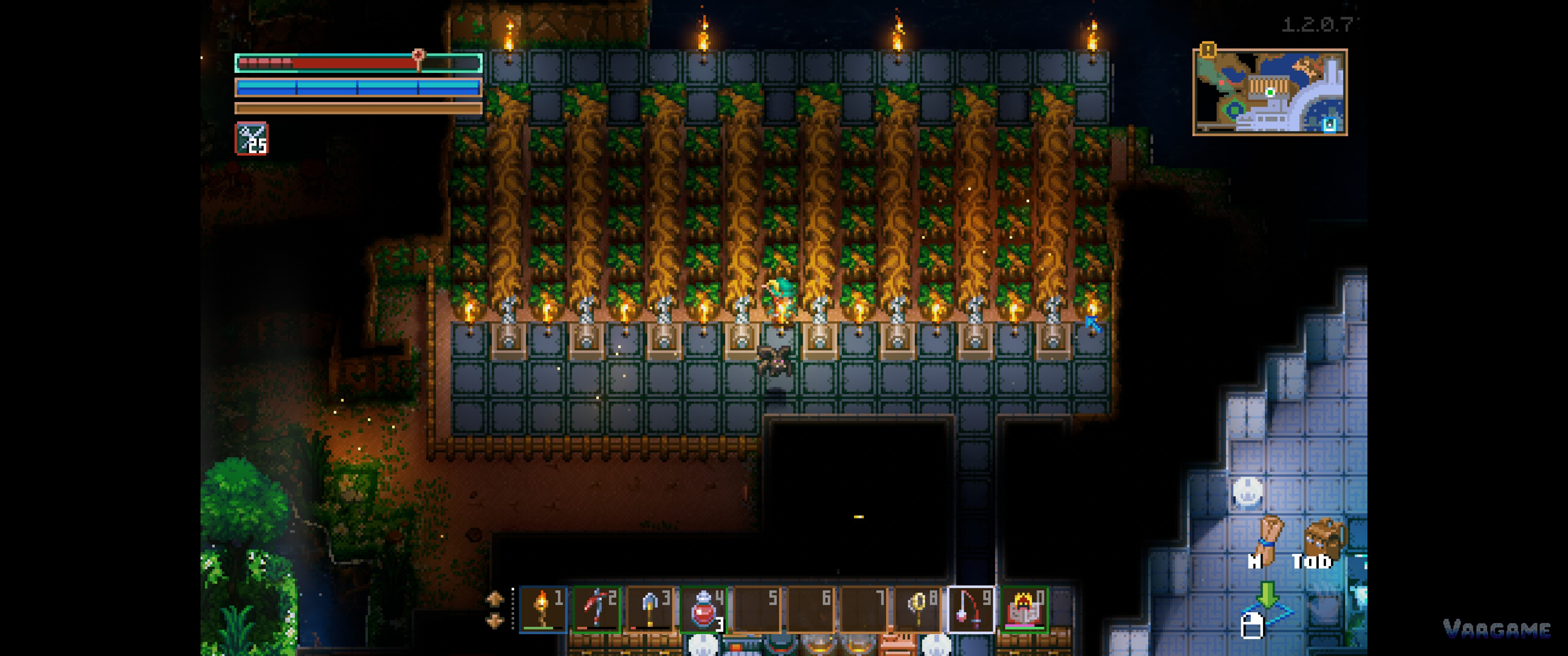
Talent points in Core Keeper are cheap, and respecs are cheaper: every skill hands you a point every five levels, and resetting costs a flat 200 Ancient Coins whenever you like. That pricing shapes everything in this guide. There is no single correct build to protect, so the real questions are rhythm and framework: how fast points arrive, how the tier gate decides where they can go, and which moments in a run are worth a reset. What follows is the earning schedule, the five-point tier rule, the four moments worth a reset, and three frameworks (mining, combat, life) you can pour points into without planning regret.
Quick answer
Earning rate: 1 talent point per skill every 5 levels, plus 5 bonus points when the skill reaches level 100
Total per tree: 25 points by the numbers (20 from levelling, 5 from the max-level bonus), and there are 12 separate trees
The gate: Spend 5 points in a tree's lower tier to unlock the tier above it, so scattered single points open nothing
Respec: 200 Ancient Coins, available at any time, so spend points on the week you are playing and rebuild when your job changes
At a glance
Points per skill: 1 per 5 skill levels, +5 bonus at level 100
Points per tree, total: 25 (by the numbers: 20 earned on the way up, 5 at the cap)
Skills with trees: 12, each levelling independently to 100
Tier unlock: 5 points spent in the current tier opens the next one up
Respec cost: 200 Ancient Coins
Respec timing: Any time, no cooldown or level requirement stated in the rules
1. Where points come from: one every five levels
Each of the 12 skills levels on its own activity and pays out talent points on its own schedule: damaging walls levels Mining, landing hits levels Melee combat, kills level Vitality, collecting finished dishes levels Cooking, and so on. The payout rule is the same in every tree. Every fifth level in a skill (5, 10, 15, all the way up) earns 1 talent point for that skill's tree, and reaching the level 100 cap adds a one-time bonus of 5 more points. Points are not shared between skills: a Mining point can only be spent in the Mining tree, which is why a character who does a bit of everything ends up with a bit of everything unlocked, one tree at a time.
Swipe horizontally to view all columns.
| Skill level | Points earned | Cumulative points |
|---|---|---|
Level 5 | 1 | 1 |
Level 10 | 1 | 2 |
Level 15 | 1 | 3 |
Level 20 | 1 | 4 |
Level 25 | 1 | 5 |
Level 30 | 1 | 6 |
Level 35 | 1 | 7 |
Level 40 | 1 | 8 |
Level 45 | 1 | 9 |
Level 50 | 1 | 10 |
Level 55 | 1 | 11 |
Level 60 | 1 | 12 |
Level 65 | 1 | 13 |
Level 70 | 1 | 14 |
Level 75 | 1 | 15 |
Level 80 | 1 | 16 |
Level 85 | 1 | 17 |
Level 90 | 1 | 18 |
Level 95 | 1 | 19 |
Level 100 | 1 | 20 |
Level 100 bonus | 5 | 25 |
Read the table as a rhythm, not a grind target. The first five points (enough to clear the first tier gate, as the next section explains) arrive by level 25 in a skill you use daily, which for most players means the first weekend. The mid-game plateau between levels 50 and 90 pays one point every five levels at a steady drip. The final five points land all at once at the cap, best treated as finishing money: by level 100 you know which top-tier effects your build still wants.
2. Tiers and the five-point gate
Talent trees are stacked in tiers, and the unlock rule is simple: spend 5 points in a tier and the tier above it opens. There is no extra level requirement, and no way around the count. This single rule creates the only real spending decision in the system, because the first five points in any tree can be played two ways.
Rush the gate. Put all five points into the lower tier as they arrive, even if one or two picks are merely decent, and you reach the upper tiers at the earliest possible moment. This suits trees whose best effects sit higher up, and your main activity most of all: the sooner a mining build reaches its upper tiers, the sooner every wall pays the better rate.
Spread for coverage. Split early points between two trees you use constantly, one point here and one there, and both builds stay shallow for longer. A point spent in a tree you touch twice a week earns almost nothing, while the same point finishing a tier in your main tree compounds daily. Coverage feels safe, but with a 200-coin respec available at any time, safety is the one thing you never need to buy with points.
3. When to reset: the four moments
A respec costs 200 Ancient Coins and can be done at any time. At that price, resetting is a routine adjustment rather than a major decision, and four situations cover nearly every worthwhile reset.
When your main activity changes
Skills level by doing, so a character's trees drift toward whatever the last few weeks involved. When the run changes phase (the base is built and the mining weeks begin, or the farm is automated and you move to exploring), the points sitting in yesterday's tree are stranded. Reset and re-deal them into the activity that now fills your sessions.
Before a boss ladder
Bosses arrive in tiers, and the fights ahead care about a narrow slice of your character: one combat tree, your Vitality, and the food behind both. If your points are spread across fishing, running and crafting from a quiet month of base work, a reset before a boss push concentrates them where the next three fights will actually test them. Rebuild for the ladder, then rebuild back for the quiet weeks after it.
After an update reshapes a tree
Trees are not fixed forever, and update 1.3 is the standing example: Summoning gained 2 new talents, summoned minions became permanent until dismissed, and the summon cast cooldown was removed, while the Magic tree had its talents rearranged and mana regeneration now continues at 50% efficiency while you cast. Points placed under the old shape of those trees were placed blind; after a tree changes, a reset lets you spend the same points with current information.
When your co-op role changes
In a group of up to 8 players, roles divide naturally: one player mines, one farms, two hunt bosses. When your group's jobs rotate (the farmer takes over boss duty, the miner inherits the kitchen), your trees should rotate with them. A 200-coin reset is far cheaper than levelling a second character into the same shape.
4. Three frameworks to spend into
These are frameworks, described by effect type rather than a fixed pick order, so they survive balance changes and fit characters at any level. Each one names what to take first and what can safely wait.
The mining build: Mining plus Crafting
Your two working trees. In Mining, prioritise the extra-ore effect type first: talents that give walls a chance to yield bonus ore multiply every swing you take for the rest of the run, so they out-earn flat improvements the earlier you hold them. Fill the tier to its 5-point gate with the strongest remaining effects, then repeat upstairs. Crafting is the natural partner tree, since its levels arrive from the same workbench sessions your mining funds, and its per-level armour dividend (+0.5% armour per Crafting level) rewards the pairing passively. What can wait: convenience and carrying effects, pleasant at level 80 and invisible at level
20. Buy them with late points.
The combat build: one weapon tree plus Vitality
Pick one of Melee combat, Range combat or Magic as your main tree and feed it first; the 5-point gate punishes splitting points across two weapon trees in exactly the way it punishes splitting across any two trees. Summoning counts as its own main tree since update 1.3, with permanent minions and 2 new talents in its tree, so treat it as a fourth weapon choice rather than a side dip. Behind the weapon tree, Vitality is the universal second: it levels from kills (which combat produces anyway) and pays +1 max health per level before talents enter the picture. What can wait: Explosives, until you are genuinely building around explosions, and Running, which levels from ordinary travel and rarely needs early points.
The life build: Gardening into Cooking into Fishing
The support chain, in the order the game feeds it. Start in Gardening and take Grateful gardener as soon as your points reach it: it turns seed returns from your harvests into a guarantee, and a guaranteed seed loop is the foundation every later food system stands on. Next, Cooking: prioritise the extra-product effect type, talents that give a finished dish a chance to come out doubled, because every dish your kitchen produces then stretches further for free. Fishing comes third: it levels one catch at a time and its per-level dividend (+1 fishing power per Fishing level) does much of the work before talents, so its points can follow once the garden and kitchen loops are closed. What can wait: harvest-speed and convenience effects across all three trees; loops first, speed later.
Common talent mistakes
Swipe horizontally to view all columns.
| Mistake | Fix |
|---|---|
Hoarding points until you know the perfect build | Points earn nothing unspent, and a reset costs 200 Ancient Coins: spend on your current activity and rebuild when it changes |
Putting 1 point in every tree to try everything | A tier only unlocks after 5 points in the tier below it, so single points scattered across trees open no upper tier anywhere |
Skipping a respec because it sounds expensive | A flat 200 Ancient Coins, at any time: less than the gear upgrades you routinely craft between bosses |
Keeping pre-1.3 points in Summoning or Magic | Both trees changed in update 1.3 (new Summoning talents, a rearranged Magic tree): reset and re-spend with the current tree in front of you |
FAQ
How many talent points does each skill tree get in total?
25, by the numbers: 20 points earned one at a time every five levels on the way to 100, plus a 5-point bonus when the skill reaches level
100. Each of the 12 skills has its own tree and its own 25.
How do the upper tiers of a tree unlock?
By spending in the tier below: put 5 points into a tree's current tier and the next tier up opens. There is no separate level requirement, so a focused tree climbs fastest in the skill you use most.
Should I reset my Summoning points after update 1.3?
Yes. Update 1.3 changed the tree itself: 2 new talents were added, minions became permanent until dismissed, and the cast cooldown was removed. Points placed under the old tree were spent on a different build, so reset for 200 Ancient Coins and spend them against the tree as it now stands. The same logic applies to Magic, whose talents were rearranged in the same update.
When is a respec not worth it?
When your points already sit in the tree behind the activity you are doing this week. A reset only pays when your job, your group's roles or the tree itself has changed; resetting a build that still matches your sessions buys you the same points back at a 200-coin charge.