
At a glance
The short version
- Game
- Nature Travel
- Guide type
- Real Life Locations
- Read time
- 8 min read
- Last updated
- Nov 10, 2026
Quick answer
In winter it turns into a skating rink and a ski hill: the Lake Louise Ski Resort opened for the 2026–27 season on 1 November 2026, and the Fairmont clears a rink on the frozen lake from about mid-December to mid-April.
Guide details
Swipe horizontally to view all columns.
| Item | What to know |
|---|---|
Where | Lake Louise, Banff National Park, Alberta, Canada; 57 km from the town of Banff |
Best time | Turquoise water July to September; golden larches mid-September to early October; skating and skiing mid-December to March |
How long | One full day in winter; two days in summer with the hikes |
Difficulty | Easy at the lakeshore; moderate on the valley trails |
Tickets | Parks Canada day pass CA$12.25 per adult; youth 17 and under free; lakeshore parking CA$42 per vehicle per day, 15 May to 12 October only |
Nearest town and airport | Lake Louise village, 5 minutes away; Calgary International Airport, about 2 hours by road |
Cost, checked 10 November 2026 | Park pass CA$12.25 per adult, Roam 8X bus CA$12.50 one way; no parking fee in winter |
Why the lake looks like this
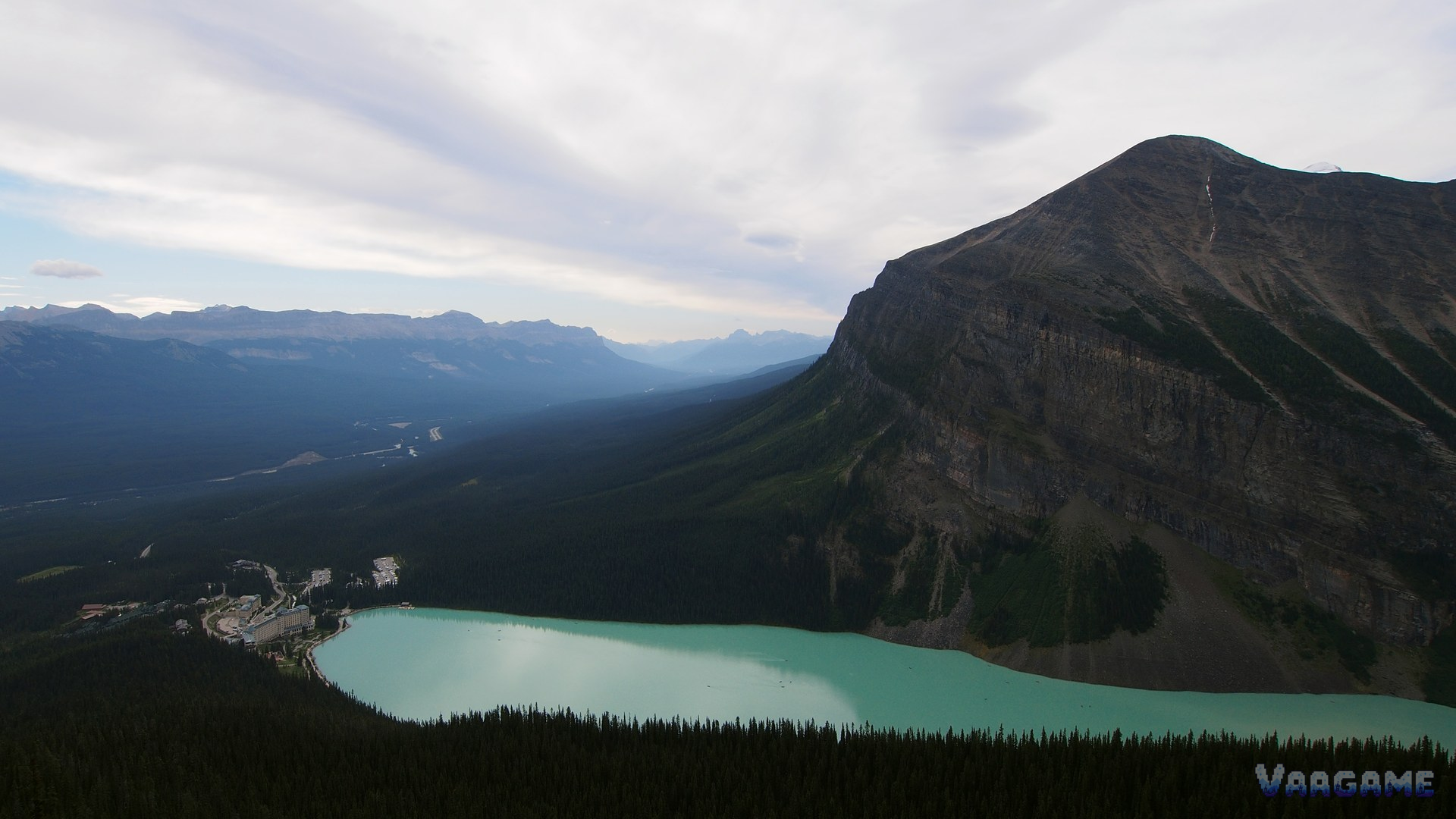
The colour is ground rock. Victoria Glacier grinds the bedrock beneath it into a fine powder called rock flour, and meltwater carries that powder into the lake. The particles are so small they stay suspended, and they scatter sunlight back in blue and green. That turquoise is rock dust held in the water. The lake is about 2.4 kilometres long, 1.2 kilometres at its widest, and about 70 metres deep, and it drains through Louise Creek into the Bow River.
The colour changes with the melt. In June the lake is still thawing, with ice breaking up on the surface. In July and August the warm sun melts the high glaciers fastest, washing the most rock flour into the lake, and the water turns its brightest milky turquoise. By late September the melt slows, the colour softens, and the larches above the valley turn gold.
In winter the same lake becomes a floor. It starts to freeze in November, and from about mid-December to mid-April the Fairmont Chateau Lake Louise clears and maintains a skating rink on the ice, with an ice castle standing on the lake in most winters. The rink is free to use. Skates can be rented at the Chateau, and cross-country skiers glide across the frozen surface with Victoria Glacier straight ahead.
The valley at the far end is named for what feeds it. Six glaciers hang in the cirque above the lake, and the Plain of Six Glaciers trail runs up the valley toward them, ending at a stone teahouse. The lake sits in a bowl of peaks: Mount Victoria rises over the glacier at the western end, and the lakeshore trail runs flat along the water between forest and rock walls.
What order to see it in
Do the lake first, then the hill or the trail. Five steps, in order.
Morning: walk the lakeshore trail. It runs flat along the shore to the far end of the lake and back, about an hour at an easy pace. Go early: the light hits the glacier first, the crowds arrive after 9:00, and in summer the red canoes are already out on the water. In winter the same walk runs over snow, with the frozen lake on one side and the cliffs on the other.
Late morning: skate the rink, from mid-December to mid-April. The Fairmont clears the ice daily, and skating is free; rentals are at the Chateau if you did not bring skates. If you would rather not skate, cross-country skis work on the same frozen surface, with the glacier straight ahead of you the whole way.
Afternoon: ski at Lake Louise Ski Resort, a short drive from the lake. The resort opened for the 2026–27 season on 1 November 2026, five days ahead of its planned 6 November date, and runs to 2 May
2027. Lifts run from 9:30 am to 4:30 pm. Check the snow report before you go: early-season terrain is limited and opens up as snowmaking and snowfall allow.
Summer add-on: hike the Plain of Six Glaciers trail, 13.8 kilometres return and 3 to 5 hours, ending at the stone teahouse with the glaciers in front of you. For a shorter walk, the Lake Agnes Teahouse trail is about 7 kilometres return and 2 to 3 hours, and the Little Beehive viewpoint above it looks straight down the whole lake — that is where the cover photo of this page was taken.
Evening: watch the light go from the lakeshore. The sun drops behind the peaks early in winter, and the lake goes still and blue. In February, the Ice Magic sculptures stand on the lakeshore from 3 to 7 February 2027 — but only for guests of participating hotels, so see the ticket note below before you plan around it.
Best time to go, and what not to do
July to September is the turquoise season, with the brightest water in July and August. Mid-September to early October is larch season: the subalpine larches turn gold for two or three weeks, peaking in the last two weeks of September, and the Larch Valley above nearby Moraine Lake is the best place to see them. December to March is the ice season: the rink, the ski hill, and the Ice Magic sculptures in early February. November is the awkward month — the lake is freezing, the trails are snow-covered, and the rink is not open yet — so come in November for the ski hill, not for the lake.
What not to do:
Do not drive to Moraine Lake. Moraine Lake Road has been closed to private cars all year since
2023. The only ways in are the Parks Canada shuttle, Roam transit, or a commercial bus, and the shuttle runs from June to mid-October. This page is about Lake Louise, not Moraine Lake, but the two lakes sit a few minutes apart and visitors mix them up every summer.
Do not step onto the lake before the rink opens. Parks Canada does not monitor natural ice for safety, and only the section the Fairmont maintains is checked regularly. The guidance is at least 15 centimetres of ice for one person walking or skating alone, and 20 centimetres for a group. If the rink is not open, stay off the ice.
Do not count on lakeshore parking in summer. The lot costs CA$42 per vehicle per day from 15 May to 12 October 2026, and it fills before sunrise on summer weekends. Take the Roam 8X bus from Banff instead — CA$12.50 one way for an adult, running year-round — or the Parks Canada shuttle in season. In winter there is no parking fee and the lot is quiet.
Do not plan Ice Magic as a walk-up. There are no general admission tickets for Ice Magic in
2027. The only way in is to stay at a participating hotel, which gives guests complimentary tickets from 26 October 2026, or to be a local resident of the Bow Valley. All ticket holders must use the event shuttles; there is no parking at the event site.
Do not follow the valley trails in winter. The Plain of Six Glaciers and Lake Agnes trails are summer routes, and in winter they run through avalanche terrain. Stay on the maintained lakeshore and the rink, and save the valley for June to October.
Practical information
Drive from the town of Banff, 57 kilometres and about 45 minutes on the Trans-Canada Highway, or about 2 hours from Calgary International Airport. The Roam 8X bus runs year-round between Banff and the lakeshore, CA$12.50 one way for an adult. In winter the bus is the easy option: no parking fee, no shuttle to book, and the lot at the lake is quiet.
You need a Parks Canada pass for every day in the park: CA$12.25 per adult, CA$24.50 for a family or group of up to seven in one vehicle, and free for youth 17 and under. The 2026 shuttle season ended on 12 October, so there is no Parks Canada shuttle until the next season starts in spring
2027. Check the Parks Canada page before you go for the new season dates.
Bring warm layers and shoes with grip: the lakeshore is icy in winter, the wind comes straight off the glacier, and the sun is strong off the snow. Carry water and sun protection in summer too — the lake sits at 1,731 metres, and the glare off the water is hard on the eyes. Prices and opening times on this page were checked on 10 November 2026; the ice and the snow decide what is open, so confirm with Parks Canada and the ski resort before you go.
Gear for the ice
The hard part of a winter visit is the ice underfoot. The trail along the water ices over, the rink is slick by definition, and a normal boot sole gives up on both. The one piece of gear that changes a winter visit is a pair of slip-on traction cleats: they stretch over the boots you already own, grip the ice with steel coils, and fold flat into a day pack when the sun comes out.
Prices change — check the current price on Amazon.
Bottom line: Lake Louise is two trips in one place. Come in July to September for the turquoise water and the valley trails, or in December to March for the rink, the ski hill, and the ice sculptures. Walk the lakeshore first, skate or ski second, and do not build the trip around Moraine Lake parking, unmonitored ice, or an Ice Magic walk-up. Facts and prices on this page were checked on 10 November 2026; the ice decides what is open, so confirm before you go.