
At a glance
The short version
- Game
- Nature Travel
- Guide type
- Real Life Locations
- Read time
- 8 min read
- Last updated
- Nov 10, 2026
Quick answer
The protected area covers about 720 square kilometres, and the best months to visit are March to May and September to November.
Guide details
Swipe horizontally to view all columns.
| Item | What to know |
|---|---|
Where | Wadi Rum Protected Area, southern Jordan, about 60 km east of Aqaba |
Best time | March to May and September to November; November days around 21°C, nights around 9°C |
How long | One night and a half-day jeep tour is the standard visit |
Difficulty | Easy by jeep; rock bridges and canyon scrambles need steady footing |
Tickets | 5 JOD for foreign visitors at the Visitor Centre; free with a Jordan Pass |
Nearest airport | Aqaba (about 1 hour by road) |
Prices checked | 10 November 2026 |
Why it looks like this
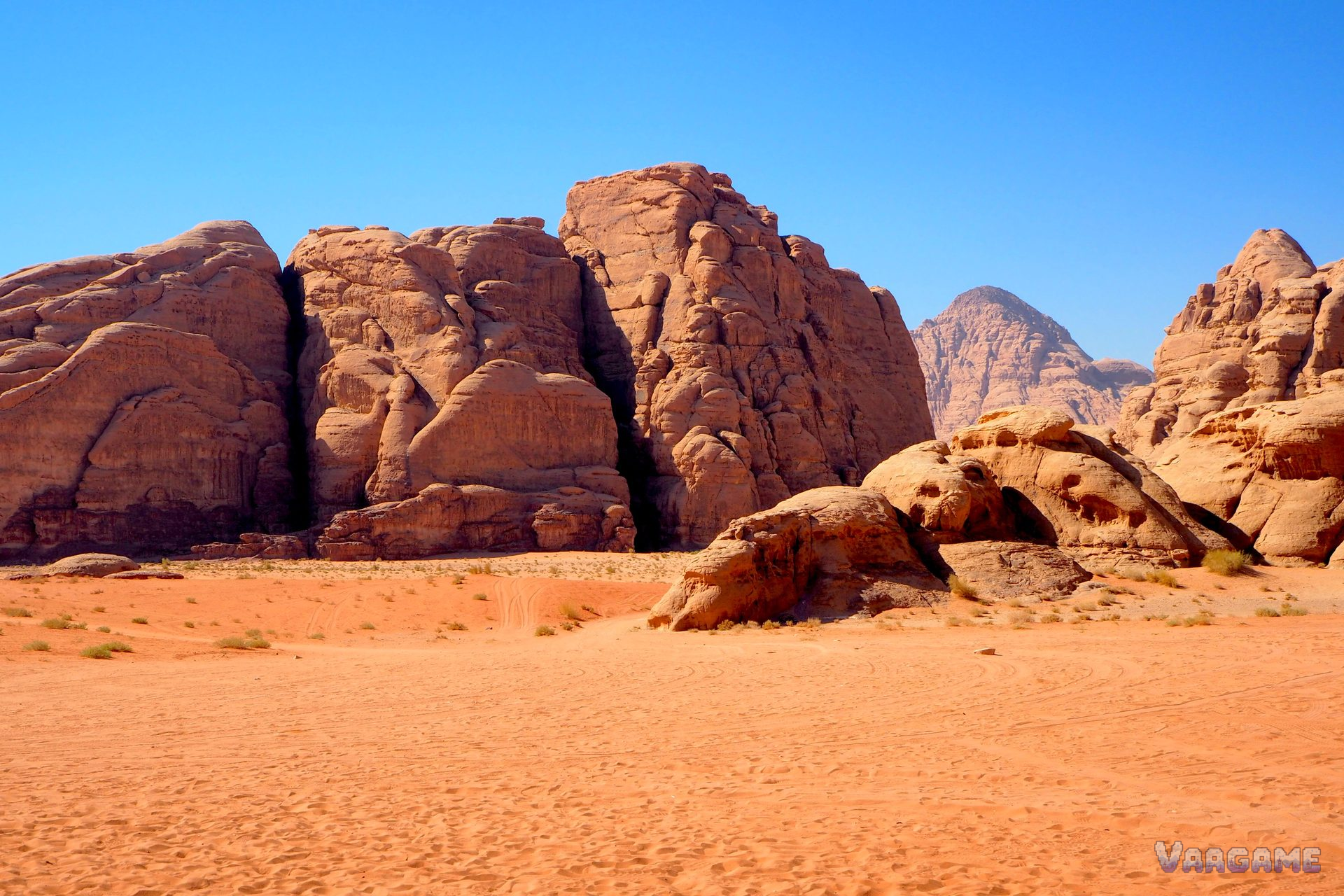
Wadi Rum did not get its shape from dunes alone. The mountains here are iron-rich sandstone laid down hundreds of millions of years ago, sitting on older granite. Wind and rare flash floods cut the sandstone into the near-vertical walls, narrow canyons and natural arches you drive between, while the valleys filled with sand washed off the cliffs. The red colour comes from the iron in the stone. Walk a few minutes from the track and the ground changes underfoot: pale granite gives way to the rust-red sand that made the place famous, and the cliffs turn gold, then deep red, as the sun drops.
The scale is what stays with you. The protected area covers about 720 square kilometres, and its mountains rise to 1,734 metres at Jebel Rum and 1,840 metres at Jabal Umm ad Dami, the highest point in Jordan. People have lived and passed through this desert for about 12,000 years, leaving around 25,000 rock carvings and 20,000 inscriptions on the canyon walls. In Khazali Canyon you can still make out figures of people, ibex and camels cut into the stone by Thamudic and Nabataean hands.
That mix of geology and emptiness is why filmmakers keep coming back. Lawrence of Arabia was shot here in 1962, and the same landscape stood in for Mars in The Martian and for the desert planet in Dune. It looks like another world because, on the ground, it feels like one: no towns, no fences, just rock, sand and sky.
What order to see it in
A half-day jeep tour covers the classic stops in about four hours. The route is the same one almost every camp runs, and it works, so do not overthink it. Ask your driver to finish at a dune for sunset.
Lawrence's Spring and the Nabataean temple — Start at the spring, about 2 kilometres south-west of Rum village. A short scramble takes you to a fig tree and a small pool; the pool is nothing special, the view over the valley is. Below Jebel Rum, on the way back, stop at the remains of a Nabataean temple from about 2,000 years ago.
The red sand dune — Climb the big dune near Khazali Canyon for the best wide view of the reserve. Going up takes ten minutes and is harder than it looks; coming down takes two, and some camps bring a sandboard.
Khazali Canyon — A narrow cleft about 100 metres long, cut into the rock about 6 kilometres south of Rum village. Walk in as far as the boulders allow and look for the carvings of people, ibex and camels on the walls. Go early in the day or late, when the light reaches inside.
The rock bridges — Little Bridge is the easy one, about 4 metres above the rocks and a short climb from the track. Umm Fruth is the one to cross: a span of about 15 metres, reached by a 20-minute scramble, and you can walk across it. Burdah Bridge, the highest natural arch in Jordan at about 35 metres above the saddle, needs a guided three-hour round trip and belongs on a full-day tour, not a half-day one.
Sunset, then camp — End the tour on a dune or a viewpoint as the cliffs turn red, then drive to camp. Dinner is zarb, meat and vegetables slow-cooked in a pit under the sand, followed by Bedouin tea around the fire. With no street lights anywhere, the sky goes properly dark: on a moonless night the Milky Way is visible to the naked eye. Sleep, wake for sunrise, eat breakfast, and leave.
Two nights makes sense if you want a full-day jeep tour, the Burdah Bridge hike, or a longer desert walk. For a first visit, one night and a half-day tour is enough to see the place properly.
Best time to go, and what not to do
March to May and September to November are the best months. November, right now, is a good time to be here: the Wadi Rum weather station records a mean daily high of 21 degrees and a mean daily low of 9 degrees, with only about 6 millimetres of rain. Days are warm enough for a T-shirt on the move; after sunset the temperature falls fast, and you will want a warm layer at camp.
Summer is the hard season. Daytime highs reach 34 to 35 degrees, and the only sensible hours are dawn and late afternoon. Winter days are mild, 15 to 20 degrees, but nights drop close to freezing, so check whether your tent has proper bedding and heating, or bring a sleeping-bag liner. Rain is rarely the problem; cold nights and midday heat are.
Do not drive your own car into the reserve. Private vehicles are not allowed past the Visitor Centre, and a normal hire car will get stuck in the sand. Leave it where your camp tells you to, usually at the Visitor Centre or at the camp office in Rum village.
Do not come for a day trip only. The reserve is at its best at sunset and after dark, and a day trip misses both. One night is the minimum; the camp is half the point.
Do not attempt Burdah Bridge or a desert hike without a local guide. There are no marked trails in the deep desert, the scramble to Burdah is exposed, and phone signal disappears between the mountains. Your camp can arrange a guide for the day.
Do not count on cards or phone signal. Bring Jordanian dinars in cash — there is no ATM in Rum village — and download offline maps before you arrive. Most camps have no Wi-Fi.
Practical information
Most people arrive from Aqaba, about 60 kilometres away and roughly an hour by road. From Petra it is about 1.5 hours; from Amman, about 3.5 to 4 hours. JETT runs a morning bus from Amman for about 20 JOD, and buses from Petra and Aqaba for about 15 JOD, but schedules change, so check the JETT timetable before you travel. A taxi from Aqaba costs about 25 to 35 JOD. From the Visitor Centre, your camp's 4x4 does the rest.
Entry is 5 JOD for foreign visitors and 1 JOD for Jordanians, paid at the Visitor Centre. The Jordan Pass, 70 to 80 JOD depending on how many days you spend at Petra, covers the entry fee, and buying it before you arrive also waives the tourist visa fee if you stay at least two nights. A private jeep costs about 35 to 50 JOD for two hours, 65 to 80 JOD for a half day, and 100 to 130 JOD for a full day, per vehicle rather than per person, so a group splits the cost. Camps on Booking.com for two people in mid-November run from about $47 for a simple Bedouin tent to about $225 for a luxury dome, with well-rated camps mostly between $55 and $100, often including dinner, breakfast and the jeep tour.
Bring a litre water bottle and refill it at camp — the desert is dry, and the jeep carries no water. Sunscreen, a hat, and closed shoes with grip for the sandstone scrambles are worth packing, and so is a warm layer for the night. A headlamp helps after dark, when the camp generator goes quiet and the paths between tents are unlit.
Gear to bring
The desert is dry, and the jeep carries no water. A one-litre bottle you refill at camp is the thing you will reach for all day: on the jeep, on the dune climb, and walking back to your tent at night. A wide mouth makes it easy to fill and to drop ice into, and a tough bottle survives being knocked around in the back of a 4x4.
Prices change — check the current price on Amazon.
Bottom line: Wadi Rum rewards a simple plan: one night, a half-day jeep tour, and a camp under the stars. Book the camp first, let it arrange the jeep, arrive before mid-afternoon, and do not try to drive the reserve yourself. November is one of the best months to do it — warm days, cold nights, and the cliffs at their reddest in the evening light.