

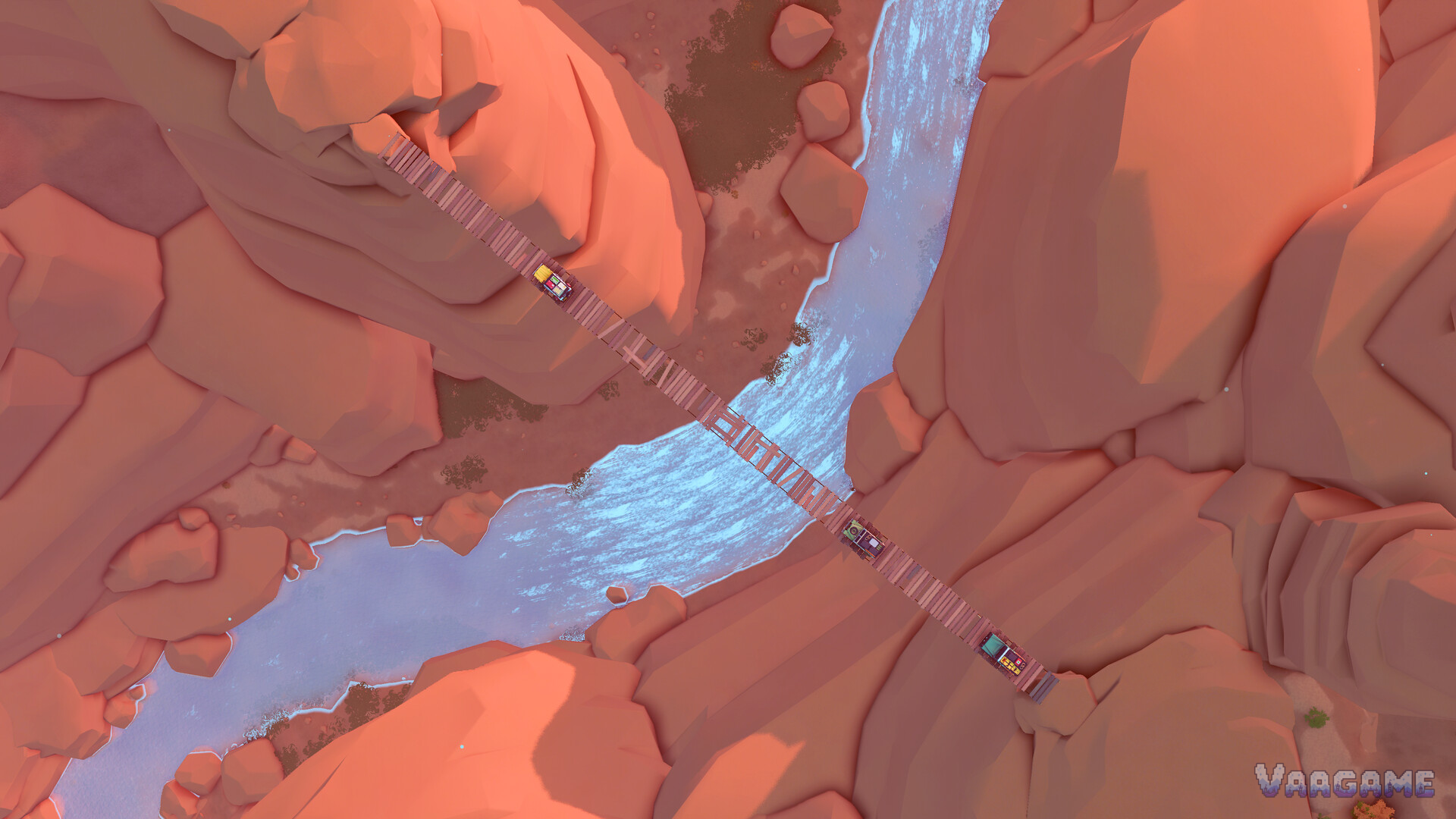
Challenge trails are where over the hill stops being a meditation and becomes an examination: set-piece driving tests — a rotting boardwalk over a swamp, a rock-crawl up a pass, a shelf road along a desert cliff — placed in the world as deliberate difficulty spikes. They matter beyond bragging rights, because completed objectives are the engine of the whole unlock economy: vehicles, upgrades and new country all flow from them. This guide teaches the general game of challenge trails — the four trail families and the technique each demands, the preparation checklist that prevents most failures, and the reset method for when a run goes wrong — rather than pretending to walkthroughs of individual trails we have not driven for you.
At a glance
What they are: Set-piece driving tests built into the world — boardwalks, rock crawls, cliff shelves and bog traversals
Why they matter: Completing objectives drives the unlock chain (vehicles, upgrades, areas) and pays Pebbles
Preparation wins more than talent: Full kit, a restocked campsite behind you, a cabin nearby, and the right time of day
Failure is cheap if you stop early: The reset method below converts most failures into retries, not recoveries
Honesty note: This is a typology and method guide; per-trail pictorial walkthroughs need first-hand footage and are Tier 2 work for this column
1. The four families
Every challenge trail we can verify from launch coverage belongs to one of four families. Naming the family correctly at the trailhead is half the pass, because each family fails differently:
Plank and boardwalk crossings. Narrow timber over swamps, gorges and washouts. The exam is line discipline at crawling pace: wheels on boards, no heroics, spotters welcome in co-op. Your carried planks exist partly to repair the crossings the world has let rot.
Rock crawls. Stepped, technical climbing where the line chooses you. Low gear, tilt gauge, winch anchors pre-read — the driving guide's curriculum at examination weight.
Cliff shelves. Traverse roads cut into exposure: roll angle is the whole game, the handbrake is a driving control, and the handbrake-hold-assess habit decides everything. These are the trails where the "never winch sideways on a slope" rule from the winch guide earns its capital letters.
Bog and soft-ground traversals. Momentum judgement inverted: steady rather than fast, planks under wheels, and the discipline to stop before the dig becomes a recovery.
A trail can chain families — a boardwalk into a rock step into a shelf — and the chained ones are the area finales. Read the chain at the trailhead and you have read the exam paper.
2. The preparation checklist
Run this before any trail you have not passed. It takes two minutes and deletes most failure modes:
Kit complete and restocked. All five recovery pieces accounted for, consumables replenished at a campsite (planks and anchors spent are options deleted).
Cabin secured nearby. A fast-travel point and time control within reach turns a failed trail into an evening's project rather than an expedition's epitaph.
Time of day chosen. First attempts in morning light, on known weather. Night and storm attempts are for repeats, style and specific achievements — not for learning.
Vehicle and upgrades honest. If the trail is above your truck's current lines (engine, tyres), that is information, not shame: bank it, upgrade, return. Trails do not expire.
Exit pre-imagined. Know, before the first obstacle, what "back out" looks like at each stage. The reset method only works if the retreat was thought about while it was still easy.
3. Running a trail: the general method
Whatever the family, the method rhymes with the rest of this collection's teaching. Enter in low gear and let the trail set the pace. Take obstacles one at a time, stopping between them to read the next — the tilt gauge between stages is information you are owed. Commit fully to each chosen line (half-committed lines are how trucks end up diagonal on boardwalks), and treat every successful stage as a checkpoint: kit still complete? line still as read? weather still honest? A trail run is a series of small, verified decisions, not one long improvisation.
When a stage feels above the current setup, that feeling is data. The upgrades guide's order — engine for gradients, tyres for surfaces, protection for water — maps directly onto trail families, and returning with the right line bought is the game's intended loop, not a workaround.
4. Resetting after a fail
Failure on a challenge trail has a correct procedure, and it is the winch guide's recovery order wearing a different hat:
Stop early. The single highest-value decision. A fail stopped at the first slide is a retry; a fail fought with throttle is a recovery inside an exam.
Assess the category. Bellied, bogged, tilted or flooded — the same four problems, the same first moves (jack before winch on a roll, high in-line anchor on a bog, shortest line to the bank on water).
Decide: extract or extract-and-reset. Pull out to the last flat ground, restock mentally, and either re-attempt with the lesson installed or withdraw to camp properly — both are professional outcomes; the unprofessional one is the third hour of digging.
Note what the trail asked. Engine? Tyres? A line you misread? The note is the souvenir; trails are how the game tells you what to buy next.
5. When to come back later
Some trails are gates in disguise: they sit at the edge of an area's intended upgrade level, and the game means you to leave them. The signals are consistent — repeated failure at the same stage with clean technique, a kit that empties before the trail does, conditions you cannot yet schedule around. Leaving is free, returning is easy (your cabin network sees to that), and a banked trail is a measuring stick for your campaign: the day it feels straightforward, your truck and your hands have both levelled up.
That is the honest shape of challenge trails in over the hill: a curriculum written in boardwalks and rock steps, examined one honest attempt at a time.
FAQ
Are challenge trails timed or ranked? No — the game has no races against the clock anywhere, and challenge trails follow the same philosophy. They are completion tests, not speed tests; the only opponent is the terrain.
What do challenge trails reward? They are objectives, and objectives drive the game's unlock chain — new vehicles, upgrades and progress toward new areas — alongside Pebbles payouts. A passed trail is progression, not just pride.
Do I need a specific vehicle for a trail? Trails examine technique and preparation more than hull choice, but upgrades matter: a trail that defeats clean driving is usually asking for an engine or tyre line you have not bought yet. Return upgraded rather than insisting.
How many challenge trails are there? No official total has been published at launch, and community counts come from mapping projects we credit rather than copy. Expect them in every area, escalating with the region — and expect the chained, multi-family ones at the hard ends.
Can I attempt trails in co-op? Yes, and teamwork genuinely helps — spotting, mutual winching and shared line knowledge (per the official FAQ). Completion still counts per player: everyone drives their own truck over the line.
Related guides
over the hill Winch Guide: Self-Recovery, Anchor Points and Getting Unstuck
over the hill Driving Guide: Gears, Terrain Reading and Vehicle Control
over the hill Beginner's Guide: The Winch, Your First Upgrades and What To Do First
over the hill Co-op Guide: How Multiplayer, Progress and Crossplay Work