

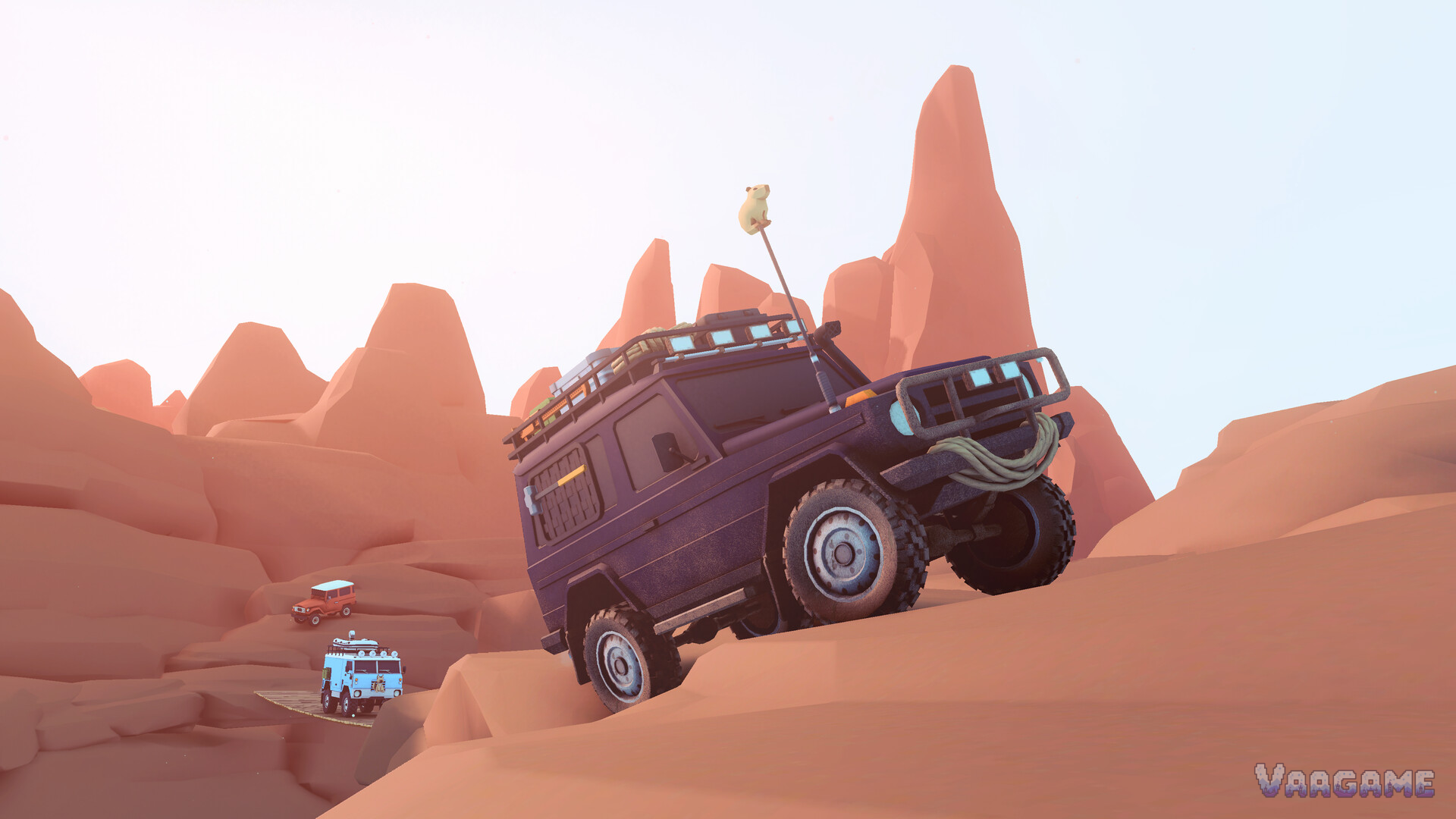
over the hill has no races to win, so its driving skill is entirely about one thing: control at walking pace. The players who struggle are rarely the slow ones — they are the ones carrying racing-game instincts into a game about gears, grip and vehicle attitude. This guide covers the high/low gearbox used properly, how to read terrain before your wheels are on it, climbing and fording technique, and how weather and darkness change the technique rather than just the view.
At a glance
Low gear is the default off-road answer: climbs, bogs, rock steps, descents you want to crawl
High gear is for linking ground — tracks, flats and easy valley floors
The tilt gauges (pitch and roll, shown in the interface) warn you a second before your eyes do
Water is judged by depth, not drama: cross at shallows, keep speed steady, respect the engine
Weather and night are difficulty settings the world turns itself — lamps, patience and cabins manage them
Damage and terrain deformation are real: the ground remembers your wheelspin, and so does the truck
1. High gear, low gear: the whole game in one lever
Your gearbox has two ranges, and choosing between them early is the core driving skill in over the hill.
High gear is travel mode: valley floors, dirt tracks, gentle traverses — anywhere the truck rolls freely and momentum is your friend.
Low gear is work mode: slower, stronger, and the range that lets the wheels turn at a pace where grip survives. Engage it before the climb, the bog or the rock step, not halfway up when the wheels are already spinning.
The failure pattern is always the same: a driver attacks an obstacle in high gear, the wheels break traction, and the spinning digs the truck into the surface it was sitting on. The game's terrain deformation means that damage is semi-permanent for that attempt — you have reshaped the obstacle against yourself. Low gear, chosen early, prevents the dig; the winch (covered in this collection's winch guide) is what you use when it happens anyway.
2. Reading terrain before you are on it
The interface helps more than most players notice. Alongside your heading it shows the vehicle's pitch and roll angles (noted by Entertainium in its launch coverage) — a live report on how close the truck is to its limits. Glance at them on any slope: roll is the dangerous number, because rollovers happen sideways, and the gauge sees the slope's true angle while your camera sees a prettier lie.
Beyond the gauges, read three things on approach:
Surface. Wet rock, mud, sand, snow and grass each break traction differently. The transitions are where trucks get stuck — the soft metre at a lakeshore, the slick band below a waterfall.
Line. Pick where each wheel will go, not just where the truck points. A line that keeps one side on solid ground halves most obstacles.
Exit. Know what the far side offers: flat ground to gather on, or a second obstacle arriving immediately? Committing without an exit is how recoveries stack.
3. Climbs, descents and the handbrake
Climbing technique in over the hill is unglamorous and learnable:
Approach in low gear, on the line you chose, at a steady walking pace.
Keep throttle even. Surges break traction; a constant input lets the tyres work at the edge of grip rather than past it.
If the climb fails, stop early. Roll back under control to flatter ground, re-choose the line or rig the winch. A failed climb rolled back calmly costs thirty seconds; a failed climb fought with wheelspin costs a recovery.
Descend as you climbed — low gear, engine braking, steering into stability. Gravity is doing the throttle work now; your job is braking and line.
The handbrake earns its place on slopes: it holds position while you assess, and it tightens turns on narrow shelf trails where a three-point turn is not on offer. Treat it as a driving control, not a parking formality.
4. Water: fording without flooding
Canadian lake country means rivers, and rivers mean the game's quietest punishment: deep water can stall and damage the engine — the waterlogging that the engine-protection upgrade defends against (launch coverage from Polygon flagged the upgrade for exactly this reason).
Ford like this:
Cross at the shallows. Shoreline shelves and gravel bars are the fords; deep-looking channels are the trap.
Steady, not fast. A bow wave looks heroic and pushes water exactly where you do not want it. Walking pace, constant throttle.
Straight and committed. Pick the exit before you enter; mid-river line changes find the holes.
Short crossings over long ones. Two quick hops across gravel bars beat one long wade, every time.
If the engine does flood somewhere remote, that is a winch-to-the-bank recovery (section 4 of the winch guide) followed by a mental note: this crossing gets the protection upgrade's priority vote.
5. Weather, snow and night: the self-turning difficulty knob
Dynamic weather and a full day/night cycle are core systems here, not decoration — Funselektor builds the world around them, and launch reviewers (Traxion among them) singled out how hard night and storms press the driving.
Rain slicks rock and turns dust to paste. Lines that were easy at noon need low gear and double the stopping margin by mid-afternoon.
Storms cut visibility to lamp range. The weather bell can clear bad weather, and a cabin lets you sleep through the worst of it — both are technique, not cheating.
Snow (the Canadian high country wears it) dulls every input: steering, braking and traction all arrive late. Slow everything by a third and it starts to feel honest again.
Night driving is lamp-lit and deliberate. Headlamps are standard kit; what changes is your planning — known ground, short hops between cabins, and no first attempts on hard trails after dark.
6. Pulling it together
Technique in over the hill compounds: the driver who reads the gauges turns around before the roll; the driver who fords properly never needs the water recovery; the driver who camps before the storm never meets it. When a section does beat you, the loop is always the same — stop early, winch early, restock at camp, and try the line again with the lesson installed. The challenge trails guide in this collection applies all of it to the game's set-piece tests.
FAQ
Gamepad or keyboard? A gamepad is the recommended way to play — the game has full controller support, and analogue throttle control is a genuine advantage on climbs. Keyboard driving works; expect climbs to demand more care.
Can I play with a steering wheel? Wheel support has not been officially confirmed. Treat the game as gamepad-first; if a wheel works for you, that is a bonus, not a promised feature.
Why do I keep rolling on slopes that look fine? Because the camera flatters slopes and the tilt gauges do not. Roll — sideways angle — is the dangerous read; check the gauge before traversing, and keep the truck pointing up or down the fall line rather than across it on steep ground.
Is there vehicle damage? Yes — the game models vehicle damage and deformable terrain, and co-op partners can help with repairs per the official FAQ. It is another reason technique beats momentum: careful trucks stay whole.
Related guides
over the hill Beginner's Guide: The Winch, Your First Upgrades and What To Do First
over the hill Winch Guide: Self-Recovery, Anchor Points and Getting Unstuck
over the hill Challenge Trails Guide: Trail Types, Preparation and Resetting After a Fail
over the hill Upgrades and Equipment: What To Buy First With Your Pebbles