
At a glance
The short version
- Game
- Project Zomboid
- Guide type
- Survival Basics
- Read time
- 4 min read
- Last updated
- Nov 8, 2026
Quick answer
” In the current Build 42.
Quick answer
Apocalypse water can shut off anywhere in the 0–30 day window; plan immediately.
Store clean water early, then secure a renewable source such as rain collection or a known world well/hand pump.
Build 42 plumbing checks a valid water source one floor above within a 3×3 area and requires a Pipe Wrench for the plumbing action.
Guide details
Swipe horizontally to view all columns.
| Preset | Water shutoff window | What it means |
|---|---|---|
Apocalypse | 0–30 days | Assume an early shutoff is possible |
Extinction | 0–30 days | Same window with less margin for error |
Outbreak | 0–2 months | Extra preparation time; still finite |
Rising | 0–2 months | Build storage instead of trusting the grid |
Six Months Later | Instant | Start with an off-grid plan |
What to do before water shuts off
Fill useful containers while taps work: bottles for daily carry, cooking pots and larger containers for base storage. Treat remaining water in world fixtures after shutoff as finite salvage, not as a renewable system.
At the same time, scout the long-term solution. Know where you can collect rain, whether a world well or hand pump exists near your route, and whether your base layout can support a collector above an indoor fixture.
Rain collectors and outdoor water
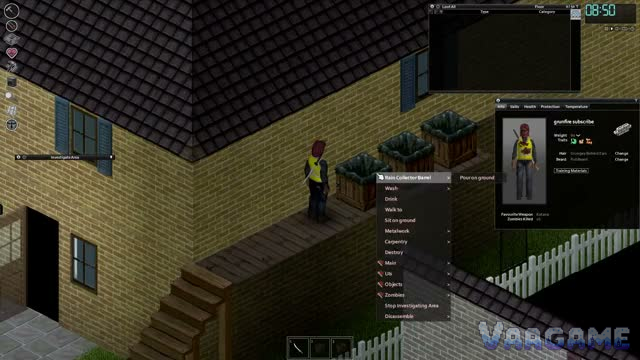
Rain collectors are the standard renewable base solution. Rivers and lakes provide huge raw-water access, but raw outdoor water should be treated as unsafe until purified under current rules. World wells and hand pumps are extremely valuable where they exist because they are map fixtures, not items you craft anywhere you want.
Do not choose a long-term base only because it has many rooms. Water access can be worth more than one extra storage floor.
How Build 42 plumbing works
For the standard plumbing action, place a plumbable fixture indoors or inside a valid player-built safehouse. Put a water source one floor above, inside the 3×3 area centered above the fixture. The source must contain water, and you need an undamaged Pipe Wrench.
This is not a long-distance pipe network. A collector on the same floor or far across the roof does not automatically feed the sink. If Plumb is missing, recheck indoor status, tool condition, height and distance.
Water priorities after the shutoff
Keep a small clean-water reserve for drinking and medicine. Use larger stores for cooking and washing only when the supply can support it. In multiplayer, separate “drinking reserve” from general water so one teammate does not empty everything into a low-priority task.
The goal is redundancy: stored clean water, renewable collection, and at least one emergency source on the map.
Common shutoff mistakes
The biggest mistakes are waiting for the tap to fail before looking for containers, assuming every rural property has a well, drinking untreated outdoor water, and building collectors without confirming the later plumbing layout. Prepare the whole chain, not just one barrel.
Troubleshooting and common mistakes
Swipe horizontally to view all columns.
| Problem | Check |
|---|---|
No Plumb action | Indoor fixture, usable Pipe Wrench, source one floor above. |
Connected but no water | Source must contain water and sit in the valid 3×3 area. |
Running out after shutoff | Separate drinking reserve from washing/cooking and add a renewable source. |
FAQ
When does water shut off in Apocalypse?
The current preset window is 0–30 days, so an early outage is possible.
Can I build a well anywhere?
Not in vanilla Build
42. World wells and hand pumps are map objects; plan around where they actually exist.
Why can’t I plumb my sink?
Check that the fixture is indoors, the source is one floor above within the valid 3×3 area, contains water, and you have a usable Pipe Wrench.