

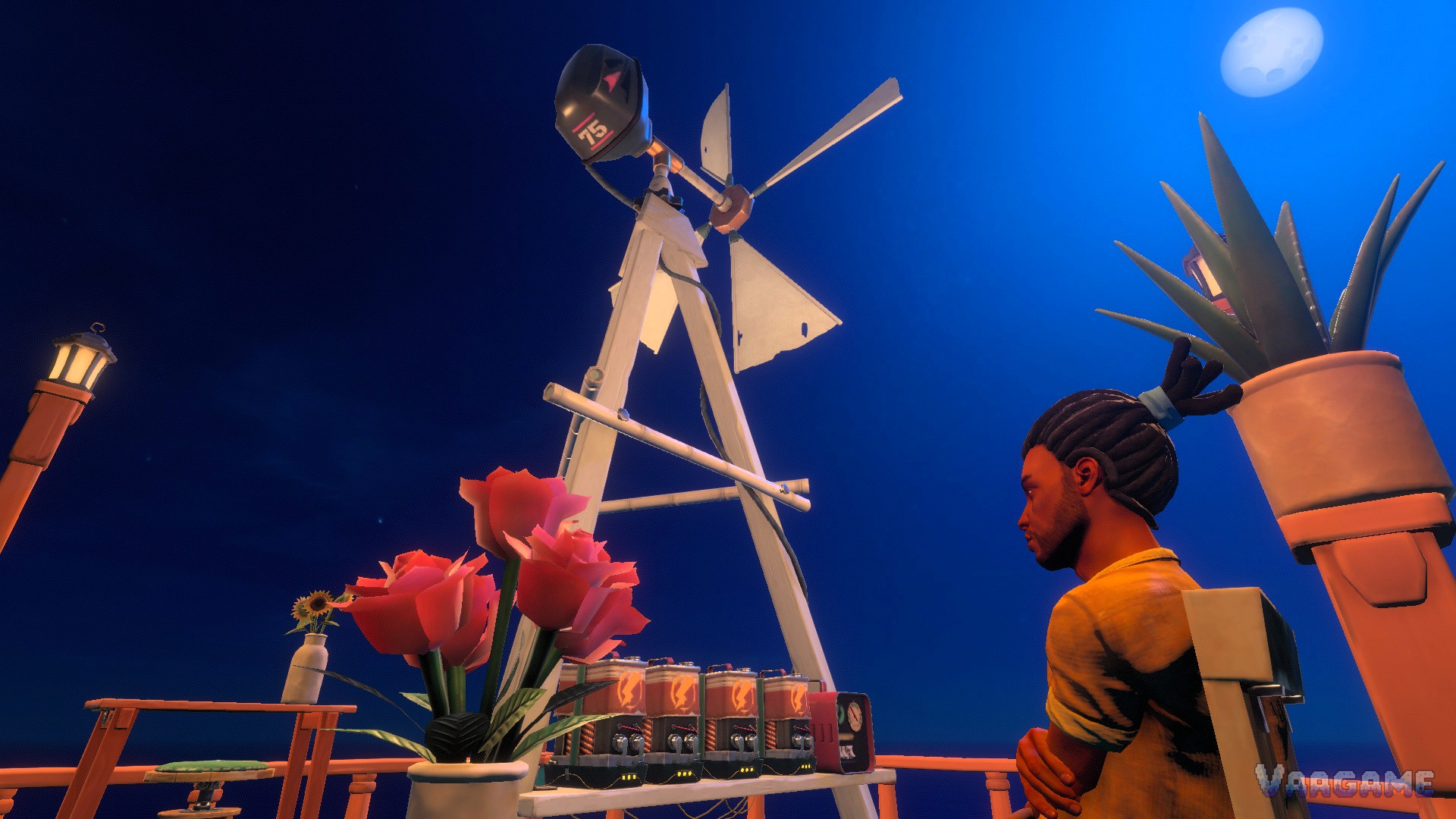
Power in Raft is not a grid you build once and forget. It is a set of separate batteries you carry, drain, and recharge, and every automated system is a trade: a sprinkler waters your crops but eats one battery charge per plant, an electric purifier makes water while you sleep but only if a charged battery sits in it. This guide frames each system as a decision: when it is worth building, what it costs you, and what chore it actually removes.
At a glance
What this is: Raft power and automation as player decisions: batteries, charging, engines, sprinklers, beehives, biofuel, and electric purifiers
Core rule: Every powered device drains its own battery; dead batteries do not vanish, they recharge
Free power: The Wind Turbine charges batteries for free, but only at height
Game: Raft, full release June 20, 2022; price $13.39 checked November 3, 2026
Verified: November 3, 2026, against the official Raft wiki and player guides
Quick answer
A Simple Battery holds 50 charges and is drained per use: a sprinkler spends 1 charge per plant watered, so one battery covers about one and two-thirds full sprinkler tanks.
Recharge with a Battery Charger first, then a Wind Turbine: the charger needs biofuel and takes 185 seconds for 2 batteries, while the turbine is free but needs height.
One engine pushes 100 foundations; six engines reach maximum speed on any raft. Fuel with biofuel through tanks and pipes, not planks by hand.
A sprinkler waters a 3 by 3 area in front of it and holds 30 uses; connect it by water pipes to an electric purifier or a water tank and only battery swaps remain.
A beehive needs flowers within one foundation: 3 flowers give 1 honeycomb, 6 give 2, 12 give 3, roughly every 8 minutes. Honeycomb plus glass becomes honey, and honey plus raw food becomes biofuel.
1. Batteries first: the currency every machine spends
Every powered device in Raft runs on a battery slotted into that device, and the battery drains as the device works. A Simple Battery holds 50 charges. The sprinkler is the clearest example: each plant it waters costs exactly 1 charge, and its tank holds 30 uses, so one battery covers 50 waterings, or one and two-thirds full tanks. The Electric Purifier shows the other end of the scale: one full battery fills its 15-cup tank 5 times, which is 75 cups of fresh water. The decision is always the same: count what the machine drinks before you build it, and keep a charged spare next to anything you depend on.
Advanced Batteries exist for the same slots and take far longer to charge, 525 seconds on a full-height wind turbine against 140 for a Simple Battery, which is the price of their larger capacity. This guide deliberately does not print an Advanced Battery charge count, because the sources checked agree on charge times but not on a single charge number. Treat the Advanced Battery as a longer-lasting, slower-turnaround battery for machines you hate swapping, not as a magic infinite cell.
2. Charging: pay biofuel now, or build high and pay nothing later
You get two chargers, and the story decides the order. The Battery Charger comes first: its blueprint is found on Caravan Island, it is researched at the Research Table, and it recharges 2 batteries in 185 seconds, with a light beside each slot turning from red to green. It runs on biofuel, and one canister charges up to 4 batteries, and it switches itself off when the batteries are full, so it never wastes fuel. Build it the moment you can: it is the first time batteries stop being disposable.
Swipe horizontally to view all columns.
| Wind Turbine height | Simple Battery | Advanced Battery |
|---|---|---|
3 walls, maximum efficiency | 140 seconds | 525 seconds |
2.5 walls | 175 seconds | 623 seconds |
2 walls | 220 seconds | 825 seconds, estimated |
0 to 1 wall | 420 seconds | 1585 seconds |
The Wind Turbine comes later, with its blueprint at Varuna Point, and it changes the maths completely: it charges for free, and charging more batteries at once does not slow it down. The catch is height. Its voltage meter shows efficiency, and it needs at least 3 walls of height for maximum speed; at ground level a Simple Battery takes 420 seconds instead of
140. The turbine itself is roughly 3 walls tall, so it is a poor fit indoors: give it a tower, not a corner. Once it stands tall, the charger becomes your backup and the turbine becomes your routine.
3. Engines: count foundations before you count engines
Engines let you sail against the wind and, with a Steering Wheel, steer anywhere. The blueprint is found on Vasagatan. The rule that decides everything is foundations: one engine pushes up to 100 foundations, and collection nets do not count. Push past 100 per engine and you enter a slow zone at half power; push past 110 per engine and the raft stops, stuttering, while burning no fuel. Six engines together reach maximum speed on any raft, regardless of size. So the decision is not how fast you want to go, it is how big your raft already is.
Fuel is the second decision, and planks lose. An engine tank holds 10 minutes of fuel, or 17 planks at 36 seconds each, and a biofuel canister powers an engine for 12 minutes, which is more than the tank holds, so pouring a canister straight in wastes at least 2 minutes. The correct setup is fuel tanks and fuel pipes: one tank holds 4 canisters and powers a single engine for 48 minutes, and pipes feed engines automatically. If an engine stutters, check four things in order: the raft is not anchored, the engines cover the foundations, every engine has fuel, and all direction levers point the same way.
4. Sprinklers: worth it the moment hand-watering gets old
A sprinkler waters grass plots and crop plots in a 3 by 3 area in front of it, and only in front: it cannot spray behind or from the sides, so place it facing the crops, not in the middle of them. It checks every 5 seconds for a plant that needs water and fires on its own. The build costs 12 plastic, 2 scrap, 2 bolts, and 1 circuit board, researched at the Research Table. It holds 30 uses of water, and since Update 12 it has a water pipe connection on the back, so it can draw from an electric purifier directly or from a water tank. Battery swaps are still manual, but water hauling stops being your job.
The decision point is plot count. With two or three plots, hand-watering is faster than building, powering, and maintaining a sprinkler. With a farm big enough to feed animals and a biofuel chain, the sprinkler pays for itself in the first harvest, because it never forgets a dry plot while you are off exploring. Pair it with a scarecrow, or the Advanced Scarecrow from the Trading Post, since seagulls eat the same crops the sprinkler waters, and an unguarded automated farm is just an automated bird feeder.
5. Beehives and biofuel: the chain that feeds your engines
Beehives turn flowers into honeycomb, and honeycomb into honey, and honey into biofuel, which is the fuel your engines and your battery charger both drink. A beehive costs 20 planks, 8 plastic, 4 clay, 2 hinges, and 15 bee jars, caught with a sweep net from swarms after Balboa Island. The bees need flowers planted and watered within one foundation of the hive: 3 flowers yield 1 honeycomb, 6 yield 2, and 12 or more yield 3, roughly every 8 minutes. Any flower colour works, and a scarecrow or a closed room is mandatory, because seagulls eat flowers too.
Six honeycomb and 1 glass craft into 2 honey, and the refiner rule is 1 honey plus 200 value of raw food per biofuel. The basic Biofuel Refiner, blueprinted at the Ranger Station on Balboa Island, holds 400 food value and 2 honey, so it makes 2 biofuel per load and must be emptied by hand. The Advanced Biofuel Refiner costs 20 plastic, 8 metal ingots, 6 titanium ingots, and 2 bolts or hinges, holds 1200 food value and 6 honey for 6 biofuel, stores the output in a barrel, and connects to fuel pipes. That pipe connection is the whole reason to upgrade: the basic refiner is a chore, the advanced one is infrastructure.
6. Electric purifiers: the last water chore you automate
The Electric Purifier is the water half of the automation loop. Its blueprint is found in the Plantation area of Tangaroa, and it costs 4 titanium ingots, 1 circuit board, 20 plastic, and 5 scrap. It must sit beside a seawater source with a water-level hole for its hose, and once powered it pulls salt water and fills its own tank with fresh water: 15 cups per tank, 80 seconds per fill, 5 fills per battery. It can only pump 8 floors up from foundation level, so keep it low. Connect it by water pipes to a water tank, and connect the tank to your sprinklers, and the entire watering chain runs on battery swaps alone.
The build order matters. Do not build a purifier before you have titanium to spare and a charger to feed it, because a purifier with a dead battery is just furniture. Build it when your farm is big enough that hand-filling bottles costs real exploring time, and put the purifier, the tank, and the sprinklers on the same low deck so the 8-floor pump limit never bites. Paired with the beehive chain, this is the point where the raft starts running itself: fuel from flowers, water from the sea, and your job reduced to swapping batteries and harvesting.
7. What this guide leaves out, honestly
Two more battery-powered machines exist and are deliberately not given full sections here. The Electric Smelter and the Electric Grill are both researchable at the Research Table, so they belong in a powered raft, but the sources checked did not agree on their exact power draw, so no consumption numbers are printed for them. Treat them as convenience upgrades to verify in your own game before committing titanium, not as proven automation wins. The same honesty applies to the Advanced Battery charge count in section 1: charge times are verified, the charge count is not.
Frequently asked questions
How do I recharge batteries in Raft?
With a Battery Charger from Caravan Island, 2 batteries in 185 seconds on biofuel, or with a Wind Turbine from Varuna Point, which is free but needs height: 140 seconds for a Simple Battery at 3 walls, 420 seconds near the ground.
How many engines do I need?
One per 100 foundations, and six for maximum speed on any raft. Past 110 foundations per engine the raft stops and stutters without burning fuel.
Is a sprinkler worth building?
Yes once your farm is big enough that hand-watering eats exploring time. It waters a 3 by 3 area in front of it, holds 30 uses, and can be piped to a purifier or tank so only battery swaps remain.
How do beehives make biofuel?
Flowers near the hive make honeycomb, roughly every 8 minutes: 3 flowers for 1, 6 for 2, 12 or more for
3. Six honeycomb and 1 glass make 2 honey, and 1 honey plus 200 value of raw food makes 1 biofuel.
Where is the Electric Purifier blueprint?
In the Plantation area of Tangaroa. It costs 4 titanium ingots, 1 circuit board, 20 plastic, and 5 scrap, and it pumps at most 8 floors up.
Should I use planks or biofuel in engines?
Biofuel, through tanks and pipes. A tank holds 4 canisters and powers one engine for 48 minutes, while a hand-fed plank tank lasts 10 minutes and needs constant refilling.