

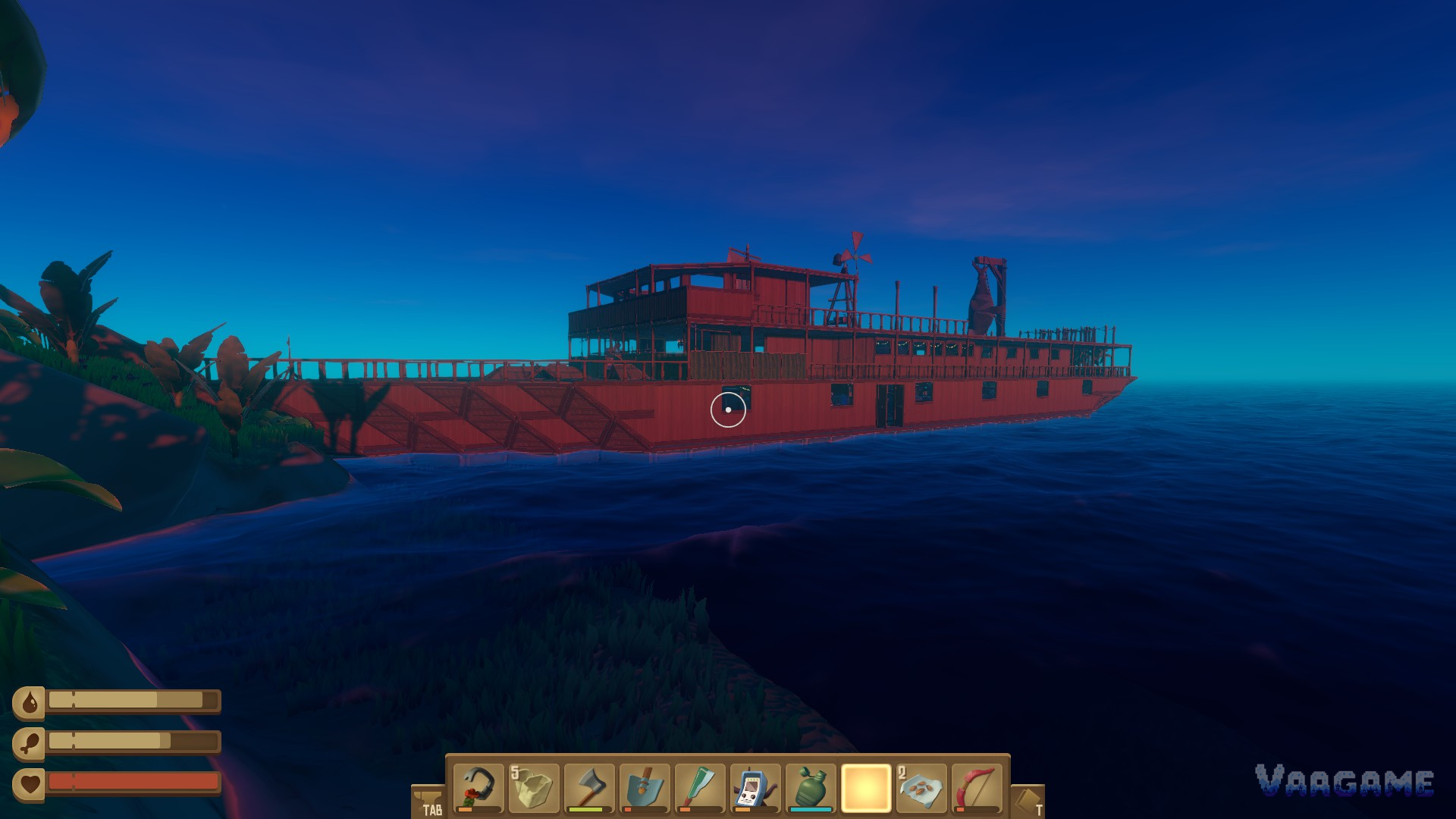
You wake up on a 2x2 raft in the middle of an endless ocean, holding a hook made of old plastic. That is the whole start of Raft, and the whole game grows out of it: hook the debris drifting past, turn it into water, food, and raft, and keep doing that until your floating wreck becomes a floating home. This guide gives you the order that works, the mistakes that kill new players, and the facts you need before you buy or upgrade anything.
At a glance
What it is: An ocean survival crafting game, solo or in online co-op, by Redbeet Interactive, published by Axolot Games
Start: A 2x2 raft and a plastic hook; thirst drops faster than hunger, so water comes first
Full release: June 20, 2022, after Early Access from May 23, 2018; the story is complete
Price checked November 3, 2026: $19.99 list, $13.39 on sale at 33% off on Steam; sale prices change, so treat this as a dated check, not a permanent price
No official Chinese name: the store name is Raft; Chinese players often nickname it 木筏求生, but that is a community nickname, not an official title
1. The official introduction: what Raft says it is
The Steam store description opens with the premise in one line: by yourself or with friends, your mission is to survive an epic oceanic adventure across a perilous sea. You gather debris to survive, expand your raft, and set sail toward forgotten and dangerous islands. Trapped on a small raft with nothing but a hook made of old plastic, you wake on a vast blue ocean, totally alone, with no land in sight, a dry throat, and an empty stomach.
The official feature list is the honest table of contents for the game: multiplayer co-op, the hook, crafting survival equipment and weapons and crop plots, building from a simple wreck to a buoyant mansion, a research table that teaches you new things to craft, navigation toward new destinations, diving for resources, fighting ocean dangers, and farming and cooking, including recipes and smoothies. If a beginner guide promises you something outside that list, be suspicious of it.
2. The survival loop, in the order that works
Everything floats past you, and everything you need comes from what floats past you. Planks, plastic, palm leaves, and barrels drift by; barrels are the best catch because they hold a mix of resources, including food and scrap. Hook everything you can reach, and grab by hand anything that drifts close enough to touch. Your first craft is a building hammer, which lets you add foundations and grow the raft beyond its starting four tiles.
Thirst kills first, so the purifier comes before almost everything else. Craft a simple purifier and a cup: fill the cup with seawater, pour it in, burn a plank under it, and drink once the cycle finishes. Food comes second. A simple grill and a fishing rod turn caught fish into real meals, and the potatoes and beets found in barrels can be grilled too. Do not eat raw fish as a plan: community guides note that raw fish hurts your thirst, which is the one meter you cannot afford to spend.
Swipe horizontally to view all columns.
| First crafts, in order | Why this early | Watch out |
|---|---|---|
Building hammer | Unlocks foundations and every structure after it | Expanding the outer edge without a spear invites the shark |
Simple purifier and cup | Thirst drops fastest; this is your water supply | It burns planks, so keep a plank reserve |
Simple grill and fishing rod | Cooked fish is your first reliable food | Raw fish hurts thirst; cook before you eat |
Wooden spear | Drives the shark off your raft | It wears out; carry a spare mindset, not a spare panic |
Storage | Stops your inventory from choking the loop | Build it before the raft gets big, not after |
3. The shark: your permanent neighbor
A shark circles your raft from the start and never really leaves. According to the Raft Wiki, it attacks the raft about every five minutes, and you must deal it 15 points of damage to drive it off, or it breaks the foundation or collection net it is attacking. You can repair a foundation with planks even while it is being attacked, so a plank reserve is also shark defense. If you kill it, loot it quickly: the wiki reports it respawns about three minutes after being looted, and a new shark is not a bug, it is the game.
Two defenses change the relationship entirely. Foundation armor on a foundation or net makes the shark skip that piece, and shark bait thrown in the water distracts it for about 80 seconds, according to the wiki. The practical rule for beginners is simpler: keep valuables off the outer edge, where the shark bites, and put them on inner foundations or upper floors instead. Your first base is a raft, not a fortress, and the edge is the wall.
4. The research table: how new things unlock
Build the research table early and feed it everything you find. Researching a material unlocks the recipes that use it, which is how you get from a wooden spear to metal tools, from a simple purifier to an advanced one, and from a bare raft to collection nets that catch debris for you. The beginner mistake is to treat research as a late-game luxury. It is the opposite: it is the thing that makes the early game stop feeling like bailing water with a cup.
Collection nets deserve a special mention because they change the daily rhythm. Line the front edge of your raft with them and debris starts arriving without constant hook-throwing, which frees you to fish, cook, build, and explore. Remember the shark rule, though: nets on the edge are also shark food unless armored, so armor the net line when you can afford it.
5. Where the story leads, without spoilers
Raft is not an endless sandbox with nothing at the end. The store description promises forgotten places above water, the challenges inside them, the story of their previous inhabitants, and a next destination after each one. In practice you build a receiver and antennas, follow the signal, and sail to story locations in order, starting with the Radio Tower. The walkthrough lane of this column covers each destination; the beginner job is to arrive seaworthy, with water, food, storage, and a way to stop the raft from drifting away while you explore.
That last point is a classic beginner loss. A throwable anchor stops the raft while you explore an island, and the basic version is single-use, so carry spares or work toward the reusable anchor. Never swim to an island without a way back: the raft drifts, the shark patrols, and the swim home is longer than it looks.
6. Player reviews: what the crowd actually says
A note on method first, because this section could not be built the usual way. The Steam reviews endpoint for Raft returned the Steam store homepage instead of review data when fetched for this guide, so no individual verified-purchase review text is quoted here. What follows is the aggregate picture from SteamDB plus press coverage, both attributed, and it is enough to answer the only question a beginner should ask: is this a safe buy with a real player base behind it.
SteamDB lists Raft with a review score of 8 and 92% positive reviews, which sits in Very Positive territory. PCGamesN reported in May 2024 that Raft held a 93% Very Positive rating from more than 263,000 reviews, during a discount surge that pushed concurrent players past 40,000. PCGamesN described it plainly as a co-op survival game where players build a base on the open ocean, progressing from a tiny raft to a full-fledged houseboat. Two years of review volume at that scale, plus a completed story, is the practical meaning of a safe evergreen buy: the game is finished, the audience is large, and the beginner guides are written for a game that is no longer moving under your feet.
The honest negative side, at the aggregate level, is the shape of the game itself, not a scandal: it is a slow loop, it repeats, and the grind between story beats is real. If you want constant action, this is the wrong ocean. If you like the loop, hook, cook, build, sail, repeat, that repetition is the game, and the co-op version of it is why the review base is so large.
7. Official PC specs, interpreted honestly
Swipe horizontally to view all columns.
| Spec | Minimum | Recommended |
|---|---|---|
Operating system | Windows 7 or later, 64-bit required | Windows 7 or later, 64-bit required |
Processor | Intel Core i5 2.6GHz or similar | Intel Core i5-6600 3.3GHz or similar |
Memory | 6 GB RAM | 8 GB RAM |
Graphics | GeForce GTX 700 series or similar | GeForce GTX 1050 series or similar |
Storage and DirectX | 10 GB available, DirectX 11 | 10 GB available, DirectX 11 |
The interpretation is good news for most players. A GTX 700-series minimum and a GTX 1050 recommended tier mean Raft is a low-spec game by modern standards: a modest laptop or an older desktop that meets the 8 GB recommended memory line should run it, and the 10 GB install is small. The store page lists Windows only, so Mac and Linux players should check current platform support before buying rather than assuming it. Broadband is listed for the online co-op side, which matters the moment you play with friends.
8. Value hardware picks: the honest answer is almost nothing
Raft does not justify a hardware purchase for most beginners, and this guide will not pretend otherwise. If your PC already meets the recommended line above, 8 GB of memory and a GTX 1050-class card, spend nothing and put the money toward the game itself while it is on sale. If you are below the minimum line, the single upgrade that helps this game most is memory to 8 GB, because the game is small, old, and CPU-light; a new graphics card for Raft alone would be money spent on the wrong bottleneck.
No affiliate hardware link appears in this guide: no specific product with a tracker-confirmed ASIN was verified for this article, so no product is linked rather than linking a near-substitute. That is deliberate, and it follows the column rule that an unconfirmed item stays unlinked.
Frequently asked questions
What should I do first in Raft?
Hook everything, then build a purifier and a cup before anything else, because thirst drops fastest. Then a grill and a fishing rod for food, a spear for the shark, and storage before your inventory fills up.
How do I stop the shark from eating my raft?
Spear it when it attacks, keep valuables off the outer edge, and armor foundations and nets when you can. Shark bait distracts it for about 80 seconds, according to the Raft Wiki.
Is Raft finished, or still in Early Access?
Finished. It left Early Access with the full release on June 20, 2022, and the story is complete, which makes it a long-tail evergreen game rather than a launch-window gamble.
Do I need a good PC for Raft?
No. The recommended spec is a GTX 1050-class card with 8 GB of memory and 10 GB of storage, which is modest by modern standards. The store page lists Windows only.
What is the Chinese name for Raft?
There is no official Chinese name. The store name is Raft, and any Chinese nickname players use is a community nickname, not an official title.