

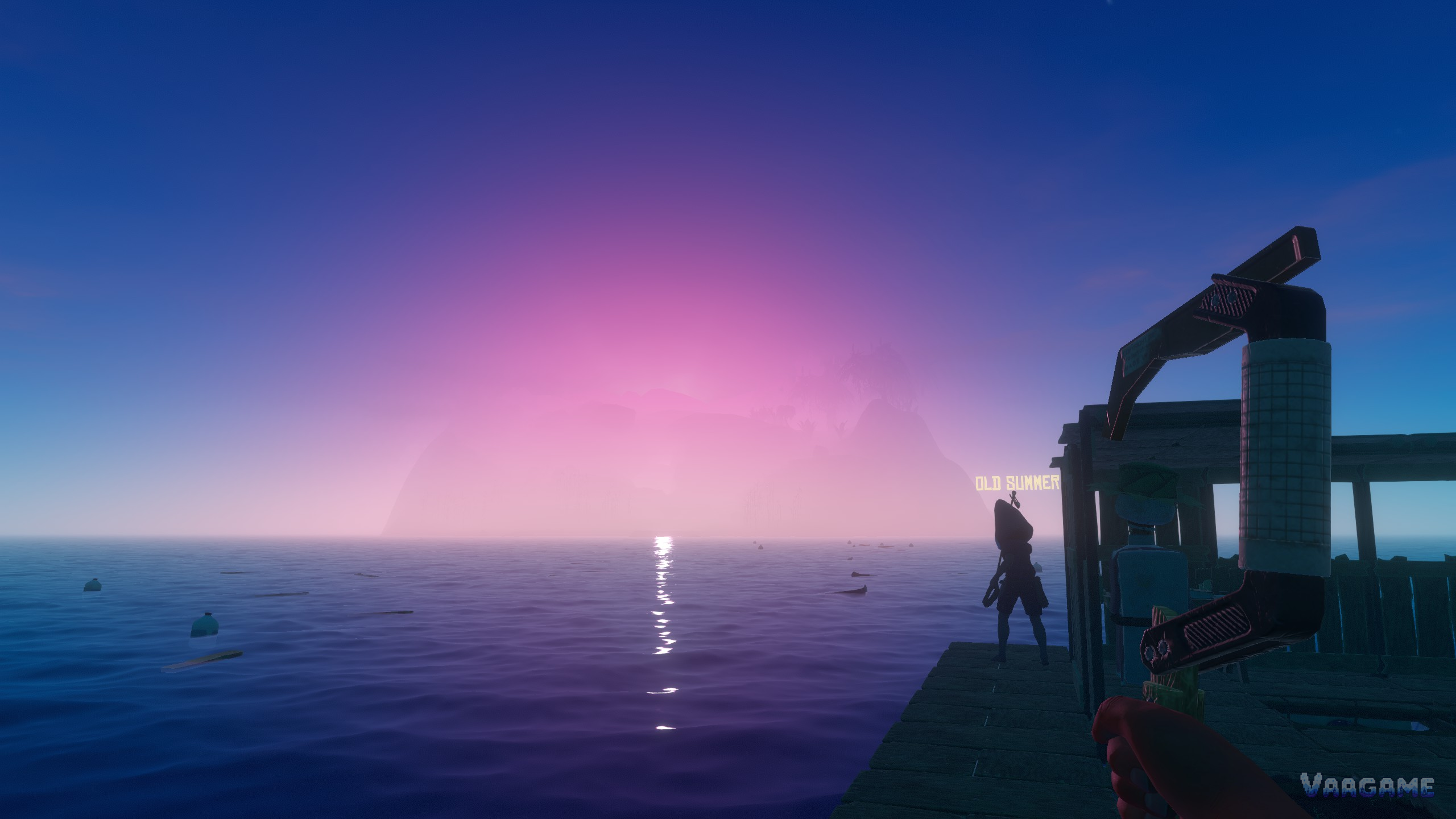
The first week in Raft is not about building something beautiful. It is about stopping four clocks at once: thirst, hunger, the shark eating your raft, and your inventory filling up. Players who lose in week one almost always lose to the same thing, not to a monster or a boss, but to doing the second-most-important thing first. This guide gives you the day-by-day order that keeps all four clocks quiet.
At a glance
The rule of week one: water before food, food before building, building before beauty
The four clocks: thirst, hunger, shark damage, and inventory space
End-of-week target: purifier and grill running, research table working, collection nets catching, crops planted, sail up, anchor ready
What this guide does not do: it gives no material counts for recipes, because those were not re-verified for this article; it gives you order and decisions, not a shopping list
Day 1: Hook, drink, eat, sleep on a raft that still floats
Do not wander, do not admire the sunset, do not jump in the water. The raft drifts without you and the shark is already circling, so your first hour is hook work: pull in every plank, plastic piece, palm leaf, and barrel you can reach, and grab by hand whatever drifts close. Barrels first when you have a choice, because they carry mixed resources. Then craft in this order: building hammer, simple purifier, cup, simple grill. Fill the cup with seawater, pour it into the purifier, burn a plank under it, and drink as soon as the cycle ends. Thirst is the fastest clock, and a purifier running is the difference between a game and a countdown.
For food on day one, eat what barrels give you and grill what you catch. Build a fishing rod as soon as you can and cook every fish before eating it. By nightfall you want three things true: the purifier has a plank reserve under it, the grill has fish on it, and you have a spear or at least the materials for one. If night finds you without water, you have already lost the day; fix that before you fix anything else.
Day 2: Spear, storage, and room to breathe
Day two is about the two clocks you ignored on day one: the shark and your inventory. Craft a wooden spear and use it the moment the shark bites the raft; the Raft Wiki reports an attack about every five minutes and 15 damage to drive it off, so do not let a bite run its course while you finish something else. Then build storage, because a full inventory is a silent run-killer: you stop hooking, you stop crafting, and the loop stalls while the meters keep falling.
Expand the raft, but expand inward in your head: add foundations around the core, keep the purifier, grill, and storage on inner tiles, and leave the edge as the sacrificial layer the shark can chew without taking your kitchen with it. A bigger raft on day two is not about comfort. It is about having somewhere to put the storage, the grill, and the next station without rebuilding everything on day four.
Day 3: Research table and the first collection nets
Build the research table on day three and start feeding it. Research is the unlock system: every material you research opens recipes, and the two that change week one most are the collection net and the next tier of purifier and grill. Do not wait for a perfect stockpile before researching. Research the scraps and oddments you already have, because each unlock changes what the next hour of hooking is worth.
Place your first collection nets along the front edge of the raft, facing the drift. From here on, debris starts arriving while you do other things, and that is the moment week one turns from frantic to manageable. The shark caveat stays: edge nets are shark food unless armored, so watch them and repair or armor them as soon as you can. A net that catches for a day and then gets eaten has still paid for itself; a net you never check has not.
Days 4 to 5: First island, with an anchor, and crops in the ground
By day four you should be ready for land, and land means an anchor first. Craft a throwable anchor before you approach an island, because an unanchored raft drifts away while you explore, and swimming after it with a shark around is a bad plan. The basic anchor is single-use, so bring spares. On the island, chop trees, gather what you cannot get at sea, and keep an eye on the time: the island is a shopping trip, not a new home, and the raft is still your base.
Plant crops on days four or five. Crop plots with potatoes, beets, and later island seeds turn food from a fishing chore into a supply line, and cooked crops plus cooked fish together cover the hunger meter far better than either alone. Protect the plots: seagulls steal crops, as any player with a farm on deck will tell you, so scarecrows or covered plots belong on the list as soon as birds become a problem rather than a joke.
Days 6 to 7: Sail, receiver, and the week-one verdict
A sail, or at least a paddle you trust, changes week one from drifting to steering. With a sail up and the anchor habit formed, you can aim at islands instead of waiting for them, and you can start the story path: the receiver and antennas that pick up the signal leading to the Radio Tower and beyond. You do not need to finish the story in week one. You need to be the kind of raft that can reach it: water handled, food handled, storage sorted, shark managed.
Take the week-one verdict honestly. If the purifier runs dry every day, the problem is planks, not thirst: hook more, net more, and stop burning your reserve on decorations. If hunger is the problem, the answer is usually crops plus fish, not more fishing alone. If the shark keeps eating something important, the answer is placement: move it inward. Week one rewards boring fixes, and the players who survive it are the ones who fix the loop instead of decorating around it.
Early mistakes to avoid
Jumping in the water on day one: the raft drifts and the shark is already there
Eating raw fish as a plan: it hurts thirst, the meter you cannot spare
Building valuables on the outer edge, where the shark bites first
Exploring an island without an anchor, or with only one single-use anchor and no spare
Letting the inventory fill up instead of building storage on day two
Treating research as a late-game luxury instead of the week-one unlock engine
Decorating before the loop works: a pretty raft with no water is still a countdown
Frequently asked questions
What is the first thing to build in Raft?
A building hammer, then a simple purifier and a cup. Water is the fastest-falling meter, and everything else waits behind it.
When should I visit my first island?
Around day four, once water, food, a spear, and storage are handled, and only with a throwable anchor and spares. The island is a supply run, not a move.
Do collection nets really matter in week one?
Yes. They turn hooking from a full-time job into a background income, which is what frees you to research, farm, and explore. Armor them when you can, because edge nets are shark food.
What ends a first week run most often?
Not a boss. It is thirst from a dry purifier, hunger from no food pipeline, a shark eating the wrong tile, or a full inventory stalling the whole loop.