

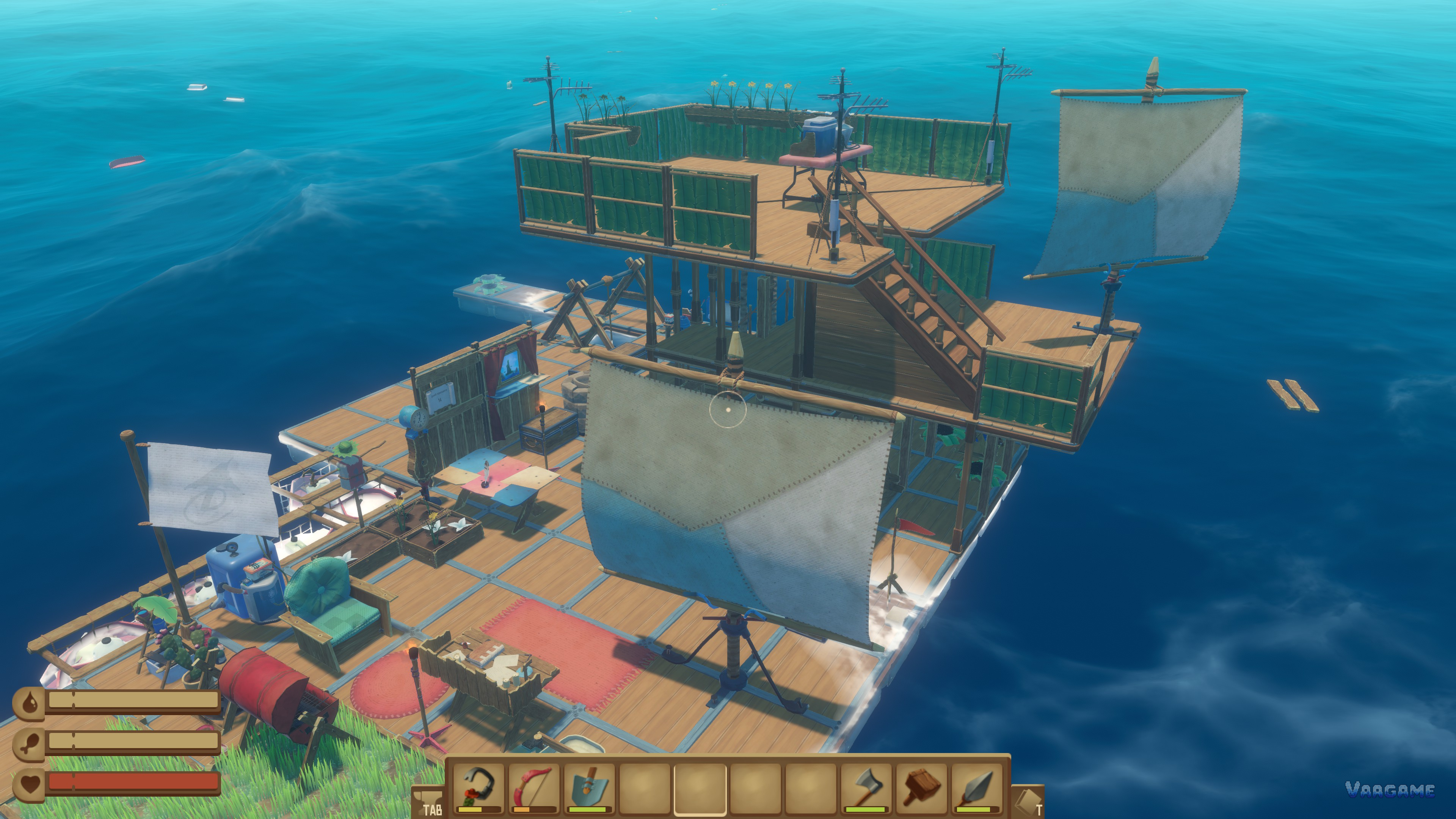
For the first hours of Raft, the ocean decides where you go. The sail nudges you, the current carries you, and story islands drift past while you wave a paddle at them. Then you build a receiver, three antennas, and a battery, and suddenly you have coordinates. Then you build engines, and suddenly the current is a suggestion. This guide covers that whole arc: sail first, receiver second, engines third, and the fuel and steering habits that make every trip cheaper.
At a glance
Game: Raft, by Redbeet Interactive, published by Axolot Games; full release June 20, 2022, Early Access May 23, 2018
Price: $13.39 on Steam as of November 3, 2026, 33 percent off the $19.99 base price; prices change, so check the store page
Chinese name note: Raft has no official Chinese name; players often call it by the nickname Mu Fa Qiu Sheng, which is a player nickname, not an official name
Order: sail, then receiver plus 3 antennas plus battery, then engine and steering wheel blueprints from the Vasagatan
Verified: November 3, 2026, against multiple community engine and navigation guides for recipes, ratios, and receiver behavior
Quick answer
Sail is free and wind-limited: it can nudge you toward an island but cannot push against the current to a story island.
Receiver needs 3 antennas and a battery: a green light means it is working; face the receiver forward or the radar will confuse you.
Engines need their blueprints from the Vasagatan shipwreck, reached by following receiver coordinates from the Radio Tower.
One engine pushes about 100 foundation squares, up to 6 engines total, and every engine must push the same direction.
Fuel early is planks; fuel late is biofuel from a refiner, made from honey and raw food, or from animal heads.
1. The sail: free, and honest about its limits
The sail is your first navigation tool and it costs nothing to run. It catches the wind and nudges the raft in the direction you set, which is enough to reach the small islands drifting past and to park beside reefs for diving. What it cannot do is fight the current. Story islands like Balboa sit against the current on purpose, and no amount of sail trimming gets you there. Treat the sail as the early-game tool and the late-game helper, not as the answer to navigation.
Two small tools make sail life much easier. A streamer on deck shows which way is forward at a glance, which matters because a raft has no bow until you decide it has one. A paddle is the emergency tool for a stuck raft, useful when you wedge against an island or drift into a reef at low speed. Neither tool costs much, and both prevent the classic early-game scene of circling an island you can see but cannot reach.
2. The receiver and antennas: how coordinates work
The receiver is the moment Raft stops being drift and starts being travel. Build it, place three antennas near it, raised high and spread apart, and power it with a battery. When the light turns green, the receiver is working, and its radar screen shows nearby signals as dots. Each story location hands you a four-digit code: enter it into the receiver, and your target appears as a marked blip instead of one dot among many.
The most common receiver mistake is placement, not power. The receiver is direction-sensitive: it points based on the direction the receiver itself faces, so a receiver angled to the side or facing the stern makes the radar read backwards. Put the receiver facing forward, put the steering wheel where you can see the receiver screen while steering, and check the screen in bursts: switch it on, line up, switch it off to save battery, and switch it on again to check for drift. The chain that matters is Radio Tower first, then the Vasagatan with its engine and steering wheel blueprints, then Balboa.
3. Engines: the blueprint, the build, and the 100-square rule
Engines change the game twice: first they let you reach Balboa against the current, then they let you ignore the wind for the rest of the story. The blueprints for the engine and the steering wheel both come from the Vasagatan shipwreck, which you reach by following the coordinates found at the Radio Tower. Build two engines and one steering wheel for the Balboa run: engines on the back of the raft, pushing the same direction, with the receiver facing forward.
Swipe horizontally to view all columns.
| Item | Recipe | Rule |
|---|---|---|
Engine | 5 metal ingots, 5 ropes, 1 circuit board, 20 planks | About 100 foundations per engine; maximum 6 engines |
Steering wheel | 10 scrap, 4 metal ingots, 4 ropes, 2 bolts, 2 hinges | Turns the raft; best combined with engines |
Receiver | Needs 3 antennas and a battery | Green light means working; face it forward |
Count foundations before you count engines. A raft of 100 to 200 foundations needs two engines for decent speed, 201 and up needs three, and six is the maximum the game counts. Engines must sit next to water and all push the same way: one engine facing backwards cancels one facing forwards, and the raft goes nowhere while burning fuel. Engine controls, a separate build, let you run all engines from one spot, and an advanced stationary anchor works remotely with those controls, so a big raft can be driven and parked without running deck to deck.
4. Fuel: planks now, biofuel later
Early engines run on planks, and that is fine for short trips: stock every engine well before a story run. But planks are also your building material, and long engine runs eat them fast. The upgrade is the biofuel refiner, blueprinted and researched, which turns honey plus raw food into biofuel cans. Animal heads can also be refined into biofuel. Biofuel is denser, longer-lasting fuel, and it frees planks for building again.
The fuel economy that works is boring and effective: sail with the wind for free, run engines against the wind and for story approaches, and shut engines off the moment you anchor. A common waste is leaving engines idling while looting an island for an hour; fuel burned at anchor buys nothing. Keep a fuel chest beside the engines, not in a tower two decks away, because the moment you need fuel is the moment you are already steering.
5. Sailing efficiently between islands
Plan by code, not by sight: enter the four-digit code before leaving, so the radar blip guides the whole trip.
Sail with the wind, engine against it: free miles on the sail, paid miles only where the sail cannot go.
Line up, then ride: steer until the target blip sits dead ahead, then hold course and recheck for drift in bursts.
Anchor before you leave the raft, every time: a drifting raft strands you, and swimming after it costs more than the anchor did.
Park nose to the island with a paddle ready: a wedged raft is fixed in seconds with a paddle and a short reverse, not by rebuilding.
Watch the raft size as you build: every big expansion is also an engine decision, so add engines when you add foundations.
Frequently asked questions
Can I reach story islands with just a sail?
Small islands, yes; story islands against the current, no. Balboa is the classic case: it needs engines, and the engine blueprint comes from the Vasagatan.
Why is my receiver light red?
Usually antennas, not power. You need three antennas, raised high and spread apart, plus a battery. Check count and height first.
How many engines does my raft need?
About one per 100 foundations, up to 6 total. Two engines cover 100 to 200 foundations, three cover 201 and up, and six is the maximum the game counts.
What fuel should I use?
Planks early, biofuel later. Biofuel comes from a refiner fed with honey and raw food, or from animal heads, and it frees planks for building.
Why does my radar seem backwards?
Because the receiver faces the wrong way. It points based on its own facing direction, so turn the receiver to face forward and put the wheel where you can see its screen.