

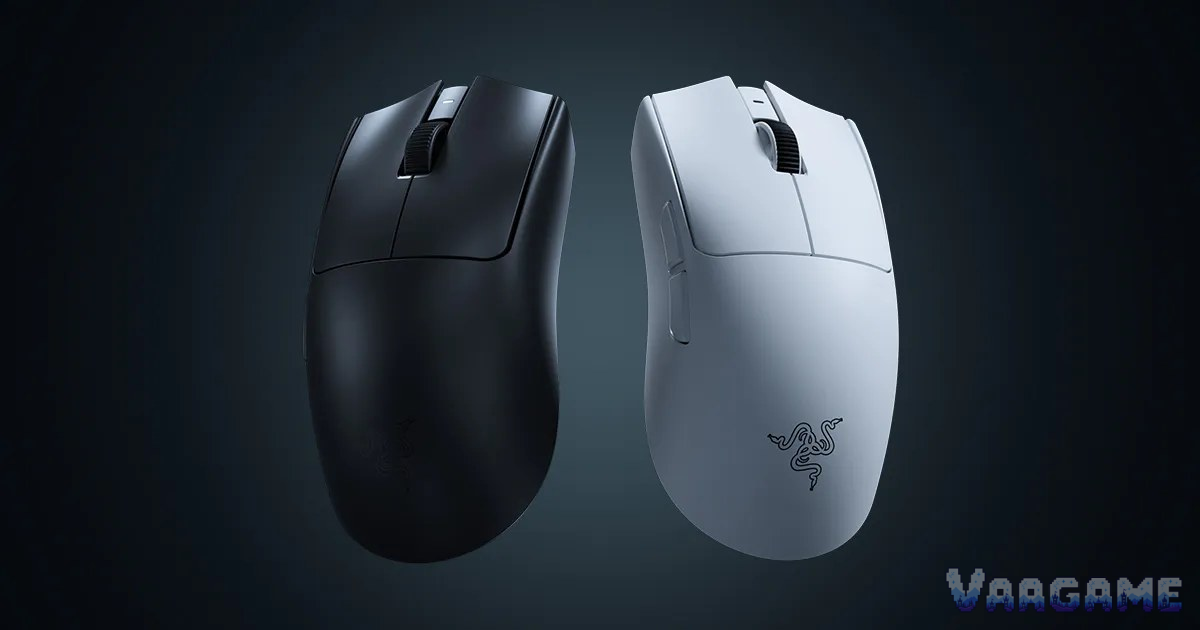
Razer launched the Viper V4 Pro in March 2026 as its new flagship symmetrical esports mouse, and within months it became the most-used mouse among professional VALORANT players: ProSettings counted 128 VALORANT professionals using it in October 2026, ahead of the Logitech G Pro X Superlight 2 at 59 and the Logitech G Pro X2 Superstrike at
52. The mouse keeps the Viper shape players already know and changes almost everything inside it: a new Focus Pro 50K Gen-3 sensor, Gen-4 optical switches, HyperSpeed Wireless Gen-2 with true 8,000 Hz polling, and a black model that weighs 49 grams. This is a reputation review, not a hands-on test by Vaagame. What follows is what independent reviewers, professional-usage data, and Razer's own specifications actually say, including where they disagree. No price is quoted in this review, because no ASIN-level tracker price was verified on 2026-11-05.
At a glance
What it is: a wireless symmetrical esports mouse, launched in March 2026, succeeding the Viper V3 Pro as Razer's flagship mouse.
The headline number: 128 professional VALORANT players used it in ProSettings' October 2026 count, the most of any mouse, from a base of 705 tracked players.
Weight: 49 g in black, 50 g in white, excluding cable and dongle. The same Viper shape as the V3 Pro, aimed at claw and fingertip grips.
Sensor and polling: Focus Pro 50K Optical Sensor Gen-3, up to 50,000 DPI, 930 IPS, 90 G acceleration; up to 8,000 Hz polling in wired and wireless modes.
Battery, by polling rate: up to 180 hours at 1,000 Hz, and about 45 hours at 8,000 Hz. The two figures are different loads and must not be read as one battery claim.
Switches and scroll: Gen-4 optical switches rated by Razer for 100 million clicks, and an optical scroll wheel encoder that replaces the V3 Pro's mechanical encoder.
Connectivity: Razer HyperSpeed Wireless Gen-2 or wired USB-C. There is no Bluetooth mode.
No price is quoted: no US ASIN was confirmed and no ASIN-level tracker price was verified on 2026-11-05, so this review carries no affiliate link either.
What the pros are actually using
ProSettings tracks the gear of 705 professional VALORANT players, and its October 2026 mouse count put the Viper V4 Pro first with 128 players, more than double the second-placed Superlight 2 at 59 and the Superstrike at
52. Named users on the list include Meteor, Xdll, nzr, and tuyz, and ProSettings' live page still showed 128 players in November
2026. The V3 Pro held the same top spot before it, so this is a crown passed inside one product line, not a new brand breaking in. Treat the count as a signal, not a fitting guide: professionals pick a mouse for their grip, their sensitivity, and their team context, and the fact that 128 of them use this shape does not make it the right shape for every hand.
Sensor, polling and latency: the numbers that matter
The Focus Pro 50K Optical Sensor Gen-3 runs to 50,000 DPI with 930 IPS tracking and 90 G acceleration, and Razer's Frame Sync aligns sensor data with the PC to cut latency further. HyperSpeed Wireless Gen-2 delivers true 8,000 Hz polling in wireless mode as well as wired, with no secondary dongle purchase, and Razer claims up to 55 percent lower latency than the previous generation. RTINGS found exceptional raw performance, low and consistent click latency, and strong sensor performance in its own testing, and TechPowerUp confirmed flawless tracking up to 50,000 DPI with no smoothing, jitter, or angle snapping. Razer's own measurements put average click latency at 0.204 ms and motion latency at 0.36 ms; those are manufacturer figures, not independent test results, and they should be read that way. One practical note from TechRadar: the mouse ships at 1,000 Hz by default, and 8,000 Hz must be turned on in Synapse. Settings can also be changed in a browser through Synapse Web, with no software install and no account required.
Weight, shape and grip: 5 grams lighter, same hand feel
The black Viper V4 Pro weighs 49 g and the white one 50 g, excluding cable and dongle, against 54 g and 55 g for the V3 Pro in the same colors. RTINGS measured the black version at 48.9 g on its own test bench, which lines up with Razer's figure rather than contradicting it. The shell keeps the Viper shape exactly, with no cutouts, and reviewers consistently describe it as solid, with no flex or creak despite the lower weight. The shape is a low, right-handed symmetrical body aimed at claw and fingertip grips; palm-grip players with large hands, and anyone looking for a left-handed mouse, should try the shape first, because the two side buttons sit on the left only and there is no left-handed version.
Switches, scroll wheel and the loud-click problem
The Gen-4 optical switches are the most argued-about part of this mouse, and the argument is about sound, not reliability. Razer rates them for 100 million clicks, which is a manufacturer lifecycle rating, not a guarantee for any individual mouse. The optical scroll wheel encoder replaces the V3 Pro's mechanical encoder, a change RTINGS notes is meant to improve long-term durability, and reviewers describe the clicks as crisp and light, with the same pressure wherever you press. The complaint is consistent across outlets: RTINGS and TechRadar both call the main clicks loud, GamesRadar calls them loud and thunky, and Windows Central notes the switches are a bit loud for its reviewer's taste. If you stream, record voice comms, or share a quiet room, this is the real reason to pause before buying. The quiet alternative in our own coverage is the Superstrike, whose haptic clicks are near-silent; it is linked in the related reading below.
Battery life, read by polling rate
Battery life is where buyers most often misread this mouse, because Razer prints one headline number and the rest depends on polling rate. At 1,000 Hz the rating is up to 180 hours, nearly double the V3 Pro's 95 hours at the same rate. At 8,000 Hz it falls to about 45 hours. Some sources print 44 hours at 8,000 Hz; the difference is rounding across sources, and this review uses about 45 hours. Either way, the practical split is simple: players who run 1,000 Hz charge roughly every few weeks, while players who insist on 8,000 Hz should expect to charge roughly once a week of heavy use. Neither figure is a promise for any individual setup, since lighting, firmware, and use all move the real number.
Against the three mice readers already know
Against the three mice our readers already know, the V4 Pro's position is clear. It is the current flagship, not a sidegrade, and the comparison below is about fit, not about declaring a single winner.
Viper V3 Pro, our earlier review: the same shape, but the V4 Pro is 5 g lighter in black, moves from the 35K Gen-2 sensor to the 50K Gen-3 sensor, from Gen-3 to Gen-4 switches, and from 95 to 180 hours of battery at 1,000 Hz, with 8,000 Hz now working wired as well as wireless. The V3 Pro remains a good mouse, and our own verdict is that it is now a discount-only buy.
Logitech G Pro X Superlight 2, our earlier review: 60 g, and the second most-used VALORANT mouse at 59 professionals. It is the proven alternative when the Viper shape does not suit your hand, or when you want the Logitech shape and ecosystem instead.
Logitech G Pro X2 Superstrike, our earlier review: 52 professionals use it, and its haptic clicks are near-silent where the V4 Pro's optical clicks are loud. It is the quiet-room alternative, and a different click technology entirely, not a spec-for-spec rival.
Who should buy it, and who should skip it
Buy the Viper V4 Pro if you play competitive FPS such as VALORANT or Counter-Strike 2, use a claw or fingertip grip, already like the Viper shape, and want the lightest Razer flagship with the longest battery life at 1,000 Hz. Skip it if you share a quiet room, need Bluetooth, want a left-handed mouse, or already own a Viper V3 Pro and play mostly casually: GamesRadar calls the V4 Pro an iterative update with only minor upgrades over the V3 Pro, and for casual play that upgrade is real but hard to feel. The strongest case for this mouse is narrow and honest: it is the best Razer mouse for competitive play right now, not the best mouse for everyone.
How this review was put together
Expert scores, kept separate and never averaged: TechRadar 4.5 out of 5; PC Gamer 95 out of 100; idealo average 90 percent across 8 expert tests, an aggregator figure, not a single review.
Expert verdicts, qualitative only, no numbers attached: RTINGS, exceptional raw performance with low and consistent click latency and strong sensor performance; Tom's Guide, the brand's best gaming mouse yet; Wired, a fantastic wireless gaming mouse and one of the most responsive its reviewer had tested; Stuff, a hands-on review of the mouse. No numbers are attached to these verdicts.
Owner-rating samples: NONE quoted. No owner-rating count was verified directly from a US listing on 2026-11-05. Two secondhand figures were seen and are not used as verified samples: a listing roundup reporting 539 ratings at 4.5 out of 5 on October 31, 2026, and a Razer store page showing 7 reviews at 4.7 out of
5. No counts are added together and no aggregator figure is substituted.
Battery figures are condition-separated, never pooled: up to 180 hours at 1,000 Hz and about 45 hours at 8,000 Hz for the V4 Pro; 95 hours at 1,000 Hz for the V3 Pro. Different loads are labelled as different loads.
What was NOT used: the widely reported US list figure is not presented as a verified price, no US ASIN was confirmed, no affiliate link is included, and no hands-on testing, review sample, or first-person experience is claimed by Vaagame anywhere in this article.
Related on Vaagame
Razer Viper V3 Pro Reputation Review 2026: 54 Grams of Esports Speed, Now a Discount-Only Buy
Logitech G PRO X Superlight 2 Reputation Review 2026: A Proven 60 g Esports Shape at $143.85, but Test the Scroll Wheel First
Logitech G PRO X2 SUPERSTRIKE Reputation Review 2026: The Click Is the Whole Story, and It Divides Reviewers