
At a glance
The short version
- Game
- Game Travel
- Guide type
- Real Life Locations
- Read time
- 7 min read
- Last updated
- Nov 8, 2026
Quick answer
The oversnow season runs December 15, 2026 to March 15, 2027.
Guide details
Swipe horizontally to view all columns.
| Item | What to know |
|---|---|
Where | Yellowstone National Park, Wyoming (edges in Montana and Idaho), USA |
Best time | Mid-December to early March; January and February for the deepest snow and thickest steam |
How long | One full day by snowcoach for Old Faithful; 2 to 3 days to add the Canyon and Lamar Valley |
Difficulty | Easy once you are booked in — the snowcoach does the driving; the north road is a winter drive with ice and closures |
Tickets | No timed entry. Book the snowcoach and in-park lodge well ahead; park entry $35 per vehicle for 7 days (checked Nov 8, 2026) |
Nearest town | West Yellowstone, Montana (west entrance) and Gardiner, Montana (north entrance) |
Cost, checked Nov 8, 2026 | Entry $35 per vehicle; snowcoach Mammoth–Old Faithful $179.45 per adult one way; non-US residents 16+ pay an extra $100 each |
Why winter looks this way
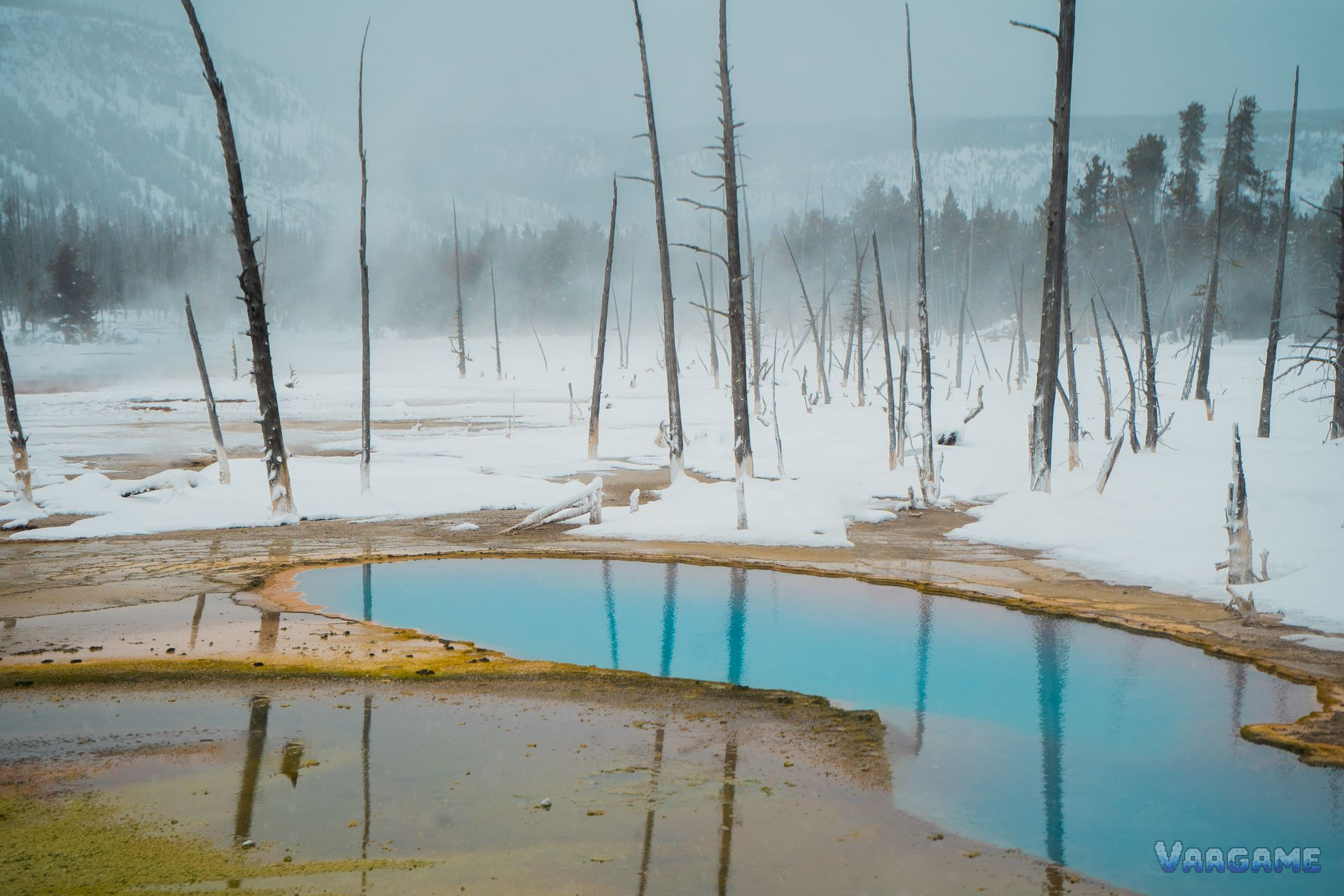
Yellowstone sits on a volcano. The ground is still hot, and in summer that heat shows as steam and colour. In winter the same heat meets air that often stays below freezing, so the steam doubles in size and hangs over the basins like fog. The white ground makes every colour louder: orange and green bacterial mats around the springs, blue water in the pools, black rock against white snow.
The scale is what makes it work. The park covers 2.2 million acres, and about half of the world's geysers are here. Old Faithful is the famous one, erupting about every 90 minutes and throwing water more than 100 feet high. Around it, the Upper Geyser Basin holds some 150 geysers in about one square mile, more than anywhere else on Earth. In winter you walk that basin on boardwalks with almost no crowd, and the steam closes in around you between eruptions.
Grand Prismatic Spring is the park's biggest hot spring, wider than a football field. In summer its rings of orange, yellow and green are the postcard. In winter the cold air pulls a sheet of steam across the surface, so the colours come and go as the wind moves. Stand on the boardwalk and wait for a gap in the steam rather than rushing past — the spring rewards patience more than any other stop in the park.
The cold also rebuilds the canyon. The Lower Falls of the Yellowstone River drops 308 feet through the Grand Canyon of the Yellowstone. In winter the canyon walls freeze, ice builds on the rock, and the falls keep running between white cliffs. It is the same waterfall as summer, but the sound is lower and the colour is gone — rock, ice and water, nothing else.
What order to see it in
One snowcoach day covers the geyser side. A second day covers the canyon or the north road. Book the snowcoach day first; it sells out before the lodge does.
West Yellowstone to Madison Junction. The snowcoach leaves town in the morning and follows the Madison River into the park. Elk stand in the river valley in the snow, and the first steam appears at the roadside before you reach the junction.
Lower Geyser Basin and Fountain Paint Pot. The first boardwalk stop. Mud pots bubble, small geysers pop, and the ground is warm enough to melt the snow in patches. Walk the loop slowly; the boardwalk is icy in places.
Midway Geyser Basin and Grand Prismatic Spring. The snowcoach stops long enough to walk the boardwalk to the spring. Wait for the wind to clear the steam, and look back at the spring from the far end of the walkway.
Old Faithful and the Upper Geyser Basin. The snowcoach drops you at the lodge area for a few hours. Check the next predicted eruption at the Visitor Education Center, walk the boardwalk loop while you wait, and be back at the basin five minutes before the prediction. The eruption lasts a few minutes.
The Grand Canyon of the Yellowstone, next day. A second snowcoach runs to Canyon. Walk the north-rim viewpoints, Lookout Point and Grand View, for the Lower Falls framed by ice. The road to Artist Point on the south rim stays closed in winter, so do not plan around it.
The north road is the other half of the trip, and it needs no snowcoach. Drive yourself from Gardiner through Mammoth Hot Springs and Lamar Valley to Cooke City. Mammoth's white travertine terraces steam in the cold at the start of the drive. Lamar Valley is the wildlife stop: bison, elk, coyotes and wolves cross the open snow, easiest to spot at dawn. Go early, drive slowly, and pull fully off the road when animals stop traffic.
Best time to go, and what not to do
The season is short and the dates are fixed. Oversnow travel opens December 15, 2026 and closes in stages: Mammoth to Norris closes March 7, 2027, the Norris and Canyon roads close March 9, Canyon to Fishing Bridge closes March 14, and the west, south and east entrances close March
15. January and February are the deep-winter months: the most snow, the thickest steam, the fewest people. Early December has fresh snow and full lodges; March has longer days and softer light, but the roads start closing under you.
Do not go between November 1 and December
14. The interior roads close to regular cars on November 1, and the snowcoaches do not start until December
15. In that gap there is no way into the interior at all — only the north road from Gardiner to Cooke City stays open.
Do not expect to drive yourself into the interior. In winter, the only vehicles past Mammoth or Madison are guided snowcoaches and snowmobiles. Your car stays at the entrance town, and that is the whole point: the park is quiet because the cars are gone.
Do not go without booking. Snowcoach seats and the two winter lodges — Old Faithful Snow Lodge and Mammoth Hot Springs Hotel — sell out weeks and months ahead. Book the snowcoach first, then the lodge, then the flight.
Do not walk off the boardwalks. The ground in the geyser basins is a thin crust over boiling water. People have died stepping off the path. Stay on the boards, even for a photo, even when the snow makes the edge hard to see.
Do not approach the animals. Keep 25 yards from bison and elk and 100 yards from wolves and bears. Bison look slow in the snow. They are not slow, and in winter they are the animal most likely to charge.
The animals are the reason to get up early. In Lamar Valley the herds move at dawn, when the light is low and the snow is untouched. Bring binoculars and a warm drink, park at a pullout, and watch from the car — the valley does the rest.
Practical information
Getting there: fly into Bozeman Yellowstone International Airport (BZN), about 90 minutes' drive to Gardiner at the north entrance. West Yellowstone is the base for most snowcoach departures; Gardiner is the base for the year-round north road and Lamar Valley. In winter, allow extra time for every drive — plows run, but storms close roads with little warning.
Entry: $35 per private vehicle, good for 7 days, everyone in the car. Since January 1, 2026, each non-US resident aged 16 or older pays an extra $100 per person, unless entering with an annual or America the Beautiful pass. No vehicle reservation or timed entry is needed. All prices checked November 8, 2026 — confirm on nps.gov before you go.
Where to stay: the two lodges inside the park in winter are Old Faithful Snow Lodge (lodging December 16, 2026 to March 6,
2027) and Mammoth Hot Springs Hotel (lodging open through the winter to March 7, 2027). Both need booking far ahead. West Yellowstone and Gardiner have rooms outside the park.
What to bring: warm layers for days that stay below freezing, insulated waterproof boots, traction for icy boardwalks, hand warmers, and binoculars for Lamar Valley. Keep a spare camera battery in an inside pocket — cold drains batteries fast, and the best light is at dawn when it is coldest.
Gear for Lamar Valley
In Lamar Valley the animals stay far out in the snow, and the park's distance rules mean you watch them through glass, not up close. A full-size 8x42 binocular is the one piece of gear that changes the morning: it turns a dark shape on a white hillside into a bison, an elk, or a wolf.
Prices change — check the current price on Amazon.
Bottom line: book a snowcoach day from West Yellowstone for Old Faithful and Grand Prismatic, add a second day for the Canyon or a self-drive dawn run through Lamar Valley, and stay inside the December 15 to March 15 window. Do not go in the November gap, do not drive into the interior, and do not leave the boardwalks. Facts and prices on this page were checked on 8 November 2026 against nps.gov; dates are weather-dependent, so check the park roads page before you go.