

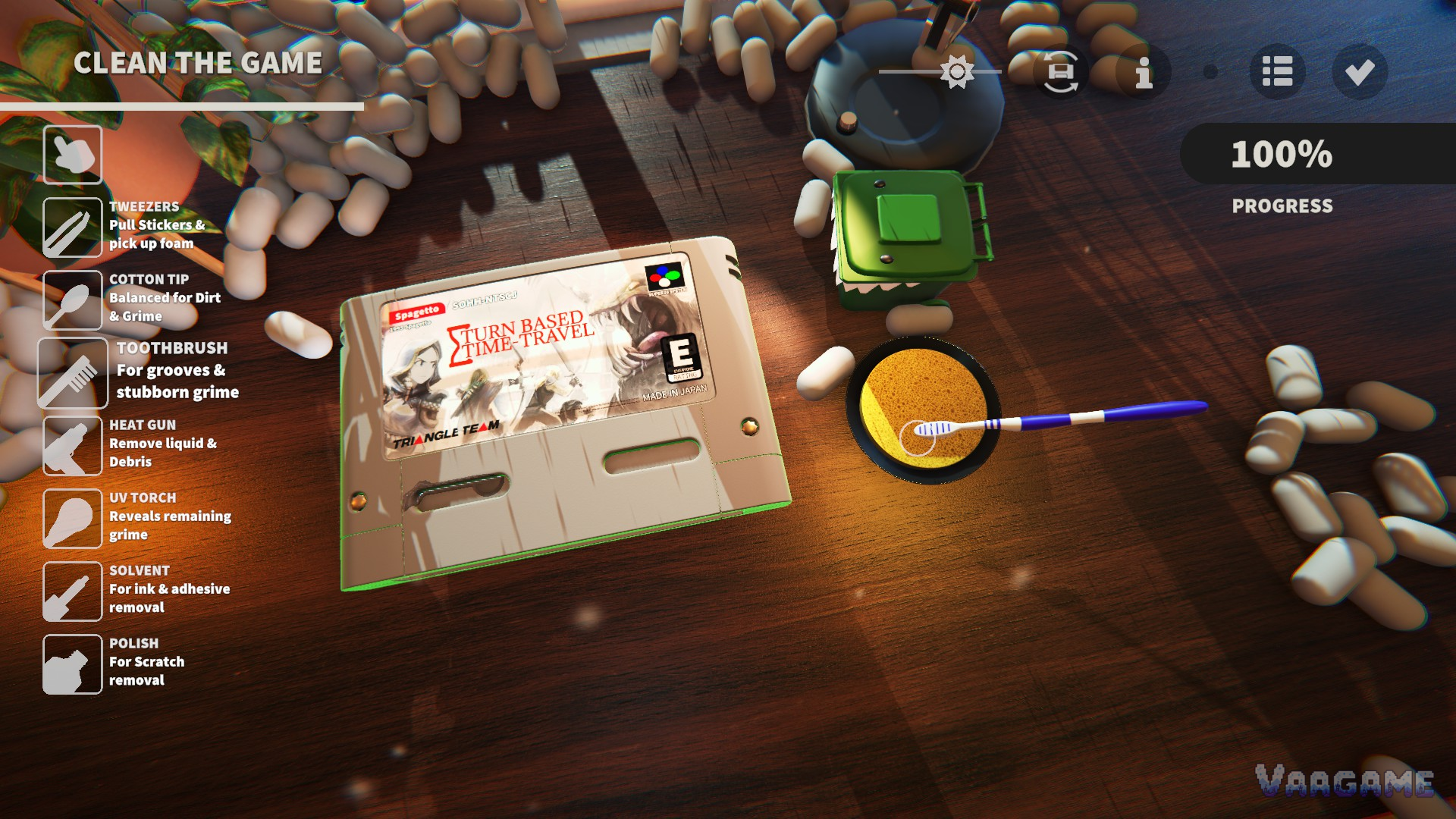
In Cozy Game Restoration your tools do not level up in a shop. They get stronger because of what you shelve. The demo gives you seven tools, each married to a kind of grime, and a shelf system the developer describes as controlling your rarity, your tools and your economy all at once: games you restore and display feed their traits back as bonuses, wider cleaning passes, faster cleaning, better prices. This guide covers the seven tools and exactly what each one is for, then explains the shelf engine underneath them, with everything drawn from the free demo ahead of the full game's November 4, 2026 launch.
Quick answer
Learn the rail: tweezers for stickers, cotton tip for dirt, toothbrush for grooves, heat gun for liquid and debris, solvent for ink and adhesive, polish for scratches, UV torch to reveal what is left.
There are no shop-bought tool upgrades to save for. Progression lives on your shelf, in the traits of the games you display.
Stack genres in rows: the developer's own example stacks high-rarity puzzle games to raise surface area, so each pass cleans more before your tools need cleaning.
Higher rarity means stronger traits, so the shelf you build in week one is the tool kit you clean with in week four.
At a glance
Tools in the demo: 7 named tools plus a hand for grabbing and rotating
Tool upgrades: none bought; bonuses flow from shelved games' traits
Bonus sources: genre rows, platform groups, rarity tiers
Bonus types seen: surface area, cleaning speed, rarity, store discount, sell price, platform price, genre percentage
The catch: tools get dirty as you work and need cleaning themselves
1. The seven tools and the grime each one answers
Swipe horizontally to view all columns.
| Tool | Best for | Notes |
|---|---|---|
Tweezers | Stickers | Pulls stickers cleanly and picks foam packing out of the way |
Cotton Tip | Dirt | The balanced all-rounder for dirt and general grime |
Toothbrush | Grooves | Reaches grooves and stubborn grime a cotton tip cannot |
Heat Gun | Liquid and debris | Removes liquid spills and loose debris |
UV Torch | Finding grime | Cleans nothing; reveals remaining grime as a glowing trail |
Solvent | Ink and adhesive | Dissolves marker ink and sticker residue |
Polish | Scratches | The scratch tool, for shells and labels |
The order on the rail is close to the order of a good restoration. Tweezers and the cotton tip do the opening work, the toothbrush and heat gun handle the awkward middle, solvent and polish are finishers, and the torch is the audit you run before you call a job done. The one tool beginners underrate is the toothbrush: grooves are where the last stubborn grime lives, and grooves are exactly where S ranks go to die, as our grades guide shows.
2. The shelf is your upgrade tree
Parasol Corp's own summary of the final demo is the clearest statement of the design: the shelf system "basically controls all your rarity, tool and economy meta". Mechanically it works through traits. Every game carries four or five traits, and games resting on your shelf project bonuses from those traits onto your tools and your wallet. The developer compares it to Mario Kart's parts: bodies, wheels and gliders change a kart's stats, and here the games on the shelf change yours.
The stacking rule is the part to internalise. Games of the same genre placed together improve the same property, and the developer's worked example is specific: line up several high-rarity puzzle games in a row and the stacked bonus raises your surface area, the amount of dirt you remove per pass before you have to stop and clean the tool itself. You are encouraged, in the developer's words, to shift things out and rearrange, because a shelf is a build, not a trophy case.
Swipe horizontally to view all columns.
| Shelf bonus | What it improves |
|---|---|
Surface Area | How much dirt one pass removes before the tool needs cleaning |
Cleaning Speed | How fast passes work overall |
Rarity | The rarity climate of your coming parcels |
Store Discount | What you pay for incoming games |
Sell Price | What your restored games fetch when sold |
Platform price | Extra value for a named platform's games (the demo shows a Super 16 bonus) |
Genre percentage | A named genre's games gain value or effect (the demo shows an Adventure bonus) |
3. The rail in practice: open, work, audit
Watch one restoration run and the rail's logic becomes muscle memory. The opening is broad work: tweezers peel the stickers and lift the foam packing out of the way, the cotton tip, which the game itself calls the balanced approach, takes the first pass at dirt across the shell. The middle is where restorations slow down, deliberately. The toothbrush goes into heavy grooves and the more stubborn dirt the tip skates over, the heat gun dries liquid and lifts debris, and the percentages stop leaping and start creeping, 25 percent, 53,
66. Nothing about that creep is failure; it is the categories separating, as the easy Dirt falls away and the Ink, Scratches and residue remain.
The audit is the phase new players skip, and the one the UV torch exists for. Run the torch and the remaining grime announces itself in a glowing trail, the specks a confident eye would have shipped. Then the finishers: solvent on the ink and adhesive ghosts, polish across the scratches, one last torch pass over a shell that finally reads clean. A restoration in this game is three short acts, and the rail, read left to right, is the script.
4. Tools get dirty, and tools get big
Two details complete the picture. First, your tools foul as you use them: the same surface-area stat that genre stacking raises is spent down as you clean, and when it runs out you stop and clean the tool. Progression, in other words, is measured in how long you can work between interruptions. Second, the late game changes the feel entirely. Recounting the design at PAX Aus, the developer described the endgame as "big fat tools that are really powerful", with cleaning speed to match. You do not buy that power. You shelve your way to it, one restored game at a time, across the 216-version collection.
FAQ
Do you ever buy better tools?
No tool shop or upgrade purchase has been shown; the developer describes tool power as something that grows out of your collection. Spend your money on parcels, and let the shelf do the upgrading.
Do shelf bonuses stack?
Yes, that is the core mechanic: the same genre grouped together improves the same property, and higher rarity strengthens the effect. The developer's example is a row of high-rarity puzzle games raising surface area.
Can you rearrange the shelf freely?
The system is built for it. The developer explicitly encourages shifting games out and reworking the arrangement as your collection grows, and shelf unlocks are visible in the demo so you can see the build coming.
What does surface area actually do?
It is the amount of dirt a pass removes before your tool needs cleaning. More surface area means longer uninterrupted cleaning, which is the closest thing this gentle game has to a power stat.