

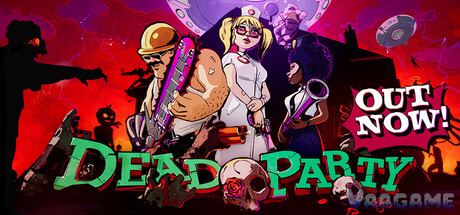
Dead Party launched just in time for Halloween. The four-player co-op zombie defense game from Radiation Blue, published by Snail Games USA, arrived on Steam and the Epic Games Store on October 29, with console versions to follow in the coming weeks. The price is $19.99, with a 15% launch-week discount to $16.99 that runs through November
5. The game is Steam Deck Verified, and its hook is easy to state: defend a neighborhood from the undead, and fight back with the power of rock music.
At a glance
Launch: October 29, 2026, on Steam and the Epic Games Store for Windows. Console versions follow in the coming weeks.
Price: $19.99, with a 15% launch-week discount to $16.99 through November
5. A bundle with West Hunt offers a further discount on the pair.
Players: up to four, with online co-op and local shared-screen co-op. A Story Mode follows four characters, and an Arcade Mode offers customizable play.
Modes: Showtime, Fuel Run, Skull Cannon, and Horde, each built around a different defense task, from music-powered combat to shooting UFOs out of the sky.
Steam Deck: Verified, with one controller note: an external Bluetooth or USB controller may need manual selection through the Quick Access Menu.
Halloween in Shady Hill
The setup is a Halloween invasion with a joke at its center. UFOs appear over the once-peaceful town of Shady Hill on Halloween, and soon after, the dead neighborhood rises from its graves. Four unlikely heroes take on the task of fighting back, and the game never pretends the premise is serious: the invaders have one major weakness, and it is human music. When a team is surrounded, each character can use the power of their guitars to push the enemy back.
Dead Party is the successor to Dead Block, the zombie barricading game with the same rock-and-roll idea, and the lineage shows in the loop. This is a defense game before it is a shooter: teams scavenge their surroundings, break furniture and objects for resources, build barricades, and deploy traps, then adapt as the horde finds a way through. Different zombie types carry different mechanics, and distinct level layouts force teams to learn chokepoints instead of memorizing one map.
Four modes, four different jobs
The four modes give a group a reason to keep playing after the story. In Showtime, teams fight back zombies with the power of music. In Fuel Run, they power generators and send out jamming radio waves against the invasion. In Skull Cannon, they collect zombie skulls and use them to shoot UFOs out of the sky. In Horde, the escape plan is dropped entirely and the only question is how long the team survives before being overrun. Story Mode runs alongside those modes with four unique characters, each with different strengths, weaknesses, abilities, and equipment to unlock.
The co-op options are wider than online play alone. Steam lists online co-op, shared-screen co-op, and Remote Play Together alongside full controller support, Steam Cloud, and 23 achievements. For a Halloween weekend game, that means one screen, four machines, or one streamed session all work. The PC specification is modest for 2026, asking for a GTX 960 at minimum and 6 GB of storage, so the barrier to getting a group in is low.
A small team with a loud idea
Radiation Blue is an independent developer near Freiburg, Germany, and its earlier work includes Dead Block, the game Dead Party directly follows. Publisher Snail Games USA framed the launch as a seasonal play, timed to Halloween to catch players looking for a multiplayer title for the weekend. It also lands in a crowded horror week on Steam, with the annual Scream Fest sale running until November 2.
That crowd is both the opportunity and the risk. A four-player party game with a clear joke has an easier time finding a group than a slow horror game does, and the $16.99 launch price is low enough for one player to buy copies for friends without much thought. The risk is that a party game without a group is a different game: the design is built around four players defending together, and a solo player should expect a thinner version of the same loop. The launch-week discount through November 5 gives groups a week to decide, which fits a game meant to be played with people rather than alone.
Buy it for the group, not the solo run
The honest way to judge Dead Party is by the group that will play it. Four friends with a Halloween evening free, a shared screen or four machines, and a tolerance for chaotic defense will get the intended game. A solo player looking for a horror story will find the systems without the company they were built for. The Steam Deck Verified status helps the first group more than the second: a handheld in the living room is an easy fourth seat.
The price keeps the decision simple. At $16.99 through November 5, the game costs less than a round of movie tickets for the same group, and the console versions are still to come for players who would rather wait for their own platform. Buyers this weekend should start with Story Mode, then pick Showtime for the music joke or Horde to test endurance.