

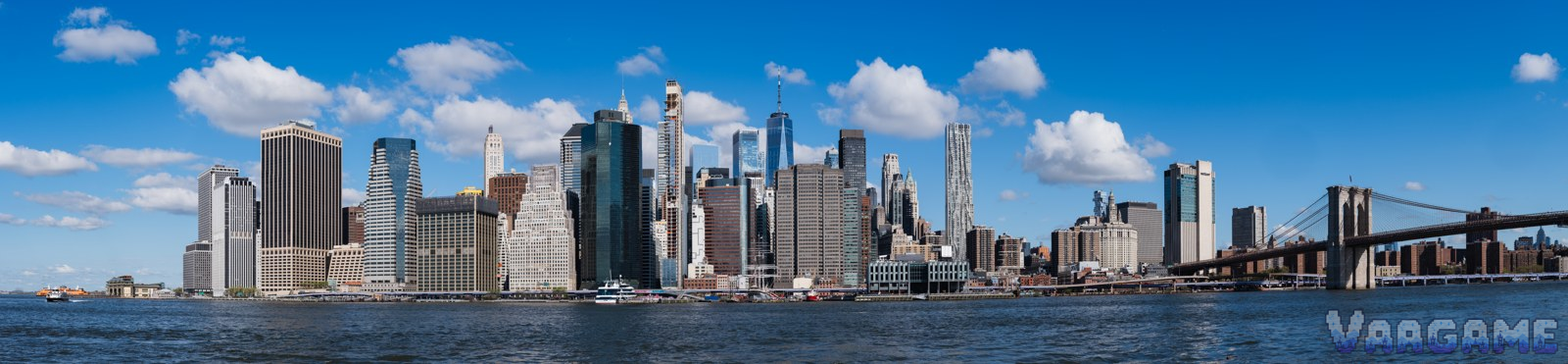
I came into New York on foot, the way a person arrives at a city that has already been arrived at three times in my head. A paper cup warmed one hand and the other stayed in a coat pocket, and above the streets there was a man in red and blue who did not exist, swinging between buildings that did. Below them, in another game, a man from Eastern Europe drove a car across a bridge that had been renamed and repainted, and in a third, an agent walked an emptied Manhattan in snow that never melted. The real street was full. It smelled of roasted nuts and bus exhaust and rain that had not quite decided to fall, and nobody on it was waiting for a mission to start. That was the first difference, and it repeated all day: in the games, New York is a place where something has just happened or is about to happen, and a single person is sent to fix it. In the real city, a great many things happened a long time ago, and nobody was sent. People were simply still there, walking, which turned out to be a harder and stranger kind of story.
A Park Built on a Village
Central Park began for me at a stone balustrade worn smooth by hands that had nothing to do with any game. I put a palm on it and felt the cold travel up my arm, and below it the terrace opened out toward water and a fountain, all of it designed to look as if it had always been there. It had not. In 1858, Frederick Law Olmsted and Calvert Vaux won a competition with a plan called the Greensward, and the city built a countryside inside itself: lawns, woods, lakes, paths that wound on purpose. The work moved millions of cubic yards of earth and planted hundreds of thousands of trees and shrubs. It also moved people.
On the ground where the park now stands, between what would have been 82nd and 89th Streets, stood Seneca Village, a community founded by free Black landowners in 1825, with churches and a school and gardens. In 1857 the city took the land by eminent domain and the village was demolished, its residents scattered, and for more than a century the story was barely told until a marker went up in 2001 and archaeologists later dug up dishes and buttons and the sole of a child's shoe. Spider-Man photographs landmarks in his Manhattan, and the game rewards the picture. The real park keeps a different kind of record: a beautiful lawn, and a few feet below it, a village that is gone. Both things are true at the same time, and standing on the terrace I could not make them into one tidy sentence, so I left them standing side by side, the way the park itself does.
Looking Up at Empire
I did not go up the Empire State Building. I stood at its foot on Fifth Avenue with my neck craned back, the way people do when a building is too tall to take in politely, and watched the limestone and steel narrow toward a spire that was once meant to moor airships. The building went up in a little over a year, opening on May 1, 1931, in the middle of the Great Depression, a hundred and two stories finished while the country around it was losing work by the week. For years afterwards much of its office space stood empty, and New Yorkers joked about it with a nickname that turned Empire into Empty. That joke is part of the building now, the way scaffolding becomes part of a photograph.
In the games, towers are perches. Spider-Man lands on this spire as if height were a place to rest, and the city's tallest things exist to be stood upon. The real spire was built for ships that never docked there, and the real building was built for tenants who did not come for years. It stayed anyway, and became the thing people mean when they point at a skyline and say the city's name. Looking up from the sidewalk, I felt small in the good way, the way a person feels small under something that was built during a hard time and outlasted it, without ever explaining itself.
Light on the Hands
Times Square hit first as light on the backs of my hands. Even in daytime the screens threw colour onto skin and coats and the pavement, and the crowd moved the way crowds move when nobody is in charge of them, in eddies and sudden stops. A man in a costume posed for a photograph, a delivery cyclist rang a bell and threaded past, and a pigeon did what pigeons do on a ledge above a subway grate, unbothered by any of it. The square was not always a square of light. It was Longacre Square, a district of horse stables and carriage workshops, until April 8, 1904, when the city renamed it for The New York Times, which had moved into a new tower on the triangle where Broadway meets Seventh Avenue.
The first electric advertisement appeared three weeks later, and on December 31, 1907, a ball was lowered from the tower to mark the new year, a habit the city has kept ever since. The newspaper itself moved out within a decade, but the name stayed, and so did the gathering. In The Division, this same crossing stands emptied by a virus spread on banknotes, a place where an agent moves carefully between abandoned cars. The real crossing was full of people who had nowhere else to be at that hour, and that fullness was both lonely and companionable at once: nobody looked at anybody else for long, and yet everyone was keeping the same time, under the same light, in the same loud square.
A Clock to Meet Under
Grand Central Terminal slowed me down, which is a strange thing for a station to do. I came in off 42nd Street with the cold still on my coat, and the Main Concourse opened above me like a room that had been built to make waiting feel less like waiting. The ceiling was painted with constellations, backwards by design or by mistake depending on which story is told, and in the middle of the floor stood the information booth with its four-faced brass clock, a small crowd of people arranged around it the way people arrange themselves around a landmark they have agreed to use. The present building opened on February 2, 1913, after a crash between two steam trains in 1902 pushed the railroads toward electric trains, and it was built by the Vanderbilt family's railroad on a scale meant to say that the city had arrived.
In 1967 it became a city landmark, and that designation saved it from the fate of the old Pennsylvania Station, demolished in 1963, a loss that taught the city what demolition costs. GTA IV built its own version of this room and called it Grand Easton Terminal, in a city where the boroughs had been renamed. The real room does not need a new name. It needs only what it already has: a clock, a ceiling full of stars, and a crowd of strangers who have all agreed, without discussing it, to meet under the clock and then go their separate ways.
A Room With a Long Floor
The Brooklyn Bridge began under my shoes as a wooden walkway with a slight give to it, and then the granite towers rose on either side, and the cables fanned out overhead like the rigging of a ship that had decided to stay still. A cyclist's bell cut past, a runner passed on the other side, and the wind off the East River found every gap in my coat at once. The bridge opened on May 24, 1883, after fourteen years of work, and it was the longest suspension bridge in the world and the first fixed crossing of the East River. Its designer, John Roebling, died from an injury suffered while surveying the site. His son Washington took over and was crippled by caisson disease, the bends, from working in the pressurised chambers sunk for the foundations.
Washington directed the work from an apartment in Brooklyn Heights, watching through a telescope, while his wife Emily carried his instructions to the site, learned the engineering herself, and saw the bridge finished. On opening day she was the first to cross, in a carriage, carrying a rooster for victory. A year later a circus owner marched twenty-one elephants across it to prove it would hold. In GTA IV, the renamed bridge carries cars between renamed boroughs, and crossing it is a matter of pressing on. On foot, crossing took time, and the time was the point: a bridge is not only a way across a river, it is a room with a long floor, and the people in it were walking, running, ringing bells, and looking at the skyline the way people look at something they are about to leave behind.
A Slice That Argues With Itself
The slice arrived on a red tray in a paper holder, with a paper cup beside it, and I folded it in half the way New York slices ask to be folded. It was thin at the middle and crisp at the edge, and it bent without breaking, which is the whole test. The usual story says America's first pizzeria opened in 1905, when Gennaro Lombardi, a baker from Naples, took out a licence for a shop in Little Italy. A pizza historian who spent years on the question says the 1905 shop may have belonged to someone else first, and that Lombardi may have been an employee before he became an owner. The argument has never been settled, and the city eats through it daily, one slice at a time.
That felt right for New York. A city that argued about its park, its tower, its square and its bridge was never going to agree about its pizza, either. I ate with the fold in one hand and a paper napkin in the other, because a slice that is meant to be eaten on the move does not ask for a table. Around me, other people were doing the same thing, in the same posture, and for a minute the street had a small, ordinary choreography to it: fold, bite, wipe hands on paper, keep walking.
Next time, come back dressed like this
Next time, come back dressed like this. I would come back in a dark coat with deep pockets for cold hands and a folded map that stays folded, sturdy shoes that do not mind wet stone or a bridge walkway, and a small backpack worn in front on a crowded train rather than behind. The coat is the point, not a costume: Spider-Man's suit is famous, but it is not something a person wears to walk a city, and pretending otherwise would turn a walk into a photograph. There are no purchase links here.
I checked, and I could not confirm a reliably in-stock, verifiable listing for the thing I actually wanted, so there is nothing to buy from this page, and I would rather say that plainly than dress up a guess as a recommendation. No replica weapons, either: the games are full of them, but houses, stations and museums have their own rules, and their rules come first wherever they apply. Walk the city without needing to be the person the games sent. That is the whole outfit, and the whole idea.
I left New York the way I came in, on foot, with the cup empty and the coat still damp at the cuffs, and the three games still running quietly in my head. The city had not resolved anything for me. The park had not apologised for the village, the tower had not explained its empty years, the square had not dimmed its lights for anybody, the station clock had not waited, and the bridge had not shortened itself for a walker. None of that felt like a failure.
It felt like the difference between a city that can be finished and a city that cannot: in the games, Manhattan can be crossed, cleared, photographed, and put down. In the real place, there were streets I had not walked and doors I had not opened, and they will still be there, which is a different feeling from a finished map. The last thing I saw was the skyline thinning into the river light, and then the crowd took the rest. Somewhere behind me, a clock was still keeping time for strangers, and a bridge was still holding its elephants' worth of weight, whether or not anyone was counting.