

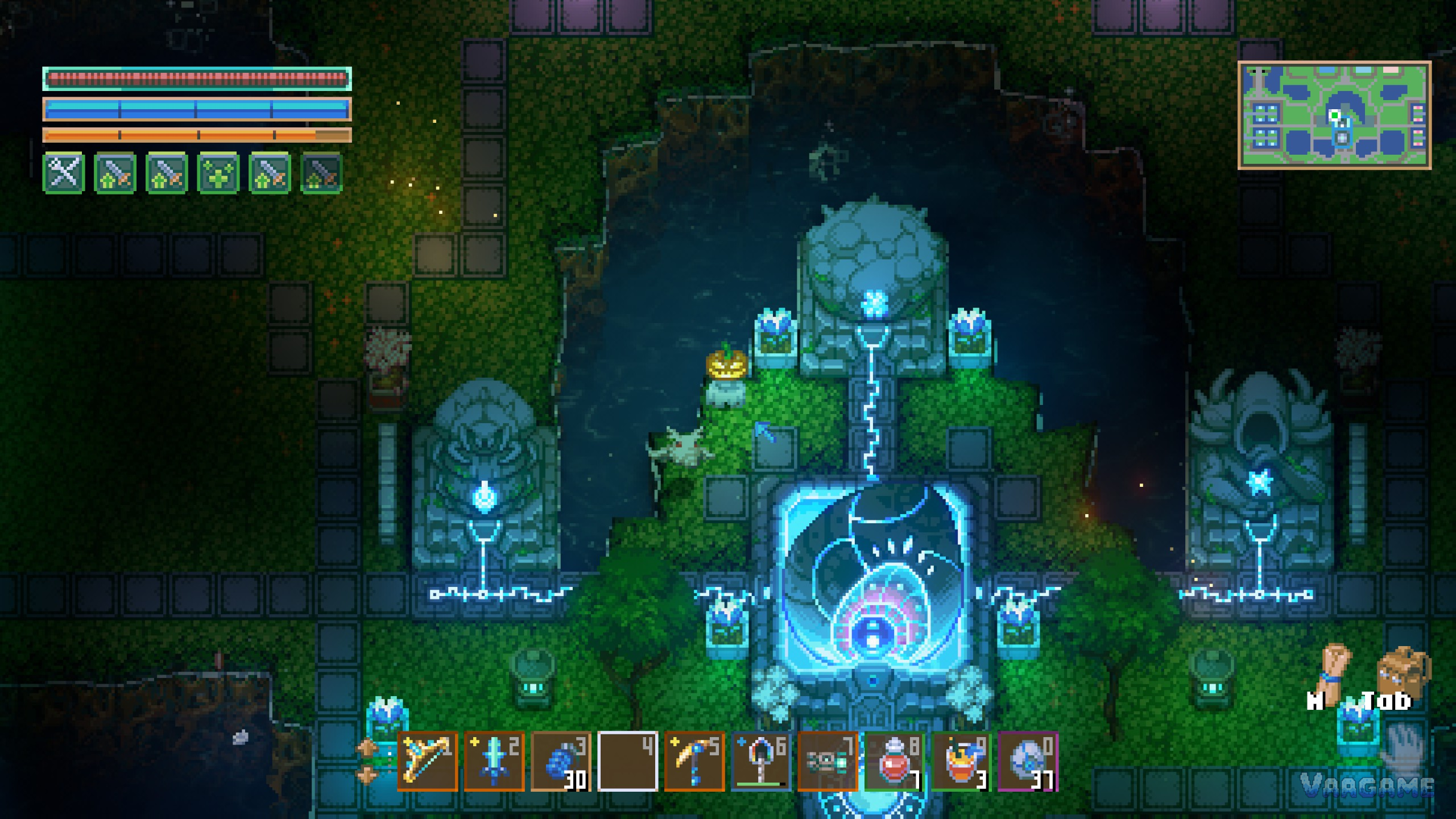
Core Keeper drops you in a procedurally generated underground world with one job: wake the ancient machine sleeping at its center. This mining sandbox adventure from Swedish studio Pugstorm is built entirely around that goal — you dig, craft, farm and fight your way to powering up the Core, starting with the three bosses whose relics feed its three statues. It plays solo or in online co-op for 1–8 players, and it has grown steadily since its 1.0 launch in August 2024: the September 2026 update (1.3, Riders of the Underground) added rideable mounts, and two further major updates are already named on the developer's roadmap. This guide walks the full beginner route: the two decisions to make before you spawn, a first-hour path from wood tools to iron, the first three bosses, and the food and skill systems that level up simply by playing.
Quick answer
Your first goal: Light the Core's three statues with the relics of Glurch, Ghorm and Malugaz — everything before that is preparation
Your gear ladder: Wood → copper → tin → iron, and iron is the ceiling until the Core wakes
Your background: Pick whichever sounds fun — the bonuses wash out within the first hour, and there are no classes
Your survival rule: Never stop eating and cooking — hunger drains constantly, and cooked food is your main source of buffs
At a glance
What it is: A top-down mining sandbox — dig, craft, farm, build and fight through a vast underground world
The goal: Power up the ancient Core by defeating bosses and feeding their relics to its three statues, then push ever outward
Players: Solo, or online co-op for 1–8 players in total
Price: $19.99 on Steam
Platforms: PC (Windows and Linux) on Steam; console versions also available
Skills: 12 skills that level up by doing the activity, each with its own talent tree
Reception: 92.9% positive across 68,005 Steam reviews
State of the game: Version 1.3 (September
2026) is live; updates 1.4 and 1.5 are named on the official roadmap
1. The Core is the whole game
You start every world standing in front of the Core, a huge dormant machine set into a stone chamber. Arranged around it are three boss statues, and the early game has one clear job: hunt down the three bosses of the starting region, take the relic each one drops, and set those relics into the statues. Every activated statue doubles as a crafting station with new recipes, and once all three are lit the Core powers up, tells you where to head next, and the sealed outer world opens.
Everything else hangs off that spine. Stronger walls demand stronger pickaxes, so you climb a material ladder — wood, copper, tin, iron — where each tier's workbench unlocks the tools that crack the next tier's rock. Beyond the Core's starting area, the Undergrounds, the world is ringed by a chasm; past it sit the Clay Caves and the Forgotten Ruins, and much further out lie six more biomes, from the Sunken Sea to the Desert of Beginnings. There is no quest log pushing you along. The Core, the ladder and your own curiosity set the pace.
2. Two decisions before you spawn
Worlds and characters are saved separately in Core Keeper, and a character can visit any number of worlds — so neither choice below is a one-time commitment to a single save. Still, both are fixed once made, so it is worth ten seconds of thought.
World difficulty is chosen when you create a world. Normal is the intended first experience. Hard doubles the health and damage of every enemy and boss in exchange for 50% more loot slots in boss chests, and nothing else — no exclusive items. Separately, character type is chosen when you create a character: Normal characters drop their main inventory into a gravestone when they die and respawn at the Core or at a bed; Hardcore characters are deleted outright on death, save file and all. For a first run, take a Normal world and a Normal character.
Background is your character's starting kit: a small head start of +3 in one skill plus a few items. There are seven:
Swipe horizontally to view all columns.
| Background | Bonus | Starting items |
|---|---|---|
Explorer | +3 Running | Small lantern, 3 food rations |
Miner | +3 Mining | Copper pickaxe, 3 food rations |
Fighter | +3 Melee combat | Copper sword, 3 food rations |
Chef | +3 Cooking | Cooking pot, 8 mushrooms |
Gardener | +3 Gardening | Copper hoe, watering can |
Fisherman | +3 Fishing | Wood fishing rod, 3 food rations |
Nomad | None | Nothing at all (a clean-slate start) |
Pick whichever sounds fun. The official wiki is blunt about it: the bonuses are small, everything on the list is obtainable within the first hour, and there are no true character classes in Core Keeper. A Miner start simply smooths your first twenty minutes of digging.
3. Your first hour: wood, copper, tin, iron
Punch the roots tangled around the Core to gather your first wood, then open the crafting menu (Tab) and make the four starter items: a Torch, a Wood Pickaxe, a Wood Shovel and a Basic Workbench. Place the workbench near the Core — this patch of dirt is your first base — and keep torches flowing. The underground is properly dark, and light is both a safety tool and a breadcrumb trail.
Dig outward through the Undergrounds and watch the walls: glittering sparkles mark buried ore and open spaces. Smelt the copper ore you find in a furnace and upgrade to copper tools at the workbench. Copper opens the ring beyond the chasm — bridge it with wood bridges and explore. One side is the Clay Caves, where tin waits; the other is the Forgotten Ruins, whose grey stone largely resists a copper pickaxe. If you hit ruins first, do not grind against them: circle the other way. Tin tools and a Tin Workbench come next, then the Ruins yield iron (and gold becomes usable), an Iron Workbench, and the strongest gear available before the Core wakes. Iron is the ceiling of the early game — no higher tier can be reached until the three statues are lit, which makes it the natural moment to go boss hunting.
Two habits pay for themselves immediately. First, build your base as one compact workshop — workbench, furnace, chests and a bed within a few steps of the Core — because you will return to it hundreds of times. Second, eat. Your hunger bar drains alongside your health, and cooked food (Section
5) restores far more than raw ingredients while adding buffs on top.
4. The first three bosses, and waking the Core
The statues want one relic each, and the wiki's recommended gear tells you the intended order.
Glurch the Abominous Mass — the first statue
Glurch the Abominous Mass is a giant orange slime holding court in a slime clearing roughly 65 tiles from the Core — when the screen starts to shake and you hear heavy thumping, you are close. Tin gear or better is the comfortable entry point. Glurch drops the Glurch Eye; set it into its statue back home, and that statue becomes a crafting station in its own right.
Ghorm the Devourer — the second statue
Ghorm the Devourer never sits still. This enormous grub circles the Core endlessly on a track roughly 250 tiles out, ploughing through the Clay Caves and the Forgotten Ruins and smashing everything in its path. Do not chase it — stand on its track, let it come to you, and fight it as it passes. Iron gear is recommended. Its Ghorm's Horn fills the second statue.
Malugaz the Corrupted — the third statue
Malugaz the Corrupted is not found but summoned. His throne room sits inside the Forgotten Ruins, and the Malugaz Scanner — crafted at Glurch's statue for 5 Ancient Gems and 5 Mechanical Parts — pinpoints it. Collect Crystal Skull Shards in the ruins, combine them into the Skull of the Corrupted Shaman, place the skull on the room's rune, and he answers. Iron gear again — it is the ceiling until the Core wakes. His relic, the Stolen Crystal Heart, completes the set — and with it, the Core powers up.
5. Food, farming and cooking
Hunger is Core Keeper's quiet clock. Raw finds — mushrooms, heart berries, bomb peppers — keep you alive, but the Cooking Pot is where food becomes a system: combine any two ingredients and the dish that comes out restores more than the parts, with buffs that depend on what went in (a pepper-based dish might add movement speed, for instance). Cooking experience is earned every time you take a finished dish out of the pot, so a busy kitchen levels you passively.
Grow the ingredients yourself. A hoe tills soil, seeds go in, a watering can finishes the job, and crops take roughly ten minutes to mature. Harvesting by hand returns seeds most of the time — take the Gardening talent Grateful gardener and seed returns become guaranteed, turning a small plot into a self-sustaining loop. Start small near your base: a few rows of heart berries and peppers cover the early game, and the farm can scale up to sprinklers and full automation much later.
6. Skills grow by doing
Core Keeper has 12 skills, each capped at level 100: Mining, Running, Melee combat, Vitality, Crafting, Range combat, Gardening, Fishing, Cooking, Magic, Summoning and Explosives. There is no XP bar for your character as a whole — each skill levels from its own activity. Mining experience comes from damaging walls, Melee from landing hits (kills are irrelevant), Vitality from kills, Cooking from collecting finished dishes, and so on. Every level also pays a small permanent dividend: +1 mining damage per Mining level, +1 max health per Vitality level, +0.5% damage per combat-skill level.
Every five levels in a skill earns a talent point for that skill's own tree (with five bonus points at level 100), and points can be reset at any time for 200 Ancient Coins. That respec price is low enough that you should spend points freely early — try the ore-duplication talent in Mining, the seed security in Gardening, whatever fits your week — and rebuild later. Update 1.3 also refreshed two trees worth knowing about: summoned minions now persist until you dismiss them, which makes Summoning a real build rather than a timer, and Magic's mana regeneration now continues while you cast.
7. Solo, co-op, and the road ahead
Solo is a complete way to play — every system works alone, and nothing on the road to the Core requires a second player. Co-op simply makes the underground livelier: up to eight explorers share a world, characters can hop between friends' worlds freely, and roles divide naturally (one player farms, one mines, two go Titan hunting). If you are starting with friends, one shared Normal world and individual Normal characters is the setup that will still feel good in week three.
And the road keeps going. Powering the Core is the end of the tutorial in everything but name: the Titans wait in the outer biomes, boats cross the Sunken Sea, mounts arrived with update 1.3, and the official roadmap's next two stops are already named — 1.4 Trials of the Depths, pitched by Pugstorm as the game "harder than ever" for veteran players, and 1.5 Beyond the Breach, which opens a new biome beyond Breaker's Reach. Neither has a date yet, and both are free updates when they land. A beginner starting today is starting at the right time: the early game in this guide is settled, and the endgame is still being written.
Common beginner mistakes
Swipe horizontally to view all columns.
| Mistake | Fix |
|---|---|
Grinding on the Forgotten Ruins with a copper pickaxe | The Ruins sit opposite the Clay Caves around the ring, so circle the other way and get tin first; grey stone is not a copper job |
Living on raw finds and skipping meals | Cook two-ingredient dishes in the Cooking Pot: more hunger restored, real buffs, and Cooking XP on every dish |
Hoarding talent points for later | A respec costs only 200 Ancient Coins: spend points on the week you are playing and rebuild freely |
Chasing Ghorm around its track | Stand on the track, clear the ground first, and fight as it passes; the boss comes to you |
FAQ
Is Core Keeper good solo?
Yes. Solo is a fully supported way to play: no content is gated behind co-op, and boss fights are tuned for one player when you are alone. Co-op adds company and shared labour, not missing features.
How many players can play together?
Up to 8 players in one world, online. Characters and worlds are saved separately, so your explorer can visit a friend's world without giving up your own.
What happens when I die?
A Normal character drops the contents of their main inventory into a gravestone where they fell and respawns at the Core or at a bed — walk back and reclaim it. A Hardcore character is deleted permanently, which is why Hardcore is best left for challenge runs.
Does my background lock me into a class?
No. Backgrounds grant +3 in one skill and a few starter items; the game has no classes, and every character can level all 12 skills. The wiki itself notes the starting bonuses are small enough to ignore by the end of the first hour.
Is there an ending?
There is a current final boss, the Core Commander, but the game is still being expanded — updates 1.4 and 1.5 are on the official roadmap, so today's endgame is not the finished one.
Is Core Keeper still being updated?
Yes. Update 1.3 (Riders of the Underground) launched on 21 September 2026 with mounts, a new sub-biome and two reworked skill trees, and Pugstorm's "Road to the Maw" roadmap names two more major updates to come, all free.