

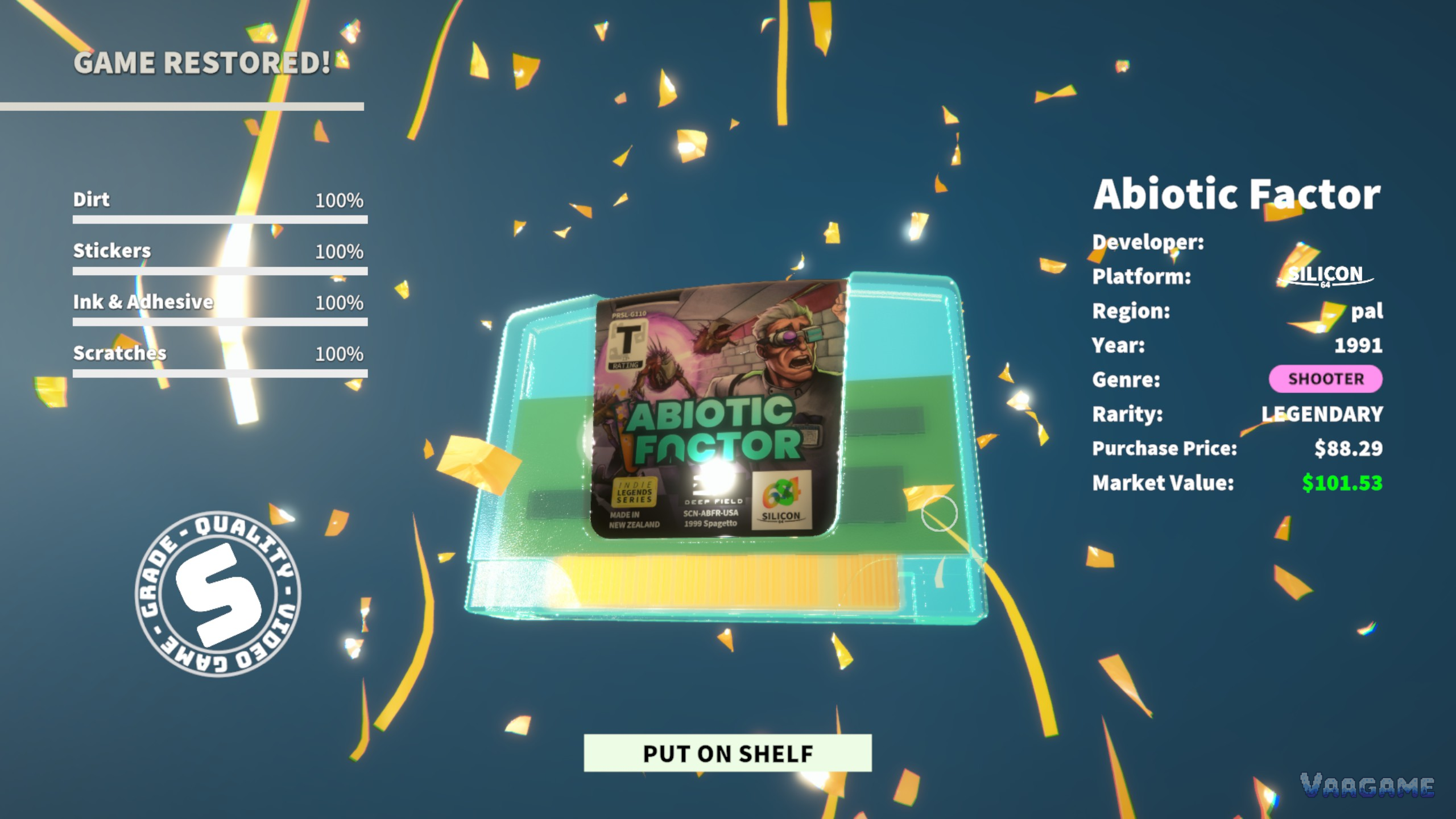
Rarity in Cozy Game Restoration runs on five tiers, Regular, Uncommon, Rare, Epic and Legendary, and every one of the game's 108 fictional titles exists in two regional variants, PAL and NTSC, which is how a 108-game catalogue becomes a 216-version collection. The tiers are not cosmetic: the developer has explained that higher-rarity games carry stronger traits, and traits are what power the shelf bonuses that make your tools faster and wider. This guide lays out the ladder as it appears in the free demo's own interface, explains what the region line on the result screen really means, and shows you how to read the Tomorrow's Rarity forecast, the panel that tells you what tomorrow's parcels are likely to hold. The full game launches on November 4, 2026.
Quick answer
Five tiers, in order: Regular, Uncommon, Rare, Epic, Legendary, shown as white, green, blue, purple and yellow tags.
Every title has a PAL and an NTSC version; the collection counts them separately, so 108 games make 216 versions.
There is no fixed drop-rate table: the game shows a daily forecast, Tomorrow's Rarity, whose percentages drift from day to day.
Rarity matters beyond collecting, because higher tiers carry stronger traits, and traits feed your shelf bonuses.
At a glance
Rarity tiers: 5 (Regular / Uncommon / Rare / Epic / Legendary)
Regional variants: PAL and NTSC for every title
Collection size: 108 titles × 2 variants = 216 versions
Drop rates: not fixed; a daily in-game forecast shows the odds drifting
Rarity's second job: higher tiers mean stronger traits and stronger shelf bonuses
Wildcards: gold (and better) shells, sticker-art variants, notes from previous owners
1. The five tiers, as the game itself labels them
The cleanest evidence for the ladder is the game's own forecast panel, which lists all five tiers by name. Developer Adam Stormhardt filled in the design logic at PAX Aus: each game carries four or five traits, rarer games are more powerful versions of that idea, and the early tiers give small bonuses while the higher tiers give much bigger ones. Read the ladder as a power curve for your shelf, not just a set of collectible colours.
Swipe horizontally to view all columns.
| Tier | Tag colour | What it changes |
|---|---|---|
Regular | White | The everyday find; individually modest traits, but the backbone of genre stacks |
Uncommon | Green | A clear step up in trait strength; worth shelf space from day one |
Rare | Blue | Strong traits; a copy you plan a shelf row around |
Epic | Purple | High-impact traits that can carry a whole bonus theme |
Legendary | Yellow | The strongest tier the demo shows; the Abiotic Factor result in this guide's cover is one |
Two cautions belong with this table. The percentages in the screenshot are one day's forecast, not the game's fixed odds, and the next section explains why they move. And a Regular game is not a failed pull: traits stack by genre and platform, so three Regular puzzle games in a row can outperform one Epic game shelved at random.
2. PAL vs NTSC: why the region line doubles your collection
Every title in the 108-game catalogue was "released" in two regions, and Cozy Game Restoration tracks both. The result screen prints the region beside the platform and year, and a title you already own in NTSC is still a new entry when it arrives as PAL. That is the entire arithmetic of the collection: 108 games, two variants each, 216 versions to restore.
For a collector this changes how a duplicate feels. A second copy of a game you own, in the same region, is a sell candidate. The same title in the other region is progress, and the same title in the other region at a higher tier is a small celebration. The variants also differ visually, with regional artwork and shells, so the two copies rarely feel like photocopies of each other.
3. Reading Tomorrow's Rarity
The forecast panel sits on the shelf screen and does three things at once. It lists the five tiers with the percentage chance the game assigns them for tomorrow, it marks each percentage against yesterday with a small rise or fall figure, and it sits directly above your current shelf bonus totals, which is the game's way of connecting what arrives tomorrow with what your shelf is worth today.
Use it as a planning tool rather than a promise. On the day captured in this guide, Regular and Uncommon made up the entire forecast and the top three tiers sat at 0.0 percent, which tells you the forecast breathes: some days are ordinary, and the interesting days are the ones where the upper tiers wake up. Parcels are the input to everything, so the days when the forecast tilts upward are the days to spend freely and clean carefully. The demo also ties weather into the economy and parcel perks, so a forecast is worth reading alongside the day's weather rather than in isolation.
4. Special shells, sticker art and the games between the tiers
Rarity is the headline system, but the variants have a second layer. The store page promises shells made of gold, "or better", and sticker-art editions of games, and some cartridges arrive with notes left by their previous owners. None of that changes the tier on the tag, but it changes what a specific copy means to a collection, and it is why two copies of the same title at the same tier can still feel like different finds. The announced collaboration cartridges, covered in our collection guide, sit in this same space: special versions of games inspired by real indie titles, including Abiotic Factor and CONSCRIPT, with more partnerships teased for launch.
FAQ
Are the drop rates for each tier fixed?
No fixed table exists to print. The game itself forecasts the odds daily on the Tomorrow's Rarity panel, and the percentages drift with rise and fall markers. Any site quoting permanent percentages for this game is guessing.
Does rarity change how hard a game is to clean?
The cleaning job is always the same four categories. What rarity changes is the strength of the game's traits, which is why a Legendary copy matters to your shelf bonuses long after the cleaning is done.
Can the same title appear in both regions?
That is the design: every one of the 108 titles exists as PAL and NTSC, and the collection counts all 216 versions separately. A title in a new region is a new entry, not a duplicate.
What is the fastest way to find higher tiers?
There is no lever the developer has described that forces a tier, and this guide will not invent one. The honest version: open parcels every day, read the forecast, and spend your best cleaning effort on the days the upper tiers show signs of life.