

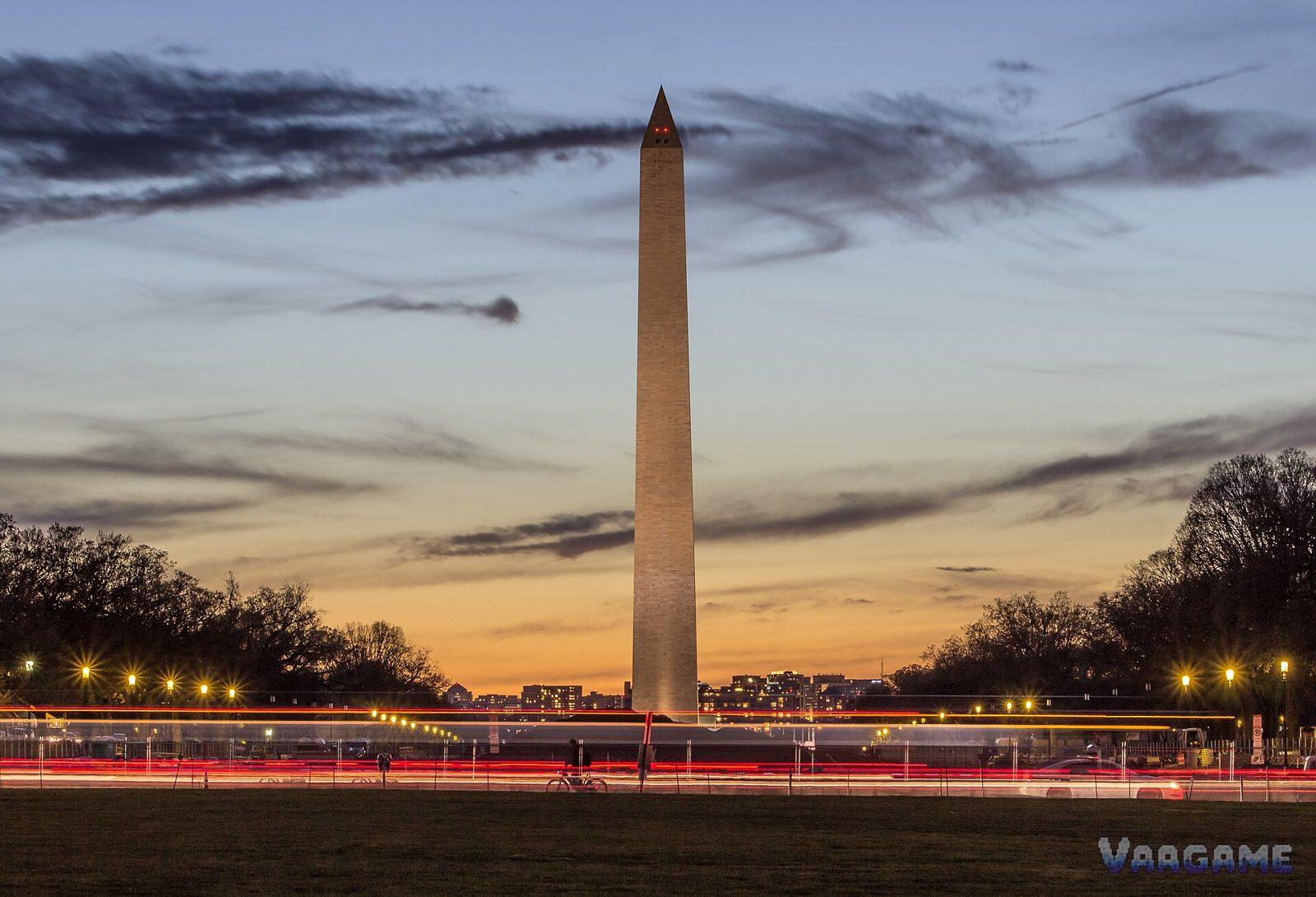
I came to Washington with two ruined versions of the city already in my head, and the real one met me with grass. That was the first surprise, and it stayed surprising all day. In Fallout 3 the Mall is a battlefield, a strip of broken stone where factions fight over the monument in the middle. In The Division 2 the same city is a summer of checkpoints and supply runs, and the White House is a base an agent walks into with a rifle on the back. The real Mall in front of me was mown grass, school groups, a man selling water from a cooler, and joggers cutting across the axis that a French engineer drew in 1791 before most of the city existed. Nothing was asking me to clear it, hold it, or save it. It was only asking to be walked, which turned out to be a stranger kind of work than either game had prepared me for.
A Monument With a Seam in It
The monument began as a line against the sky, and then, as I got closer, as stone with a seam in it. I put a hand on the base and felt the heat the day had left in it, and looked up until my neck complained, the way everyone does, and then looked back down at the seam. The Park Service says the building stopped at about 156 feet in 1854, when the money ran out and the society behind it fell apart, and stood unfinished for more than twenty years, through a civil war, while the country argued about what it was. When Congress finally paid to finish it, the new stone came from a different place and did not quite match, and the change in colour is still there, partway up, for anyone who stops looking at the top and looks at the middle instead. In Fallout 3 the monument is a position to hold, ringed by Brotherhood paladins, a tall thing in a flat fight. The real monument was once a much quieter embarrassment: a stump that reminded a young country, every day, that it had promised a memorial to its first president and then could not pay for it. I liked the seam better than the height. Height is easy to photograph. A seam is a record of a country stopping, and then, much later, deciding to go on.
Steps Made for a Crowd
I walked west along the Reflecting Pool with the water throwing the sky back at me in a long, broken mirror, and the Lincoln Memorial grew out of the end of it, white and still, the way a building looks when it is trying not to move. Inside, the statue sat in its chair and did not look at me, which felt right; it looked past me, toward the Mall, toward the monument, toward the Capitol, down the whole axis. In Fallout 3 this building is broken and fought over, and a quest sends the player here to settle who gets to speak for Lincoln. The real building settles nothing so neatly. On August 28, 1963, Martin Luther King Jr. stood on these steps and spoke about a dream to a quarter of a million people gathered on the Mall below, and the Park Service later set a marker into the stone where he stood, so that a visitor now has to decide where to put their own feet. I stood a little to one side of the marker, not on it, because standing exactly on it felt like posing, and I did not want a photograph of myself in someone else's speech. What stayed with me was not the statue but the steps: wide, shallow, made for a crowd to stand on together and listen. In the game, a memorial is a location with loot and enemies. Here it was a staircase that had once held a crowd, and the crowd was the point.
A Dome Finished During a War
The Capitol came at me slowly, which is the honest way to see it, because the Mall is longer than any game lets a player believe. In Fallout 3 the Mall is compressed until the monuments sit almost within shouting distance, and an agent can cross in minutes what takes a real walker the better part of an afternoon. My feet were tired by the time the dome filled the end of the walk, and the tiredness felt like information: this city was drawn to be approached, not teleported across. The building has been burned and rebuilt; British troops set it on fire in August 1814, and the wings were rebuilt and reopened by 1819, and then, decades later, while the Civil War was still going on, workers kept building the great cast-iron dome, and the Statue of Freedom was set on top of it in December
1863. A dome finished in the middle of a war is not a decoration. It is an argument, made in iron, that the building underneath it would still be there when the war ended. In the games, the Capitol is a ruin with a flag on it, or a backdrop for a firefight. Standing under the real dome, with my shoes dusty and my water bottle empty, I thought about how little of that argument survives when a building is reduced to a level. A level can be cleared. A dome that was finished during a war cannot be cleared; it can only be looked up at, and then walked away from, still standing.
Too Fragile to Have Flown
The museum stopped me with a different kind of height. Inside the National Air and Space Museum, aircraft hang from the ceiling as if they have only just stopped flying, and I stood under them with my neck craned back again, the same posture as at the monument, but for a different reason. In The Division 2 this museum is a mission, and the planetarium becomes a place to fight in while planets swing overhead. The real museum opened on July 1, 1976, in the country's bicentennial year, under a director who had himself flown to the Moon, and its first month brought more than a million people through the doors. The objects inside are not replicas for the most part: the Wright Flyer from 1903, Lindbergh's Spirit of St. Louis, Glenn's Friendship 7 capsule, the Apollo 11 command module Columbia. I stood in front of the Wright Flyer for a long time, because it is made of wood and cloth and looks too fragile to have done what it did, and that fragility felt like the opposite of the museum levels in the game, where everything is cover and calibre. In the game I had learned to read a museum as a series of rooms to clear. In the real one I kept forgetting to move on, because each object was asking for a slower kind of attention: not what to shoot from behind it, but who had sat in it, and whether they had been afraid.
This Far and No Farther
The White House was the one place I could not enter, and that turned out to be the most honest part of the day. In The Division 2 an agent walks into it in the first mission, links up with friendly forces, and makes it a base, upgrading it room by room until it hums. In Fallout 3 it is a ruin a player can enter from below, through tunnels, after the fighting. The real building stood behind its fence with its north portico white in the afternoon light, and people on my side of the fence took photographs through the bars, and guards watched without hurry, and nobody pretended this was a base. I stood there with my hands in my pockets and felt the difference between a game and a city settle into something simple: games give the player the inside of power because the story needs the player to fix it, and the real city keeps the inside closed because power is not a level to complete. That did not make the fence feel like a rejection. It made the walk feel complete in a way the games never do. In a game there is always one more room. Here the fence said, plainly, this far and no farther, and the rest of the city was still there, waiting to be walked.
A Counter That Refused to Close
By late afternoon my feet had made their argument and I followed it to U Street, to a counter that has been serving since
1958. The half-smoke arrived on a bun under chili, onions, and mustard, the sausage coarser and spicier than a hot dog, with a snap to its casing, and I ate it standing at first and then sitting, because sitting down after the Mall felt like a small ceremony. The place, Ben's Chili Bowl, stayed open in 1968, in the days after Martin Luther King Jr. was killed, when much of U Street was burning and closing, and fed the people who were still there: neighbours, firefighters, activists, anyone who needed a hot plate and a counter to lean on. That history is not printed on the food, and it does not need to be; it is in the fact that the counter is still there, and that the recipe did not change to chase a trend. In the games, food is a number that restores health. Here it was a place that had refused to close when closing would have been easier, and the chili on my hands, wiped off with a paper napkin, tasted like that refusal: ordinary, hot, and still standing.
Next time, come back dressed like this
Next time, come back dressed like this. I would come back in a dark coat with deep pockets for cold hands and a folded map that stays folded, sturdy shoes that do not mind wet stone or a long Mall, and a light bag that leaves both hands free for railings and doorframes. Nothing in this walk needs a costume, and nothing in it should be bought as one: the games' combat gear and vault suits are not clothes for a real street, and a replica weapon would be wrong here in a way that goes beyond taste, because the museums and memorials on this walk have their own rules, and the house rules come first. I checked, and I could not confirm a reliably in-stock, verifiable listing for the thing I actually wanted, so there is nothing to buy from this page, and I would rather say that plainly than dress a guess up as a recommendation. The walk itself is the thing to bring back: the seam in the monument, the steps, the dome, the fragile Flyer, the fence.
I left Washington the way I had walked it, on foot, with the chili taste still on my tongue and the two games still running quietly in my head, and the real city not resolving them. In Fallout 3 the Mall can be cleared, and in The Division 2 the White House can be rebuilt room by room, and both endings feel satisfying because a game has to end. The real Mall does not end. It goes on past the Capitol in one direction and past the Lincoln Memorial in the other, and the people on it keep walking it in both directions, carrying their own versions of the city with them. I did not finish Washington, and that felt less like a failure than like the truest thing the day had offered: a city drawn as an axis, walked as a line, and left open at both ends.