

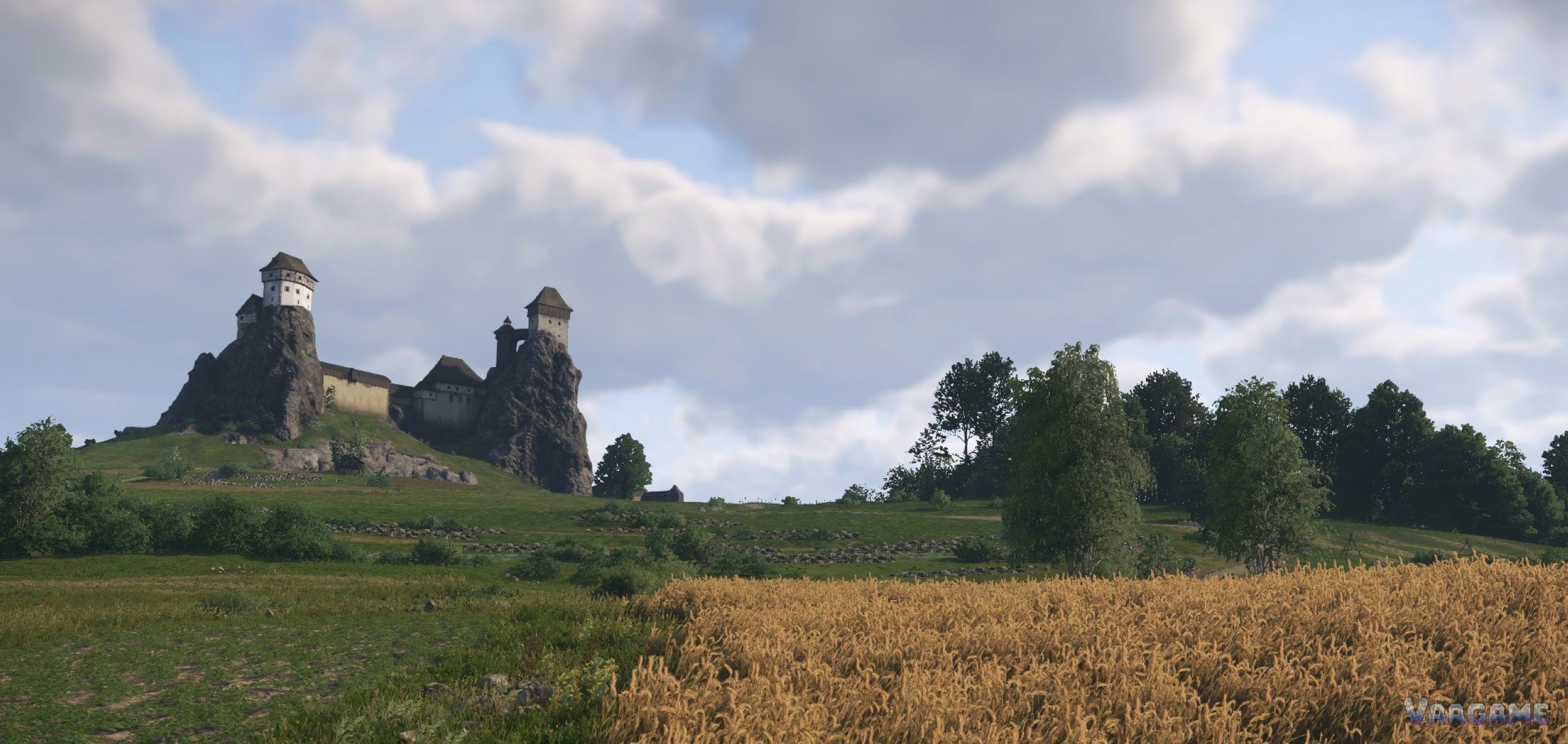
From the road below, Trosky Castle does not look like one castle at all. It looks like two towers that happen to share a hill: Baba, the broad, lower tower, and Panna, the tall, slender one, each standing on its own plug of black basalt. The game Kingdom Come: Deliverance 2 rebuilds the castle whole, as it stood in 1403, when its lord was Otto von Bergow and two mud-spattered messengers were turned away from its gates. The ruin on the hill is what is left after six centuries of sieges, robber knights, a change of estate, and a fire in
1648. Walk from the castle down to the village that took its name from it, out into the sandstone rock country, and on to Kost, and the two timelines, game and history, keep meeting at the same stones.
At a glance
The game: Kingdom Come: Deliverance 2, Warhorse Studios, released 4 February 2025; Trosky is its first region, modelled on the Bohemian Paradise of northern Bohemia.
The castle: Trosky Castle, in the municipality of Troskovice, built around 1380-1390 by Cenek of Vartenberk on two basalt volcanic plugs; Baba stands on the lower rock, 47 metres above the first courtyard, and Panna on the higher, 57 metres.
The name: Trosky is the Czech word for ruins or debris, and the village below, Troskovice, is first mentioned in 1388 in connection with the castle; its name comes from the rock that, from a distance, already looked like a ruined castle.
The war line: a Catholic stronghold in the Hussite Wars, besieged in 1424 and 1428 and never taken by the Hussites; seized by robber knights from 1438 to 1444; sold into the Kost estate in 1455; its garrison surrendered to King George of Podebrady in 1469.
The landscape: Bohemian Paradise (Cesky raj) became Czechoslovakia's first protected landscape area in 1955 and is now the country's only UNESCO Global Geopark, a country of sandstone rock towns and volcanic hills between Jicin, Turnov and Sobotka.
Evidence boundary: this article is written from published sources, the castle's official history, and the game's own codex entries. It contains no first-person visit account, and no scene is presented as something the author saw in person.
Day one: two towers on two rocks
The first thing the hill teaches is geology. Long before any lord built here, a volcano left two hard plugs of basalt standing in the softer ground, and erosion did the rest. Cenek of Vartenberk, who held the estate in the late fourteenth century, saw what the rocks offered and used them as the castle itself: palaces and living quarters went into the saddle between the two summits, and a tower went on top of each rock. The lower tower, Baba, the Crone, is the broader and more homely of the two, two storeys of living space on a rock 47 metres above the courtyard. The higher tower, Panna, the Maiden, is a four-sided shaft on a rock 57 metres up, three storeys high, and is said to have housed the castle chapel. Between them, three rings of wall closed the complex. A castle that is two towers is not a flourish; it is a builder reading the ground and letting the ground decide the plan.
By 1403, the year of the game, the castle already had a new master. Cenek's debts had forced him to hand Trosky to King Wenceslaus IV in the early 1390s, and the king passed it to Otto III of Bergow, whose family held it into the Hussite Wars. That is why the game's Trosky belongs to Otto von Bergow, and why Henry and Hans Capon, arriving with a message for him, find the gates shut against outsiders after recent bandit attacks. The game compresses distances and invents its own people, but the political shape is the town's own: a Catholic lord, holding a nearly unapproachable fortress, in a kingdom sliding toward civil war. The castle in the game is whole because in 1403 it still was. The ruin came later, and it came in stages: Hussite sieges in 1424 and 1428 that failed to take it, a night seizure by the robber knights Sof and Svejkar, who held it from 1438 to 1444 and raided the countryside from it, and finally, in 1648, a burning in the last phase of the Thirty Years' War that left it the skeleton on the hill.
There is one story the hill keeps that should be told as a story, not as a fact. Otto of Bergow, the chronicles say, raided the monastery at Opatovice and hid its treasure in a cellar at Trosky, blocked by a boulder so large that no one could move it, until scree covered the way in for good. No treasure has been found, and the tale is best left where it belongs: in the same drawer as the legend that gives the two towers their names, a mother and a daughter, a feud, and two towers that turned their backs on each other. The stones do not need the legend. Two towers on two rocks, built because the rocks were there, are strange enough on their own.
Day one, below: the village that took its name from a ruin
The village below the castle is older than its first written mention, and its name is a small piece of honesty. Troskovice is first recorded in 1388, in connection with the neighbouring castle, but the settlement probably stood long before that, and it took its name from the rock itself, which from a distance already looked like the ruins of a castle. The name of the castle and the name of the village are the same joke told twice: the place was called after broken stone before any wall had fallen. In the game, Troskowitz is the first larger village of the Trosky region, and the place where Henry and Hans end up when the castle will not have them: its tavern, its traders, its scribe and its apothecary are the working village beneath the fortress, and the game is right about the relationship even where it invents the people. A castle like Trosky never fed itself. It was fed by the fields, the ponds and the hands of the village below.
The day ends the way village days end here: at a table, not at a viewpoint. The kitchens of the Troskovice country serve the plain food of a farming landscape, dumplings and roast meat and the beer of the region, and the night is spent in one of the village guesthouses or farm stays below the hill, with the two towers dark against the sky. Nothing about the evening needs to be grand. The castle has done the grand part, and it does it better in silhouette.
Day two: the rock town and the horse village
East of the castle, the ground changes its mind. The basalt gives way to sandstone, and the sandstone has been cut by wind, water and frost into a rock town: narrow passages, overhanging walls, caves and sudden clearings, gathered under the name Apolena, a protected reserve tucked into the woods beneath Trosky Castle. In the game this is Apollonia, the eastern, wilder edge of the map, where the story sends Henry after a hermit, a hidden girl and a rumoured revenant among the crags. The game invents those errands, but it does not invent the ground they happen on: a sandstone country where a path can narrow to a crack between two walls and the light goes green under the trees is exactly what the real rock towns of Bohemian Paradise feel like. The shared action between the two worlds is simple and wordless: both the player and the walker learn to move slowly here, because the rock decides the pace.
West of Troskowitz, the map softens again into Semine, the village of the horse stud. The game's codex records that a fortress at Semin belonged to Jan and Oldrich of Semin in 1365, that the ground itself was settled far earlier, with Celtic ramparts whose ten-metre frontal bank and moat can still be traced, and that the mill below belonged to the lords of Semin for centuries and remains part of the landscape. The game makes the place a yard of horses and a wedding, and keeps the shape of the real one: a small, walled farming settlement where horses have always been the business. A traveller who has spent the morning among rocks and the afternoon among horses has spent the day the way this country asks to be spent: one hard landscape, one working one.
The second evening belongs to the same plain register as the first: supper in a village kitchen, a bed in a guesthouse in one of the Trosky villages, and the towers, if the sky is clear, still visible from the road home. The rock town is not a place to hurry through, and the horse village is not a place to hurry past. Both reward the slower second day.
Day three: Kost, where Trosky's story went
On the third day the story leaves Trosky and follows its ownership. In 1455 Jan of Bergov sold Trosky to Jan Zajic of Hazmburk, lord of the nearby Kost Castle, who folded it into the Kost estate, and Trosky ceased to be a lord's seat and became an administered property. Kost itself is the older, tougher cousin: founded before 1349 by Benes of Vartenberk on a rocky spur between three valleys, it is the castle that the siege stories gather around, and the castle that, in 1469, held out when George of Podebrady's army took Trosky and the other castles around it. Its name carries its own small lesson in honesty. The popular tale says Jan Zizka, failing to take it, declared it solid as a bone, kost in Czech. The founding charter says otherwise: Benes signed himself Benesius de Costi, in Latin, and Czech tongues bent it into Kost. The legend is better, and the document is true, and a walking essay can hold both without pretending they are the same thing.
The essay ends where it began, under the two towers, because that is where the whole story is visible at once. The castle was built on rocks that were already old, held by men who are now names in charters, besieged by armies that could not take it, kept for a few years by robbers, sold into another estate, and finally burned into the shape that now stands for a whole region. The game gives the visitor one gift the ruin cannot: it shows the castle whole, in the year when it still had roofs and a lord and a gate that could be shut. The ruin gives the other gift: it shows what time does to even the best-built things, and it does it without a single invented scene. Between the two, a walker has the complete picture, and the road back down the hill is downhill in both worlds.
The third evening closes the three days in the same key as the first two: a last supper in the village below the hill, a last night in a guesthouse within sight of the towers, and a morning road that leaves Bohemian Paradise the way it was entered, slowly, with the silhouette still in the mirror of the mind long after the hill itself is out of sight.
Next time, dressed like this
The return visit asks for nothing exotic, only for clothes that match the ground. A wool cloak or a heavy wool coat for the wind on the ridge, a linen shirt under it for the climb, leather boots broken in long before the trip, and a pair of sturdy walking shoes for the sandstone passages, where the rock is smooth and the steps are uneven. No costume is needed, and no weapon, real or replica, belongs on this walk: the towers are the armour of this story, and they are already in place.
Keep walking
Kutna Hora, the Silver City That Kingdom Come: Deliverance 2 Rebuilt in 1403
Cusco and the Valley That Was Never Lost: Walking Peru with Lara Croft
A note on sources: the castle's history follows the official history of Trosky State Castle and the standard castle histories; the village and Semine details follow the game's codex entries, which present themselves as history written for the game and are quoted here as such; the Opatovice treasure and the naming of Kost are told as legend and as document respectively, and are not mixed. No ticket price, opening hour, restaurant name or hotel name is given in this article, because none was verified for this draft, and none is needed to walk the story.