

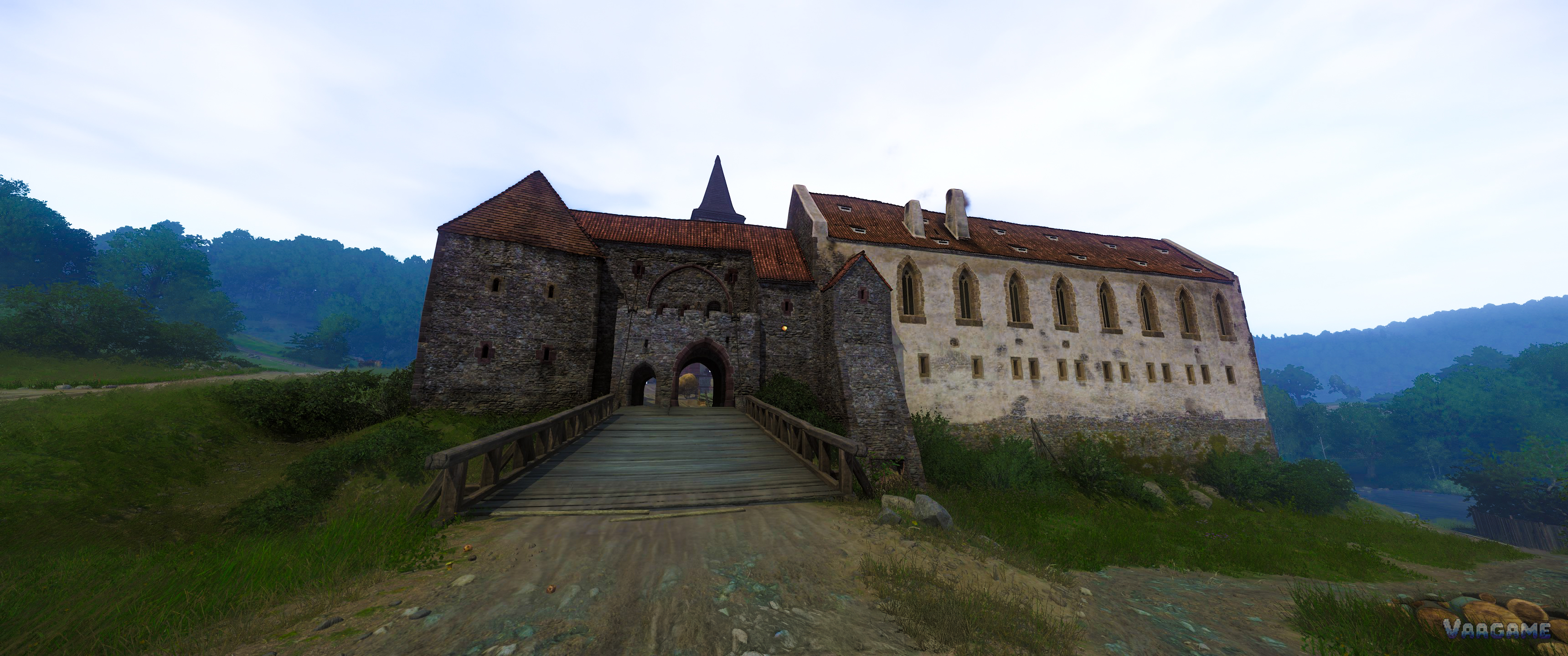
The game Kingdom Come: Deliverance opens with a burning village and a boy on horseback, and the country he rides through is real. It is the valley of the Sázava river, southeast of Prague, where a monastery founded in 1032, two castles in a single small town, a ruined hilltop fortress and a silver-mining village all stand within a few miles of each other. The game rebuilt them as they stood in
1403. The valley keeps them as time left them, and walking from one to the next is walking between the two versions of the same place.
At a glance
The game: Kingdom Come: Deliverance, Warhorse Studios, released 13 February 2018; set in 1403 Bohemia, its map covers about 16 square kilometres around Rataje nad Sázavou, some 44 kilometres southeast of Prague.
The monastery: Sázava Monastery, founded in 1032 by the hermit Procopius; home of the Slavonic liturgy until 1096, sacked by Hussite troops in 1421, dissolved by Joseph II in 1785; its great three-nave Gothic church was never finished.
The two castles: Rataje nad Sázavou holds two castles a few hundred metres apart, the upper castle and the lower Pirkštejn, both from the 14th century; the upper castle now houses the town offices and the Museum of Central Posázaví.
The refuge: Talmberk Castle, first attested in 1297, seized from Diviš of Talmberk in 1390 and recovered by him in 1397, abandoned by 1533; only the ruin remains, a protected monument.
The silver town: Stříbrná Skalice, first mentioned in 1360, its name means little silver rock; its mines were the closest to Prague. The game's codex dates its burning to 23 March 1403, and its castle was never rebuilt.
Evidence boundary: this article is written from published sources, the monastery's official history, and the game's own codex entries. It contains no first-person visit account, and no scene is presented as something the author saw in person.
Day one: the monastery that prayed in another language
The valley's story starts with a hermit in a cave. Procopius settled above the Sázava in the early 11th century, and the community that gathered around him became a Benedictine monastery in 1032, with the backing of Prince Oldřich and his son Břetislav. What made it unlike any other monastery in Bohemia was its language: here the liturgy was sung in Old Church Slavonic, the tongue of Cyril and Methodius, in a kingdom that otherwise prayed in Latin. That difference lasted more than sixty years, until the Slavonic monks were driven out in 1096 and Latin Benedictines from Břevnov took their place. The stones kept the older memory anyway: the church of St. Procopius still holds part of the saint's relics, and the monastery garden still shows the foundations of the 11th-century Church of the Holy Cross, consecrated in 1070.
The building the walker sees today is a record of interruption. In the 14th century the Romanesque basilica was being rebuilt as a monumental three-nave Gothic church, and then, in 1421, Prague Hussite troops sacked Sázava, cast out monks and builders alike, and the work stopped. What survives is the torso: the chancel, covered by the later Baroque church, and the stump of the southern nave with its tower of red Nučice sandstone, standing roofless and unwalled. The monastery was revived under the Habsburgs in 1664 and reached a Baroque prime, but at the top of that prime came the decree of Joseph II, and in 1785 the monastic life ended. In the game, Sasau Monastery stands whole and walled, its gate reached by a wooden bridge; the real place answers with the opposite image, a great church that was never allowed to be finished, and that is precisely why it is worth the walk.
The first evening closes the way valley evenings close: at a table, not at a viewpoint. The kitchens of the Sázava country serve the plain food of a farming landscape, dumplings and roast meat and the beer of the region, and the night is spent in a village guesthouse or farm stay below the monastery hill. Nothing about the evening needs to be grand. The unfinished church has done the grand part, and it does it better in silhouette.
Day two: the town with two castles
Six kilometres to the southeast, Rataje nad Sázavou is a town that kept two castles when most towns kept one. The place was first mentioned in 1156, as a stronghold and market, and its upper castle grew from a Gothic stronghold of the 14th century into the three-wing château that stands today, its north wing still Gothic, its south wing Renaissance, its west wing Baroque. In the game it is Rattay, the seat of Sir Hanush of Leipa, and the place Henry is sent when there is nowhere else to go. The real castle's later history is quieter and stranger: it burned in 1447 through the carelessness of servants, was rebuilt as a Renaissance château, was remade in Baroque style around 1672, and since 1933 has belonged to the municipality, which keeps its offices, its library and the Museum of Central Posázaví inside walls that were built to keep people out.
A few hundred metres away stands the reason the town has two castles at all. Pirkštejn, the lower castle, was built by Henry of Lipá in the early 14th century, and when his family bought Rataje they renamed the lower castle after themselves. In the game it is Pirkstein, the smaller, harder shadow of the upper castle. Its later life ran the other way from its neighbour's: damaged in the peasant revolt of 1627, it was abandoned as a fortress, and in 1713 to 1724 it was rebuilt as a rectory with a bell tower, which is why the tower a walker sees today stands beside a house rather than a garrison. It is privately owned and, with few exceptions, not open to the public, so the right way to see it is from the street below, the way the town itself has always seen it.
The second evening belongs to the same plain register as the first: supper in a village kitchen, a bed in a guesthouse in one of the valley villages, and the river, if the sky is clear, still audible from the road home. Two castles in one town are enough marvel for one day, and the valley rewards the slower second day.
Day three: the refuge and the burning
On the third day the walk turns to the two places the game made famous for opposite reasons. Talmberk, the game's Talmberg, was founded at the end of the 13th century, likely by Hroznata of Úžice, and is first attested in 1297 in the name of William of Talmberk. Its best-known lord is Diviš, the game's Sir Divish: in 1390 Havel Medek of Valdek seized the castle and imprisoned him, and only a ruling of the land court in 1397 gave Talmberk back to him. Diviš died in 1415, his son Oldřich inherited, and by 1533 the castle was abandoned altogether; villagers later carried its stone away for their own houses, and in 1933 part of what remained collapsed. In the game, Talmberg is the refuge: the castle Henry rides to with an arrow in his leg after Skalitz burns, where Divish pulls his people inside the walls. The real place offers the darker half of that story, a fortress that outlived its lord by a century and then quietly fell apart, its lower bergfried still standing, open to the sky.
The walk ends where the game's story begins. Stříbrná Skalice, the game's Silver Skalitz, lies on the Sázava river, and its name says what it was: little silver rock. The settlement was first mentioned in 1360, and the silver mined around it in the 15th and 16th centuries was the closest to Prague, close enough to give impulse to the building of a Prague mint under Ferdinand I. In 1403 the town passed to King Wenceslaus IV, who placed it under his knight Sir Radzig Kobyla, and in that same year Sigismund's army burned town and castle to the ground; the game's codex dates the burning to 23 March
1403. The castle was never rebuilt, and today only foundations remain visible. That is the valley's sharpest lesson, and the reason the walk is worth making backwards as well as forwards: the game shows Skalitz whole, with its forge and its castle and its people, and the real village shows what a single year of war can take from a place that had stood for half a century.
The essay ends where it began, on the river, because that is where the whole story is visible at once. A monastery that prayed in the wrong language for sixty years, a town with two castles, a fortress that lost its lord and then itself, and a silver town that a single campaign erased. The game gives the visitor one gift the valley cannot: it shows all of them whole, in the year when they still had roofs and lords and gates that could be shut. The valley gives the other gift: it shows what time does to even the best-built things, and it does it without a single invented scene. Between the two, a walker has the complete picture, and the road back along the river is downhill in both worlds.
The third evening closes the three days in the same key as the first two: a last supper in a village below the hills, a last night in a guesthouse within sight of the river, and a morning road that leaves the Sázava valley the way it was entered, slowly, with the sound of the water still in the mind long after the river itself is out of sight.
Next time, dressed like this
The return visit asks for nothing exotic, only for clothes that match the ground. A wool cloak or a heavy wool coat for the wind on the ridges, a linen shirt under it for the climb, leather boots broken in long before the trip, and a pair of sturdy walking shoes for the river paths, where the ground is soft and the steps are uneven. No costume is needed, and no weapon, real or replica, belongs on this walk: the castles are the armour of this story, and they are already in place.
Keep walking
Kutna Hora, the Silver City That Kingdom Come: Deliverance 2 Rebuilt in 1403
Trosky Castle, the Two Towers That Kingdom Come: Deliverance 2 Rebuilt in 1403
A note on sources: the monastery history follows the monastery's official history and the standard castle histories; the Rataje, Talmberk and Skalice details follow published histories and the game's codex entries, which present themselves as history written for the game and are quoted here as such; the burning of Skalitz is dated from the game's codex, not from a chronicle. No ticket price, opening hour, restaurant name or hotel name is given in this article, because none was verified for this draft, and none is needed to walk the story.